Table of Contents
There is a particular kind of silence that fills a conference room when someone finally says what everyone was already thinking. Not the productive silence of reflection. The uncomfortable silence of a group realizing it spent the last hour agreeing with itself.
We have built entire corporate religions around the word “collaboration.” It is printed on office walls, embedded in job descriptions, and whispered reverently in leadership seminars as though it were the secret ingredient to every successful outcome in human history. And to be fair, sometimes it is. But far more often than anyone wants to admit, what passes for collaboration is really just groupthink wearing a nicer outfit.
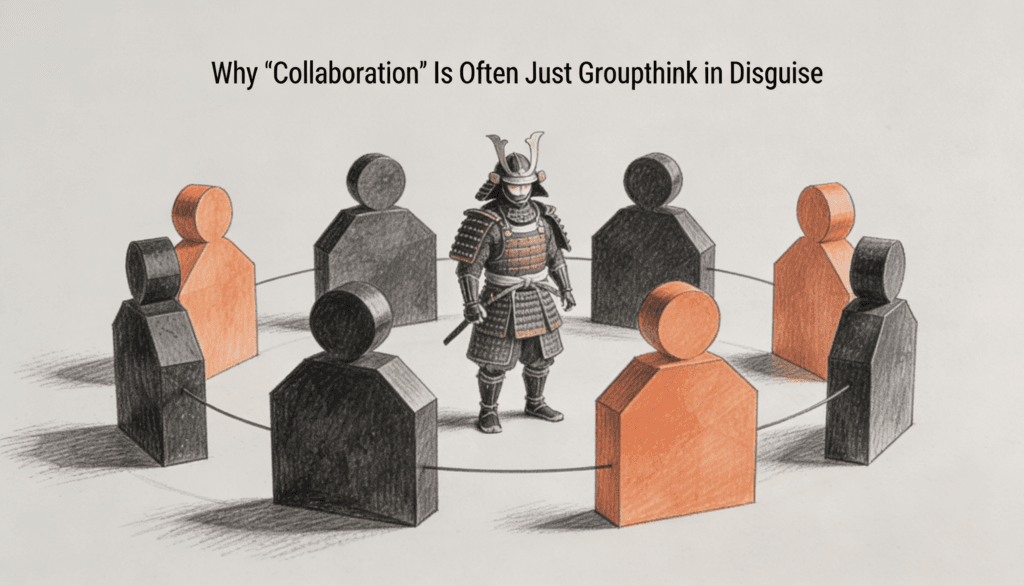
Miyamoto Musashi would have seen through it immediately.
The Sword Saint Who Refused to Join the Club
Musashi was a 17th century Japanese swordsman, strategist, and philosopher who won over sixty duels, many of them to the death. He wrote The Book of Five Rings, a treatise on strategy that has outlived its era by centuries. CEOs quote it. Military strategists study it. And yet the most radical thing about Musashi was not his technique or his philosophy. It was his refusal to belong.
He never joined a school. He never pledged allegiance to a feudal lord for any extended period. He wandered. He trained alone. He developed a two sword fighting style that nobody taught him because nobody else was doing it. In an era when your survival depended on group affiliation, Musashi chose to remain unattached. Not out of arrogance, but out of clarity.
He understood something that modern organizations have spent decades trying to unlearn: the group does not always make you stronger. Sometimes the group makes you slower, blinder, and more predictable. Sometimes the group is just a room full of people waiting for someone else to think first.
The Comfortable Lie of Collective Intelligence
The idea that groups are smarter than individuals is appealing. It sounds democratic. It feels safe. And in certain specific contexts, it is even true. Crowds can estimate the weight of an ox with surprising accuracy when individual guesses are averaged out. This is the famous “wisdom of crowds” that James Surowiecki wrote about, and it works beautifully when three conditions are met: the participants are diverse, they are independent, and they do not know what each other think.
Now think about the last team meeting you attended. Were the participants diverse in thought, or did they share the same training, the same incentives, and the same fear of contradicting the person with the highest title in the room? Were they independent, or were they watching each other’s faces for cues on how to react? Did they form their opinions in isolation, or did the first person to speak effectively set the range of acceptable responses for everyone who followed?
The wisdom of crowds requires independence. Collaboration, as most organizations practice it, destroys independence. It replaces individual judgment with social monitoring. And the result is not collective intelligence. It is collective comfort.
Why Agreement Feels Like Progress
One of the more insidious features of groupthink is that it feels productive. When everyone in the room nods, when the whiteboard fills up with aligned ideas, when the meeting ends with consensus, there is a warm neurological reward. We are social animals. Agreement triggers the same circuits that helped our ancestors survive by staying in the good graces of the tribe.
But agreement is not the same as correctness. And consensus is not the same as quality.
Irving Janis, the psychologist who coined the term “groupthink” in 1972, studied some of the worst decisions in American political history. The Bay of Pigs invasion. The escalation of the Vietnam War. In each case, he found the same pattern: a cohesive group of intelligent people, insulated from outside opinion, gradually converging on a course of action that no single member would have chosen alone. They did not fail because they were stupid. They failed because they were comfortable. The social cost of disagreement was higher than the intellectual cost of being wrong.
This is exactly what Musashi warned against when he wrote about the danger of following a fixed path. A fixed path feels secure. You know where you stand. You know what is expected. But a fixed path also means you have stopped adapting. You have stopped seeing. You have traded perception for belonging.
The Two Sword Problem
Here is where Musashi gets genuinely interesting for anyone thinking about how groups work and fail.
Musashi developed Niten Ichi Ryu, a style of fighting with a katana in one hand and a shorter sword in the other. At the time, this was considered bizarre. The katana was meant to be held with both hands. Every school taught it that way. Every master reinforced it. The two handed grip was not just a technique. It was an identity. It was what real swordsmanship looked like.
Musashi looked at this consensus and asked a simple question: why?
The answer, as it turned out, was mostly tradition. There was no biomechanical law that required two hands. There was no strategic proof that it was always superior. It was simply what everyone did because everyone before them had done it. The group had been collaborating on the same assumption for so long that the assumption had become invisible.
This is what happens in organizations every day. Teams collaborate on refining ideas that nobody ever stopped to question in the first place. They optimize within a framework that might itself be the problem. They hold the sword with two hands because that is how swords are held, and they mistake this inherited consensus for truth.
Musashi’s breakthrough was not just technical. It was epistemological. He was willing to discard the most basic assumption of his entire discipline because he had tested it against reality rather than against tradition. And this is the kind of thinking that collaboration, in its most common form, actively suppresses.
The Loneliness Tax and Why It Is Worth Paying
None of this means that solitude is automatically superior to teamwork. Musashi’s path was brutal. He was often hungry, often homeless, and by his own account, deeply lonely for stretches of his life. The wandering ronin lifestyle was not a productivity hack. It was a sacrifice.
But Musashi understood the transaction he was making. He was paying a loneliness tax in exchange for perceptual freedom. He could see what school trained fighters could not see because he had no school telling him where to look.
This is the part that modern collaboration culture refuses to acknowledge. There is a real cost to dissent, to independent thinking, to stepping outside the consensus. It is socially expensive. It is emotionally uncomfortable. And organizations that claim to value “diverse perspectives” almost never compensate people for the actual price of providing them.
Instead, they do something worse. They create the performance of diversity within the structure of conformity. Brainstorming sessions where the parameters have already been set. Innovation labs that report to the same leadership that maintains the status quo. Cross functional teams that are cross functional in title but identical in incentive.
Musashi would have seen through this theater in about thirty seconds.
What Musashi Actually Recommended
It would be easy to read Musashi as a pure individualist, a lone wolf who rejected all forms of cooperation. But that is a shallow reading. Musashi was not against learning from others. He studied painting, sculpture, and calligraphy. He engaged with Buddhism, Confucianism, and Shinto. He absorbed from every direction.
What he rejected was not input. It was allegiance.
There is a critical difference between learning from many sources and pledging yourself to one. The first expands your perception. The second narrows it. Musashi learned from everyone but followed no one. He treated every encounter, every art form, every duel as data, not as doctrine.
This is the model of collaboration that actually works but that almost nobody practices. Real collaboration is not a group of people in a room converging on a shared conclusion. Real collaboration is a network of independent minds, each doing their own thinking, sharing their findings openly, and remaining free to disagree with the synthesis.
It looks less like a team meeting and more like a research community. Less like a brainstorm and more like a debate. Less like alignment and more like a productive argument where nobody is keeping score on who is being a “team player.”
The Counter Intuitive Truth About High Performing Teams
Research on teams that actually outperform, as opposed to teams that merely feel productive, reveals something that should embarrass every collaboration evangelist. The best teams are not characterized by agreement. They are characterized by psychological safety combined with genuine disagreement.
Google’s Project Aristotle found this. Amy Edmondson’s research at Harvard confirmed it. The teams that produce the best outcomes are the ones where people feel safe enough to say “I think you are wrong” without social penalty. Not teams that agree. Teams that fight well.
Musashi would have approved. His entire philosophy rested on the idea that comfort is the enemy of perception. The moment you stop questioning, you stop seeing. The moment the group settles into consensus, it starts missing things. Not because the individuals are incompetent, but because the social dynamics of agreement have quietly disabled their capacity for independent observation.
How to Actually Use This
If you run a team, stop rewarding agreement. Start rewarding the quality of objections. Measure how often someone in the room says something that makes everyone else uncomfortable, and treat that as a vital sign, not a problem.
If you are an individual contributor, develop your ideas in private before you bring them to the group. Write your position down before the meeting starts. Musashi would tell you to know your own mind before you enter the arena, because the arena will try to change it.
If you are a founder, be suspicious of unanimity. When your entire leadership team agrees on a strategy, that is not validation. That might be the most dangerous moment in your company’s life. Assign someone to argue the opposite case, not as a performance, but as a discipline.
And if you are a creative, a strategist, or anyone whose value depends on seeing what others miss, protect your solitude like Musashi protected his independence. Not because people are the enemy, but because the gravitational pull of consensus is so strong that it will bend your thinking before you even notice it happening.
The Final Lesson of the Sword
Musashi died in 1645, alone in a cave, having written his life’s philosophy in the weeks before his death. He had no school to carry his name. No army of students polishing his legacy. Just a manuscript and a reputation.
And yet his ideas outlasted every school that mocked his methods. Every collaborative tradition that called him a rogue. Every consensus that said the katana must be held with two hands.
The group is not always wrong. But the group is always powerful. And power that goes unquestioned does not become wise. It becomes blind.
Musashi knew that the most dangerous opponent was not the one standing in front of you with a sword. It was the one standing beside you, nodding along, quietly making sure you never asked the question that could change everything.
The next time someone tells you that the team has reached consensus, remember the ronin who held two swords when everyone said to hold one.