Table of Contents
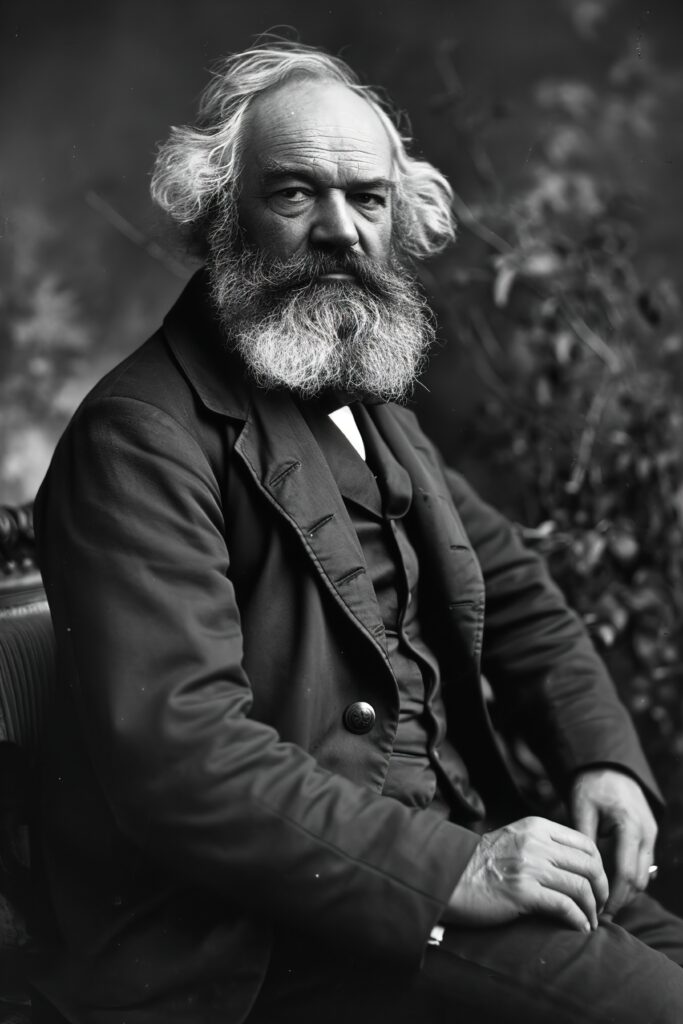
There is a peculiar irony at the heart of Marxist thought that few people sit with long enough to feel uncomfortable. Karl Marx, a man who spent his life in libraries, who argued furiously with rivals, who wrote thousands of pages of dense theory, built a system that, when applied, tended to silence the very kind of person he was. The philosopher who lived by the freedom to think and publish helped construct a worldview that, in practice, made independent thought a dangerous occupation.
This is not a small footnote. It is the central paradox of his legacy. And understanding why it happened requires us to look not just at the men who came after him, the Lenins and Maos and lesser tyrants, but at something embedded in the original blueprint itself.
The Mind as a Mirror of the Wallet
Marx had a memorable theory about why people believe what they believe. He argued that ideas do not float freely above society. They are shaped, almost entirely, by the material conditions a person lives in. The factory owner thinks like a factory owner. The peasant thinks like a peasant. The priest, conveniently, thinks in ways that serve whoever pays the priest.
This sounds clever, and parts of it are. We do all carry the fingerprints of our circumstances. But notice what this idea does once you take it seriously. It quietly removes the possibility that someone might disagree with you for honest reasons. If your critic is wealthy, his ideas are simply the noises a wealthy person makes. If he is poor but disagrees anyway, he must be confused, brainwashed, suffering from what Marx called false consciousness.
You can see the trap closing. Once you decide that disagreement is a symptom rather than an argument, you no longer need to engage with it. You only need to diagnose it.
This was not Stalin doing this. This was Marx, in the 1840s, sitting in the British Museum reading room. He was building a framework where the act of disagreeing with him could be explained away as a class condition. It is the intellectual equivalent of those puzzles where every door leads back to the same room.
The Comforting Certainty of Being Right
There is another piece of the puzzle, and it is the part that gives Marxism its religious flavor. Marx believed that history was moving in a direction. Not a vague direction, but a specific one, with stages and laws and an inevitable destination. Feudalism would give way to capitalism. Capitalism would collapse under its own contradictions. The workers would rise. A classless society would follow.
He called this scientific socialism, which is one of those phrases that does a lot of heavy lifting. Calling something scientific does not make it so. But the label served a purpose. It gave the theory an air of inevitability, the way gravity is inevitable. To argue against it was not just to hold a different opinion. It was to argue against history itself, like shouting at the tide.
When you have decided that history has a direction, and you happen to know what that direction is, an interesting moral calculation becomes available. People who slow down history are not just wrong. They are obstacles. And obstacles, by their nature, exist to be removed.
This is not a small step. It is the step that transforms a philosophy seminar into a tribunal.
The Awkward Question of the Intelligentsia
Marx had a complicated relationship with intellectuals, which is amusing because he was one. He needed thinkers to spread his ideas, but he was deeply suspicious of any thinker who did not arrive at exactly his conclusions.
The reason was structural. In his system, the working class was the chosen vehicle of history. Workers, by their position in the economy, would eventually see the truth and act on it. Intellectuals, on the other hand, were a problem. They came from the wrong class. They had soft hands and bookish habits. They were more likely to muddle the workers with their fancy ideas than to lead them anywhere useful.
The implication was that thinkers had a single legitimate function. They could explain the inevitable to the masses, dressing up what was already true in language workers might find inspiring. What they could not do was disagree with the inevitable. A thinker who reached different conclusions had, by definition, gotten something wrong. Probably his class background. Possibly his moral character. Almost certainly both.
This is why Marx spent so much of his life feuding with other socialists. He did not just think they were mistaken. He thought they were class traitors, dupes, or charlatans. Read his correspondence and you find a man who treated philosophical disagreement as something close to personal betrayal. Bakunin, Proudhon, Lassalle, the list of former allies he came to despise is long.
The Loyalty Test Built In
Now imagine taking this framework and giving it real political power. What happens?
You have a theory that says history is moving in a known direction. You have decided that those who disagree are either corrupt or confused. You have a chosen class that is, conveniently, never quite ready to rule itself, so it needs a vanguard of true believers to interpret its interests. You have a tradition of treating dissent within the movement as proof of bad faith.
Add these together and you do not need to be a tyrant to see what comes next. The structure itself selects for orthodoxy. Anyone who raises serious questions can be reframed as serving the enemy. Even silence becomes suspicious. The faithful must not just agree. They must agree visibly, loudly, and on the correct issues at the correct times.
This is the bureaucratic miracle of ideological systems. They do not need a single villain to produce conformity. They produce it through a thousand small incentives, a thousand careful career choices, a thousand quiet decisions to look the other way.
The Universities That Stopped Asking Questions
You can trace what happens to intellectual life under regimes that took Marx seriously. The pattern is remarkably consistent across countries that otherwise had little in common.
In the early years, there is often genuine excitement. Old hierarchies fall. Workers and peasants enter universities. New ideas are encouraged, sometimes wildly. The atmosphere can feel intoxicating, a sense that everything is being rebuilt from the ground up.
Then the line hardens. Subjects that once seemed open become closed. Genetics becomes suspect because it suggests inherited differences that complicate egalitarian theory. Linguistics becomes political because language reveals national identities that should be dissolving. Economics becomes a minefield because the data keeps refusing to behave.
Scholars who had been celebrated for their boldness learn the new rule. Boldness is fine, as long as it points in the approved direction. Originality is welcome, as long as it confirms what is already known. The clever ones survive by mastering a particular kind of doublethink, where they can write the required sentences while preserving, somewhere private, the ability to think clearly. The less clever ones do not survive.
The Strange Career of Self Censorship
What is rarely appreciated is how much of the intellectual collapse under Marxist regimes was not imposed from above. It was performed by the thinkers themselves, often without anyone needing to ask.
This is what gives the whole system its eerie quality. Censorship by a state is one thing. You know the rules, you push against them, you pay the price. But a culture where everyone has internalized the rules, where the censor lives inside your own head and edits your sentences before you write them, is something different. It is more efficient and harder to fight.
Writers in such systems describe a kind of mental fog. They begin a thought and then, almost without noticing, redirect it. They reach for a word and choose a safer one. They start a project and then quietly abandon it because they can already see where it would lead. The remarkable thing is how quickly this becomes habit. The dangerous thoughts simply stop arriving.
A whole generation of brilliant minds learned to work this way. Some produced extraordinary work despite it, the literature of dissent, the underground samizdat, the coded novels. Most produced nothing memorable. They had learned to think small.
The Question Marx Did Not Ask
Here is where we should be careful. It is too easy to draw a straight line from a man writing in a London library to a gulag in Siberia and call the case closed. The world is more tangled than that. Plenty of thinkers have built systems with internal logics that, taken to extremes, would justify terrible things. The thinker is not always responsible for what others do with his words.
But Marx did fail to ask a particular question, and the failure mattered. He never seriously addressed what would happen if he was wrong. His theory presented itself as scientific, as inevitable, as the unfolding of historical law. But there was no obvious test he proposed by which someone could discover it was mistaken. There was no provision for honest disagreement, no mechanism for the system to learn from the people inside it.
A theory that cannot be wrong is not a theory at all. It is a creed. And creeds, when they meet political power, do not produce open inquiry. They produce orthodoxy, and orthodoxy produces silence.
This is the structural flaw, and it does not require any one of his followers to be evil for it to bite. It only requires them to be consistent.
The Ironic Inheritance
The deepest irony, the one that should sit with us, is that Marx himself benefited from precisely the conditions his ideas would later be used to destroy. He wrote in countries where he could publish freely. He argued with rivals who were not arrested. He read books from libraries that did not curate them according to his approved viewpoints. He raised his children in cities where strangers could disagree in coffeehouses without anyone reporting them.
He took these conditions for granted. He treated them, when he noticed them at all, as bourgeois decoration, the polite mask of a deeper oppression. He did not see them as fragile achievements that had taken centuries to build, or as the very oxygen his own work depended on.
And so his followers, when they finally got their chance, dismantled them. The libraries were purged. The rivals were arrested. The coffeehouses fell silent. The children learned to whisper.
You can argue, and many have, that this was not what Marx wanted. Perhaps he would have been horrified. But the question is not what he wanted. The question is what his ideas, taken seriously by serious people with real power, tended to produce. And the historical record, across many countries, with many different cultures, in many different decades, is consistent enough to suggest that the outcomes were not accidents.
What We Can Take From This
There is a lesson here that has nothing to do with whether capitalism is good or whether inequality matters. Those are real questions and reasonable people will disagree about them.
The lesson is about a particular kind of intellectual humility. Any system of ideas that explains away its critics rather than engaging with them is in trouble. Any worldview that is so certain of its direction that it cannot imagine being wrong has stopped being a tool for understanding and become a wall against it. Any movement that treats disagreement as a sign of moral failure rather than a possibility worth considering will, eventually, run out of people willing to think clearly inside it.
This is true of Marxism. It is also true of many other things. The discomfort it should produce is not partisan. It is the simple recognition that intellectual freedom is not a luxury we earn after solving the big questions. It is the precondition for solving them at all.
Marx, who lived by it, did not see this. The cost of his blindness was paid by people he never met, in countries he never visited, for generations after he died. We can at least learn what he could not, which is that no idea, however brilliant, deserves the kind of trust that closes other minds.