Enlightenment

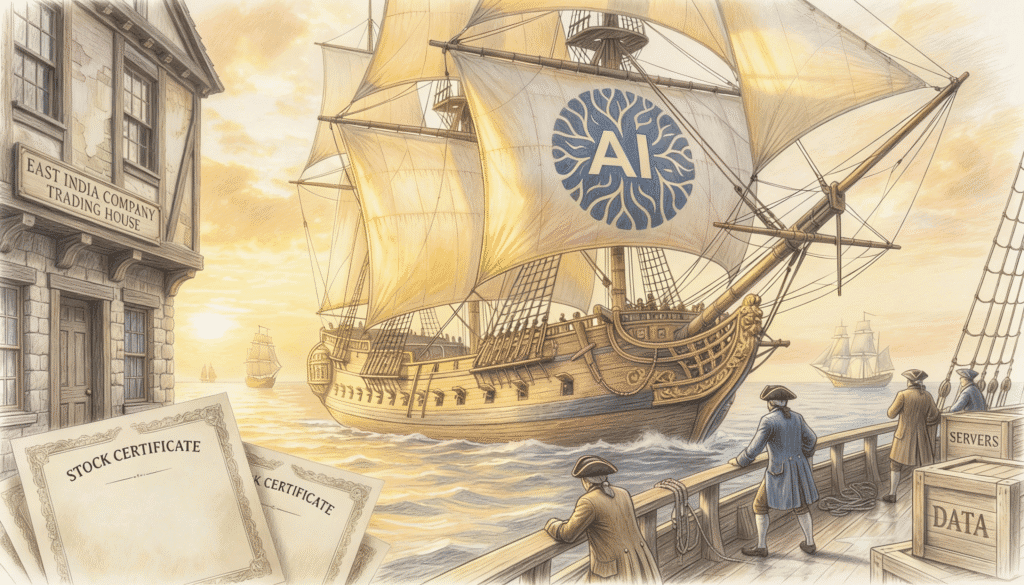
Why OpenAI is the New East India Company (A David Ricardo Reading)

Why OpenAI is the New East India Company (A David Ricardo Reading)

In 1600, merchants convinced Queen Elizabeth I to grant them a monopoly on trade with the East Indies. The pitch: we’ll bring back exotic goods, expand English influence, and share profits with the Crown. In 2015, technologists convinced Silicon Valley that AI should be developed as a nonprofit for humanity’s benefit. The pitch: we’ll build […]

Why OpenAI is the New East India Company (A David Ricardo Reading) Read More »
Why You're Not an Entrepreneur Until You Combine Labor and Capital (and Risk it All) According to Jean-Baptiste Say

Why You’re Not an Entrepreneur Until You Combine Labor and Capital (and Risk it All) According to Jean-Baptiste Say

Everyone who’s ever sold something on Etsy or posted a “CEO of myself” caption on LinkedIn thinks they’re an entrepreneur. We live in a time when the word has been stretched so thin it barely means anything anymore. Side hustles, passion projects, freelance gigs—we call all of it entrepreneurship. But if we transported a French

Why You’re Not an Entrepreneur Until You Combine Labor and Capital (and Risk it All) According to Jean-Baptiste Say Read More »

The Anatomy of a Bad Idea (And How to Kill It According to Francis Bacon)

The Anatomy of a Bad Idea (And How to Kill It According to Francis Bacon)

Francis Bacon never had to sit through a business meeting where someone proposed building a moat around the office to improve security. But if he had, he would have recognized something familiar. The same mental traps that plagued 17th century natural philosophers still plague us today. We just dress them up in better PowerPoint slides.

The Anatomy of a Bad Idea (And How to Kill It According to Francis Bacon) Read More »

Rousseau and the Gig Economy: Is the 'Freelancer' Truly Free, or Just Isolated?

Rousseau and the Gig Economy: Is the ‘Freelancer’ Truly Free, or Just Isolated?

Jean-Jacques Rousseau wrote his famous line in 1762: “Man is born free, and everywhere he is in chains.” More than 250 years later, we’ve created something curious. We’ve built an economy that promises freedom above all else. You can work from anywhere. You can choose your own hours. You can be your own boss. The

Rousseau and the Gig Economy: Is the ‘Freelancer’ Truly Free, or Just Isolated? Read More »

The Cost of Ignorance: Condorcet's Mathematical Argument Against Uninformed Voters

The Cost of Ignorance: Condorcet’s Mathematical Argument Against Uninformed Voters

Picture a courtroom where twelve jurors must decide between guilt and innocence. Each juror has seen the same evidence, heard the same testimony. Now imagine that each of them is slightly better than a coin flip at reaching the right verdict. Maybe they’re correct 60% of the time. Here’s where mathematics delivers a surprise. When

The Cost of Ignorance: Condorcet’s Mathematical Argument Against Uninformed Voters Read More »

Why Your Country's Geography Pre-Programmed Its Politics (Montesquieu)

Why Your Country’s Geography Pre-Programmed Its Politics (Montesquieu)

Your government didn’t choose you. The rivers, mountains, and weather patterns did. This is the provocative claim made by Charles-Louis de Secondat, better known as Montesquieu, the 18th century French philosopher who looked at the world and saw something his contemporaries missed. While others debated the divine right of kings or the social contract, Montesquieu

Why Your Country’s Geography Pre-Programmed Its Politics (Montesquieu) Read More »

Is Profit a Sin? Re-examining Adam Smith's View on 'Interest' and the Ethics of Passive Income

Is Profit a Sin? Re-examining Adam Smith’s View on ‘Interest’ and the Ethics of Passive Income

Your landlord just raised your rent again. Your savings account yields 0.5% while inflation runs at 3%. Meanwhile, someone’s trust fund baby Instagram account shows them sipping cocktails in Bali, captioned “passive income life.” And somewhere in your chest, something tightens—a feeling that’s part envy, part moral indignation, and entirely confused about whether it should

Is Profit a Sin? Re-examining Adam Smith’s View on ‘Interest’ and the Ethics of Passive Income Read More »

Why the AI Revolution Was Predicted in 1637, Netherlands

Why the AI Revolution Was Predicted by Radical Rene Descartes in 1637, Netherlands

AI revolution quietly started in a modest room in the Netherlands, where a French philosopher sat by his stove and contemplated the nature of thought itself. The year was 1637, and Rene Descartes was about to publish a work that would inadvertently lay the conceptual groundwork for the artificial intelligence revolution (AI) that would unfold

Why the AI Revolution Was Predicted by Radical Rene Descartes in 1637, Netherlands Read More »

Hume's Intellectual Legacy: The 18th-Century Shock That Still Echoes

Hume’s Intellectual Legacy: The 18th-Century Shock That Still Echoes

When David Hume published A Treatise of Human Nature in 1739, he expected to revolutionize philosophy. Instead, the book, as he later lamented, “fell dead-born from the press.” Yet this initial failure masked what would become one of the most profound intellectual earthquakes in Western thought. Nearly three centuries later, Hume’s ideas continue to reverberate

Hume’s Intellectual Legacy: The 18th-Century Shock That Still Echoes Read More »

Perpetual Peace Immanuel Kant World War

Can Immanuel Kant’s ‘Perpetual Peace’ Stop the Next World War?

In 1795, amidst Europe’s revolutionary war and the looming threat of Napoleon, the German philosopher Immanuel Kant published a concise treatise that would resonate through the ages. “Perpetual Peace: A Philosophical Sketch” introduced a groundbreaking concept for its era: a systematic framework aimed at eradicating war altogether. Over two centuries later, following two devastating world

Can Immanuel Kant’s ‘Perpetual Peace’ Stop the Next World War? Read More »