Enlightenment

Taxation as Tyranny- Montesquieu's Argument for a Frugal Republic

Taxation as Tyranny: Montesquieu’s Argument for a Frugal Republic

The modern state has an appetite. It consumes revenue the way a growing organism consumes nutrients, always requiring more to sustain its expanding functions. We accept this as normal, even inevitable. But Charles-Louis de Secondat, Baron de Montesquieu, writing in eighteenth-century France, saw something different when he looked at heavy taxation. He saw the slow […]

Taxation as Tyranny: Montesquieu’s Argument for a Frugal Republic Read More »
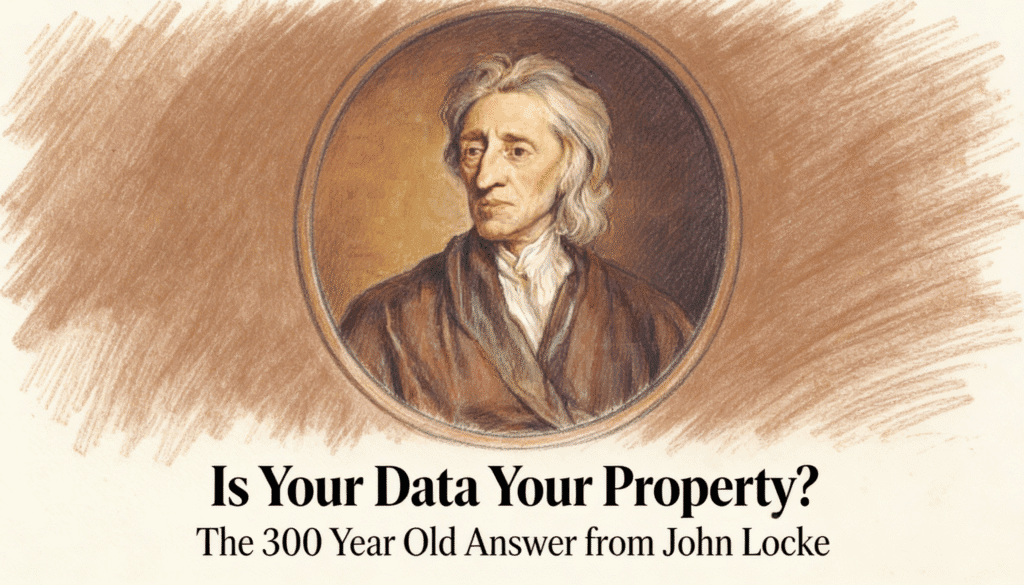
Is Your Data Your Property? The 300 Year Old Answer from John Locke

Is Your Data Your Property? The 300 Year Old Answer from John Locke

Every time you scroll through a feed, tap “accept” on a cookie banner, or type a search query, you are producing something. You are generating data. Clicks, locations, preferences, habits, relationships, fears, desires. All of it captured, stored, processed, and sold. The question nobody seems to settle is whether any of that belongs to you.

Is Your Data Your Property? The 300 Year Old Answer from John Locke Read More »

The Final Boss of Philosophy- Why Every Modern Debate Ends with Immanuel Kant Image

The Final Boss of Philosophy: Why Every Modern Debate Ends with Immanuel Kant

You know how every video game has that one boss you can’t skip? The one where all your previous skills get tested, where button mashing won’t work, and where you finally understand what the whole game was preparing you for? That’s Immanuel Kant in philosophy. Except instead of a fantasy dragon or evil wizard, he’s

The Final Boss of Philosophy: Why Every Modern Debate Ends with Immanuel Kant Read More »

The Morality of Profit- Why Being Pro-Business is Actually Pro-Human

The Morality of Profit: Why Being Pro-Business is Actually Pro-Human

There’s a peculiar shame attached to profit in modern discourse. We celebrate the entrepreneur who “gives back” but eye with suspicion the one who simply makes money. We applaud companies that announce charitable initiatives but question those that focus on doing one thing exceptionally well at a good price. This moral framework treats profit as

The Morality of Profit: Why Being Pro-Business is Actually Pro-Human Read More »

The Intellectual Entrepreneur- Why Your Laptop Is the New Textile Mill

The Intellectual Entrepreneur: Why Your Laptop Is the New Textile Mill (Jean-Baptiste Say)

Jean-Baptiste Say never owned a smartphone. He died in 1832, decades before the telegraph, let alone Twitter. Yet the French economist understood something fundamental about wealth creation that applies more today than it did in his era of steam engines and spinning jennies. Say argued that entrepreneurs don’t just shuffle resources around. They create value

The Intellectual Entrepreneur: Why Your Laptop Is the New Textile Mill (Jean-Baptiste Say) Read More »

The Paradox of Progress- Why Locke Thought We'd Get Less Free Over Time

The Paradox of Progress: Why John Locke Thought We’d Get Less Free Over Time

John Locke never said this explicitly, but buried in his ideas about government lies an uncomfortable truth: the very systems we create to protect our freedom will inevitably eat away at it. This isn’t a bug in the Lockean system. It’s a feature. And we’re watching it play out in real time. Most people remember

The Paradox of Progress: Why John Locke Thought We’d Get Less Free Over Time Read More »

Why Modern Leaders are Too Afraid of Friction (Carl von Clausewitz)

Carl von Clausewitz on Why Capable Modern Leaders are Too Afraid of “Friction”

Carl von Clausewitz never met a management consultant. The Prussian general, writing in the early 19th century, would have found their obsession with efficiency puzzling. He spent his career studying war, the messiest human endeavor imaginable, and came to understand something most modern leaders have forgotten: friction is not a bug in the system. It

Carl von Clausewitz on Why Capable Modern Leaders are Too Afraid of “Friction” Read More »