Table of Contents
There is a particular kind of courage that does not involve swords, battlefields, or dramatic last stands. It involves something far more dangerous: telling everyone around you that the thing they have believed for a thousand years might be wrong. Not because you have a better belief, but because you have a better method.
Francis Bacon had that kind of courage. And most of us, whether we realize it or not, are still catching up to what he proposed over four hundred years ago.
Born in 1561, Bacon grew up in Elizabethan England, a world drenched in tradition, superstition, and the unquestioned authority of ancient texts. If Aristotle said it, it was true. If the Church endorsed it, questioning it was not just rude but potentially fatal. Knowledge was not something you discovered. It was something you inherited, like furniture or debt.
Bacon looked at this arrangement and essentially said: prove it.
That might sound obvious now. It was not obvious then. It was, in fact, revolutionary. And the strange thing is that even today, in an era of laboratories and peer review and data analytics, we are still remarkably bad at following his advice.
The World Before Bacon: A Love Affair with Authority
To understand why Bacon matters, you need to understand what he was pushing against. Before the scientific method took hold, European intellectual life ran on a simple engine: deference. You did not test ideas. You cited authorities. If you wanted to know how the body worked, you read Galen. If you wanted to understand physics, you read Aristotle. If you wanted to know about the heavens, you checked what the Church had approved.
Nobody asked whether Galen had actually opened enough bodies to be sure. Nobody checked whether Aristotle’s claims about falling objects matched what actually happened when you dropped things. The entire system was built on trust, reputation, and the comforting assumption that the smartest people had already figured everything out.
This is not as alien as it sounds. We do this constantly. We defer to experts we have never vetted. We repeat statistics we have never checked. We share articles we have never read past the headline. The medieval scholar who cited Aristotle without testing the claim is not so different from the modern professional who cites a TED talk without reading the underlying study.
Bacon saw this pattern and named the disease before offering the cure.
The Idols: Bacon’s Map of Human Stupidity
One of Bacon’s most brilliant contributions was not a discovery about nature. It was a discovery about us. He identified what he called the “Idols of the Mind,” four categories of bias that distort human thinking. This was centuries before behavioral psychology, centuries before Daniel Kahneman, centuries before anyone used the phrase “cognitive bias” at a dinner party to sound interesting.
The first category, the Idols of the Tribe, describes the errors built into human nature itself. We see patterns where none exist. We favor evidence that confirms what we already believe. We are drawn to simple explanations even when reality is complicated. Bacon understood that the human mind is not a clean mirror reflecting the world. It is a warped one, bending everything it receives.
The second, the Idols of the Cave, refers to individual biases. Your education, your upbringing, the books you happened to read, the teachers who happened to impress you. Every person lives in their own intellectual cave, and the shadows on the wall look like truth. Plato would have appreciated the metaphor, though he might not have liked where Bacon took it.
The third, the Idols of the Marketplace, concerns language itself. Words, Bacon argued, are not neutral. They carry assumptions, create false categories, and trick us into thinking we understand things we have merely named. If you have ever watched a political debate where both sides used the same word to mean entirely different things, you have met this idol personally.
The fourth, the Idols of the Theatre, targets philosophical systems and received doctrines. These are the grand narratives, the complete worldviews that people adopt wholesale and then squeeze all of reality into, whether it fits or not. Bacon compared them to stage plays: elaborate, internally consistent, and entirely fictional.
What is remarkable about this framework is not just its accuracy but its self awareness. Bacon was not merely saying “other people are biased.” He was saying “we are all biased, including me, and the only way forward is a method that compensates for this.” That is an uncomfortable proposition. It is also, as far as anyone can tell, correct.
The Method: Observation First, Theory Second
Bacon’s proposed solution was what he called induction, though his version was more rigorous than the casual use of that term. The idea was deceptively simple. Instead of starting with a grand theory and then looking for evidence to support it, you start with observations. You collect data. You look for patterns. You test those patterns. And only then, cautiously, do you form a conclusion.
This sounds like common sense. It was not. The dominant method of reasoning for centuries had been deduction from first principles. You started with what you “knew” to be true, things handed down from Aristotle or the Church or some other authority, and you reasoned your way to specific conclusions. The problem, of course, was that if your starting principles were wrong, every conclusion built on them was also wrong. And nobody was checking the starting principles.
Bacon flipped this. He insisted that knowledge must be built from the ground up, brick by brick, through careful observation and experiment. No authority gets a free pass. No tradition is immune to scrutiny. If the evidence contradicts the textbook, the textbook loses.
There is a wonderful irony here. Bacon, a man of immense political ambition who served as Lord Chancellor of England, who navigated one of the most treacherous courts in European history, who understood power and hierarchy better than almost anyone alive, turned around and told the intellectual world that hierarchy means nothing. That the newest apprentice with good data outranks the oldest professor with bad assumptions.
The Surprisingly Modern Relevance of a 400 Year Old Idea
Consider how much of modern life still runs on the logic Bacon attacked. Corporate decisions are routinely made based on the opinion of the highest paid person in the room rather than on data. Political beliefs are adopted as packages, entire worldviews swallowed whole because they come from the right tribe, exactly the Idols of the Theatre that Bacon described. Health advice circulates on social media not because it has been tested but because someone with a large following said it confidently.
Even science itself, the very institution Bacon helped create, struggles with the problems he identified. The replication crisis, where a disturbing percentage of published scientific studies turn out to be unrepeatable, is essentially a failure to follow Bacon’s method. Researchers form hypotheses, find confirming evidence, publish, and move on. The slow, unglamorous work of replication and verification gets neglected because it does not advance careers or generate headlines.
Bacon would have recognized this immediately. He warned specifically about the human tendency to notice evidence that supports our beliefs and ignore evidence that contradicts them. He called it out in the 1620s. We gave it a fancy name, confirmation bias, in the 1960s. The problem has not changed. Only the vocabulary has.
The Connection to How We Consume Information Now
There is a direct line from Bacon’s Idols of the Mind to the way algorithms shape what we see online. Social media platforms are, in a sense, bias amplification machines. They identify what you already believe, what you already like, what already confirms your existing worldview, and they serve you more of it. The Idols of the Cave, your personal intellectual blind spots, are no longer just personal. They are being engineered and reinforced at scale by systems designed to keep you engaged, not informed.
Bacon could not have imagined the internet. But he described its central problem with eerie precision. When he warned that the human mind naturally gravitates toward what is comfortable rather than what is true, he was describing the architecture of the modern attention economy four centuries early.
This is not a coincidence. It is a consequence of the fact that human nature has not changed. The technology is new. The biases are ancient. And Bacon’s prescription, demand evidence, check your assumptions, distrust your own comfort, is more relevant than it has ever been.
What Bacon Actually Demands of You
The real challenge of Bacon’s philosophy is not intellectual. It is personal. He is not just asking you to think more carefully about science or philosophy. He is asking you to distrust the one thing humans find it hardest to distrust: themselves.
When Bacon says to question tradition, he does not mean only the traditions you dislike. He means the ones you cherish. When he says to demand proof, he does not mean only from people you disagree with. He means from your own side, your own sources, your own deeply held convictions.
This is profoundly uncomfortable. It is much easier to be a skeptic about other people’s beliefs than about your own. It is much easier to demand evidence from your opponents than from your allies. Bacon’s method does not allow for this asymmetry. It applies equally to everyone, including you. Especially you.
And that is exactly why it works. A method that only applies to your enemies is not a method. It is a weapon. Bacon was offering something rarer and more valuable: a tool that works on everything, including the person holding it.
The Unfinished Revolution
Bacon died in 1626, reportedly after catching pneumonia while stuffing a chicken with snow to test whether cold could preserve meat. There is something almost poetic about a man who spent his life advocating for experimental science dying from an experiment. Whether the story is entirely accurate is debated, but it has persisted because it feels right. It captures something essential about the man: he did not just theorize about testing ideas. He tested them.
Four hundred years later, his revolution is still unfinished. We have built extraordinary institutions on his foundations, laboratories, universities, journals, peer review systems, but we have not internalized the habit he considered most important. We still defer to authority more than evidence. We still trust tradition more than testing. We still find it easier to believe than to verify.
Bacon did not ask us to stop believing things. He asked us to start earning our beliefs. To treat every claim not as something to accept or reject based on who said it, but as something to investigate based on what supports it.
That is not a small request. It is, in fact, one of the most demanding intellectual disciplines a person can adopt. But it is also, as four centuries of scientific progress have demonstrated, the one that actually works.
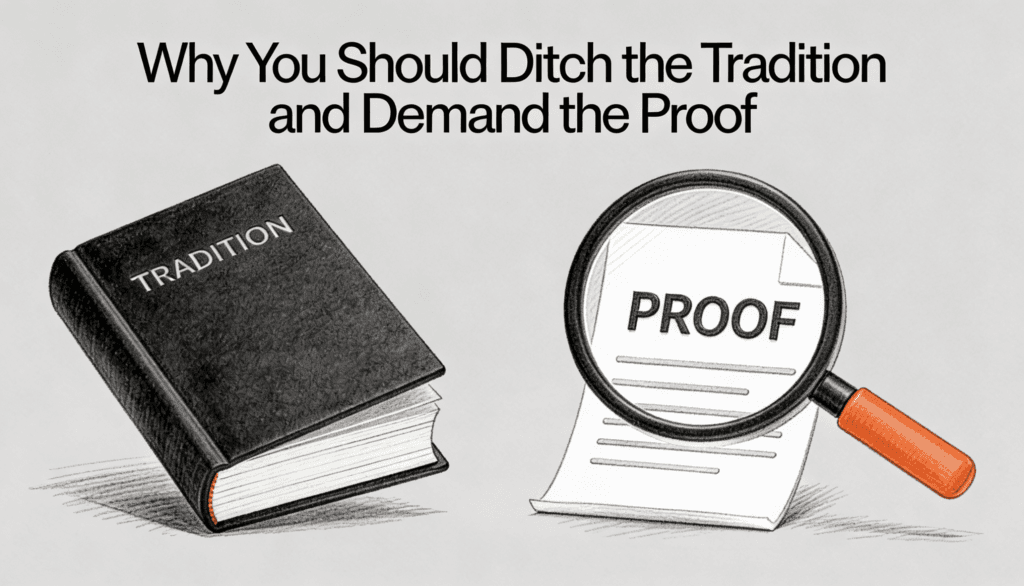
The tradition says trust. Bacon says prove it.
He was right then. He is right now. The only question is whether you are willing to do the work.