Table of Contents
In 1930, one of the most brilliant economists who ever lived made a prediction. John Maynard Keynes, writing during the Great Depression of all times, looked ahead to the year 2030 and saw something remarkable. He saw us, his grandchildren’s generation, working about 15 hours a week. He believed that by now, the economic problem of scarcity would be essentially solved. Humanity would finally be free to figure out what to actually do with its time.
He was not wrong about the math. Productivity has increased roughly fivefold since he wrote those words. The economic output per hour of labor today would have been unimaginable to someone in 1930. We have machines that think, factories that run themselves, and software that automates what used to take entire departments of people. By every measurable standard, Keynes was right about our capacity to produce.
He was spectacularly wrong about what we would do with that capacity.
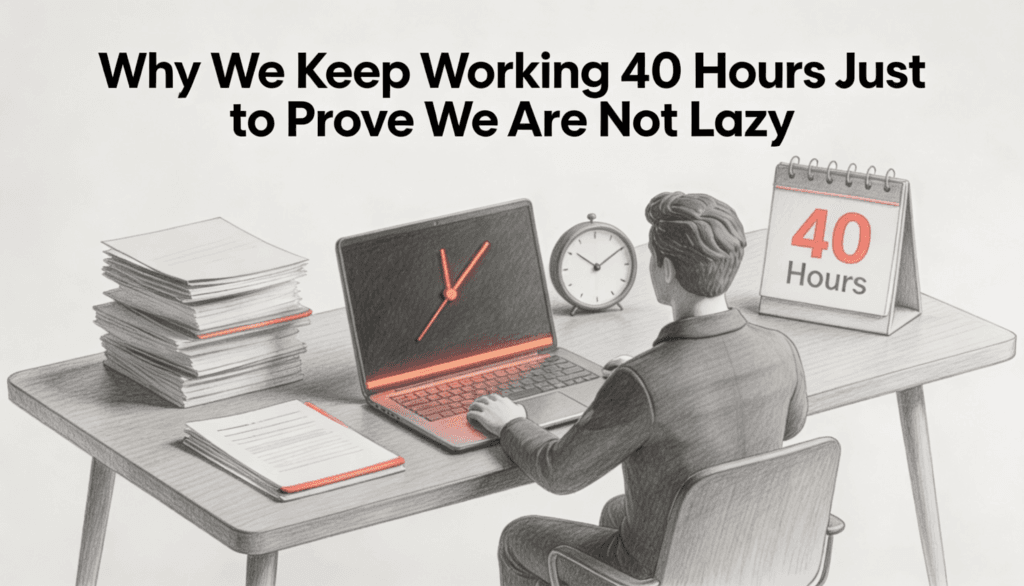
Instead of working 15 hours and spending the rest of our time on philosophy, art, and long afternoons in the park, we work 40 hours. Sometimes 50. Sometimes 60. We answer emails at 11 PM and feel guilty about taking a full lunch break. We have created an economy productive enough to give everyone enormous freedom, and then we used that freedom to invent more work.
The question is not really an economic one. It is a psychological and cultural one. Why did we take Keynes’s gift and return it unopened?
The Essay That Started It All
The essay was called “Economic Possibilities for our Grandchildren,” and it remains one of the most fascinating documents in the history of economic thought. Not because of its technical sophistication, but because of its optimism. Keynes was writing at a time when the global economy was collapsing. Banks were failing. Unemployment was catastrophic. And yet here he was, telling people to look a hundred years ahead and imagine leisure.
His argument was straightforward. Technological progress and capital accumulation would continue to compound. Output per worker would keep rising. At a certain point, the amount of labor needed to provide everyone with a comfortable standard of living would shrink dramatically. The only remaining challenge, Keynes thought, would be a psychological one: learning how to fill all that free time without going mad.
He even worried about it. He called it “the problem of leisure,” and he suspected that many people would struggle with it. He imagined a kind of existential crisis, where people who had spent centuries defining themselves through work would suddenly have to find meaning elsewhere. It was an elegant concern, almost tender in its foresight.
What he did not foresee was that we would solve the problem of leisure by simply refusing to have any.
Where the Prediction Went Sideways
The first and most obvious reason Keynes got it wrong is that he underestimated our appetite. He assumed that once people had enough, they would stop wanting more. This turned out to be, to put it mildly, a misunderstanding of human nature.
Keynes distinguished between two types of needs. The first he called absolute needs, things we want regardless of what other people have. Food, shelter, warmth. The second he called relative needs, things we want because they put us above our neighbors. He acknowledged that relative needs might be insatiable, but he seemed to believe that absolute needs would win the day. Once those were met, people would relax.
He did not account for the extraordinary ability of consumer capitalism to turn relative needs into things that feel absolute. In 1930, nobody needed a smartphone. Today, try functioning in society without one. The baseline of what counts as a normal, acceptable life keeps moving upward, and it moves in lockstep with productivity. We produce more, so we expect more, so we need to earn more, so we work more. The treadmill does not slow down just because the motor got more powerful. It speeds up.
The Moral Weight of Busyness
But consumer appetite alone does not explain the full picture. Something deeper is at play, something that Keynes, for all his brilliance, did not quite see. We do not just work to earn. We work to prove something.
Somewhere along the way, Western culture fused work with moral identity. Being busy became a signal of virtue. Not working became a signal of failure. This is not new. The sociologist Max Weber traced it back to Protestant theology, where labor was treated as a calling from God and idleness was practically a sin. But what is remarkable is how thoroughly secular society inherited this framework without keeping any of the theology.
We dropped God from the equation and kept the guilt.
Today, telling someone you work 60 hours a week is a humble brag. Telling someone you work 20 hours a week invites suspicion. Are you independently wealthy? Are you a trust fund case? Are you just not very ambitious? The assumption is that if you are not busy, something is wrong with you. Leisure is not seen as the fruit of a productive society. It is seen as evidence of a defective character.
This is why Keynes’s prediction failed at the cultural level. He imagined a world where people would embrace leisure as a sign of civilization. Instead, we built a world where leisure is something you have to earn, justify, and feel slightly ashamed about.
The Jobs That Exist to Exist
There is another layer to this puzzle, and it is one of the more uncomfortable ones. A significant portion of the work being done today may not need to be done at all.
The anthropologist David Graeber made this argument in his book about what he called BS jobs, positions that even the people holding them secretly believe contribute nothing of value. Think of the middle manager whose job is to oversee people who do not need oversight. The consultant hired to produce a report that no one reads. The administrative coordinator whose role exists because the organization is too bureaucratic to function without someone dedicated to navigating its own bureaucracy.
Graeber estimated that somewhere between 20 and 50 percent of jobs fall into this category. Even if you think he exaggerated, the basic observation is hard to dismiss. We have all sat in meetings that could have been emails. We have all filled out forms that served no purpose. We have all watched someone get promoted for looking busy rather than being productive.
This connects directly to Keynes. If productivity gains should have reduced the need for labor, and they clearly have, then why are so many people still working so much? Part of the answer is that we invented new work to fill the gap. Not because the work was needed, but because the alternative, admitting that we do not actually need everyone to work 40 hours, is culturally unthinkable.
It is easier to create a pointless job than to create a society that can handle people not having one.
The Trap of Identity
Here is where things get genuinely interesting from a psychological standpoint. For many people, work is not just a source of income. It is the primary source of identity, community, structure, and purpose. Take it away, and you are not liberating someone. You are taking their scaffolding.
Keynes assumed that people would naturally gravitate toward art, philosophy, and meaningful leisure. But meaningful leisure is a skill, and it is one that very few people have been taught. Our education system trains people to be workers. Our social systems reward productivity. Our cultural narratives celebrate the hustle. Asking someone raised in this environment to suddenly find deep fulfillment in reading Aristotle is like asking someone who has only eaten fast food to suddenly appreciate a 12 course French meal. The palate is not ready.
This is perhaps Keynes’s most forgivable blind spot. He was a Cambridge intellectual who spent his free time collecting rare books, managing a theater, and socializing with the Bloomsbury Group. His idea of leisure was Virginia Woolf and ballet. He may not have fully appreciated that most people, through no fault of their own, have never been given the tools to enjoy freedom.
What Game Theory Reveals
There is also a coordination problem here, and it is a vicious one. Even if you personally wanted to work 15 hours a week, you would face immediate consequences. Your employer would replace you. Your peers would outcompete you. Your income would drop, and in an economy where the cost of housing, healthcare, and education has outpaced general inflation, that drop could be devastating.
This is the structure of a classic prisoner’s dilemma. Everyone might be better off if everyone worked less. But no individual can afford to be the first one to try. The system punishes defectors. So everyone keeps working, not because they want to, but because they cannot afford to stop while everyone else keeps going.
Keynes did not think much about coordination problems. He was thinking about aggregate outcomes, the big picture of economic growth and technological progress. But economies are not just aggregates. They are collections of individuals making decisions under pressure, and the pressure to keep working is immense even when the economic necessity is not.
The Curious Case of the Netherlands
It is worth noting that not every country ignored Keynes entirely. The Netherlands, for example, has one of the shortest average workweeks in the developed world. Part time work is normalized, legally protected, and does not carry the stigma it does in places like the United States. The Dutch have a word, “niksen,” that roughly translates to doing nothing on purpose. It is considered a legitimate activity, not a character flaw.
The result is not economic collapse. The Netherlands has one of the highest standards of living in the world, strong productivity per hour worked, and consistently ranks among the happiest countries on earth. This does not prove that Keynes was right in every detail, but it does suggest that his vision was not as naive as it might seem. The problem was never that fewer hours could not work. The problem was that most societies chose not to try.
The Real Question Keynes Was Asking
Strip away the specific prediction and what remains is a profound question that we still have not answered. If our economies can produce enough for everyone to live well, why do we organize society as though scarcity is still the defining problem? Why do we treat work as the only legitimate way to distribute resources, assign status, and structure time? Why do we keep running on a treadmill that we built ourselves?
Keynes was not just making a forecast. He was issuing a challenge. He was asking whether human beings could evolve past the scramble for survival and find something better. Nearly a century later, we have the tools he predicted. We have the productivity. We have the technology. What we do not have is the imagination, or perhaps the courage, to use them the way he hoped.
The 15 hour workweek was never really about economics. It was about whether we could learn to value ourselves for something other than our output. So far, the answer has been no. We chose the 40 hour week, the full inbox, and the perpetual busyness. Not because we had to. Because we were afraid of what we would find if we stopped.
And that might be exactly the problem Keynes was trying to warn us about all along.