Table of Contents
There is a seductive idea floating around. It goes something like this: the reason central planning failed in the Soviet Union was not that central planning is inherently flawed. It failed because the planners were human. They were slow, biased, and working with pencils and telegrams. Give the job to a sufficiently advanced artificial intelligence, one that can process every transaction, every preference, every weather pattern and shipping delay in real time, and the old objections to planned economies simply vanish.
It is a compelling pitch. It is also, I think, profoundly wrong. And the person who explained why it is wrong died in 1992, decades before anyone had heard of large language models.
Friedrich Hayek spent much of his career arguing that the failure of central planning was not a hardware problem. It was not about the speed of the calculator or the size of the filing cabinet. The failure was about the nature of knowledge itself. And if you take his argument seriously, you realize that replacing the Soviet Gosplan with a datacenter in Nevada does not solve the problem. It just makes the same mistake at a higher clock speed.
The Knowledge Problem Is Not a Data Problem
The core of Hayek’s critique, laid out most famously in his 1945 essay “The Use of Knowledge in Society,” is deceptively simple. Economic knowledge is not the kind of thing that can be collected, centralized, and fed into a formula. It is dispersed across millions of minds, embedded in local contexts, and much of it exists in a form that no one can articulate, let alone upload.
Consider a small restaurant owner in Lisbon. She knows that her neighborhood has been slowly changing. Young families are moving in. The old regulars are ordering less wine and more coffee. A new office building is going up two blocks away, which means lunch traffic will shift. She does not write any of this down. She does not submit a report. She adjusts her menu, changes her hours, renegotiates with her supplier. She acts on knowledge that is partly intuitive, partly observational, and entirely local.
Now multiply this by every economic actor on the planet. Every farmer who can feel that the soil is different this season. Every mechanic who knows that a particular engine part is about to become scarce because the factory that makes it just lost its best engineer. Every teenager who senses that a fashion trend is about to die before any data set could detect it.
Hayek called this “knowledge of the particular circumstances of time and place.” It is not data. It is not the kind of thing that sits in a spreadsheet waiting to be scraped. It is tacit, contextual, and often pre-verbal. The person who holds it frequently cannot explain it. They just know.
The AI planning enthusiasts assume that if you collect enough data points, you can reconstruct this knowledge from the outside. But that is like assuming you can reconstruct the taste of a meal by analyzing its molecular composition. Technically, all the information is there. Practically, something essential has been lost in translation.
Prices Are Not Just Numbers
This brings us to the mechanism Hayek believed actually solved the knowledge problem: the price system. And here is where things get interesting, because the price system is one of those ideas that seems too simple to be profound.
Prices, in Hayek’s view, are not just tags on products. They are a communication network. They compress an unimaginable amount of dispersed knowledge into a single signal that anyone can read and act on. When the price of tin goes up, every user of tin in the world gets a message: use less, find substitutes, postpone your project. They do not need to know why the price went up. Maybe a mine collapsed. Maybe a government imposed an export ban. Maybe demand surged in another industry. It does not matter. The price carries just enough information for each actor to adjust their behavior appropriately.
This is, if you think about it, a kind of distributed computing that makes any centralized system look primitive. Billions of processors, each with access to unique local knowledge, all coordinating through a shared protocol that no one designed. It emerged. It evolves. And critically, it works precisely because no one is in charge of it.
An AI planner, no matter how sophisticated, would have to replace this system. It would need to not only collect all the information that prices currently encode but also transmit the right signals back to every actor in the economy, telling them what to produce, what to consume, what to invest in. And it would need to do this continuously, because the underlying reality changes every second.
The Problem of Tacit Knowledge
Michael Polanyi, a contemporary of Hayek, introduced a concept that strengthens the argument considerably. He pointed out that we know more than we can tell. A master craftsman cannot fully explain how he shapes wood. A surgeon cannot reduce his skill to a set of instructions. An entrepreneur cannot articulate exactly why he believes a particular venture will succeed.
This is not mysticism. It is a well documented feature of human cognition. Much of our knowledge is encoded in habits, instincts, and pattern recognition that operates below the level of conscious awareness. It is real knowledge. It produces real results. And it is, by definition, invisible to any external data collection system, including an AI.
When AI proponents talk about training models on “all available data,” they are talking about the explicit, recordable fraction of human knowledge. The vast underwater portion of the iceberg remains untouched. And that underwater portion is often the part that matters most in economic decision making. The gut feeling that a deal is too good to be true. The sense that a neighborhood is about to gentrify. The instinct to stockpile materials before anyone else has noticed the coming shortage.
An AI economy would be an economy running on the visible tip of the iceberg, supremely confident in its completeness.
Dynamic Preferences and the Pretense of Prediction
Here is another wrinkle that the planners tend to overlook. Human preferences are not fixed. They are not sitting in a database waiting to be discovered. They change, and they change partly in response to the options available.
No one “wanted” a smartphone in 2005. No one “demanded” ridesharing before Uber existed. Entrepreneurial action does not just satisfy existing preferences. It creates new ones. The entire process is exploratory, experimental, and fundamentally uncertain. A market economy handles this through trial and error at massive scale. Thousands of entrepreneurs try things. Most fail. A few succeed, and the successes reshape the landscape of what people want and expect.
An AI planner would need to predict not just current preferences but the preferences that do not yet exist, the ones that will only emerge through the creative destruction of market competition. This is not a prediction problem. It is a logical impossibility. You cannot optimize for a target that has not been defined yet.
This is why planned economies, historically, have been decent at producing more of what already exists, like steel and concrete, and terrible at producing what no one has imagined yet. The Soviet Union could build dams. It could not build a Walkman.
The Calculation Problem Gets Worse, Not Better
Ludwig von Mises, Hayek’s intellectual predecessor, raised a related but distinct objection in the 1920s. Without genuine market prices formed by actual exchanges between real owners of real property, there is no rational way to calculate whether resources are being used efficiently. Prices in a planned economy are not prices in any meaningful sense. They are just numbers that the planner assigns.
AI does not escape this trap. If an artificial intelligence is setting the prices, those prices are not emerging from the interaction of supply and demand. They are outputs of a model. And the model, no matter how complex, is built on assumptions about what matters, what should be optimized, and how different values should be weighed against each other.
Who decides those assumptions? Who tells the AI whether to prioritize environmental sustainability over consumer satisfaction? Whether to favor rural development over urban efficiency? Whether a new art gallery is more valuable to a community than a parking garage?
These are not technical questions. They are political and moral questions. And outsourcing them to an algorithm does not make them go away. It just hides them, which is arguably worse than debating them openly.
The Corruption of Feedback Loops
Markets generate something that planned systems struggle to replicate: honest feedback. When a business is losing money, that is a signal. It means the resources it consumes are more valuable elsewhere. When a business is profitable, that is also a signal. It means it is creating value that people are willing to pay for. These signals are ruthless, impersonal, and extremely difficult to manipulate at scale.
An AI planner introduces a fatal fragility into this feedback loop. The system is only as good as its data, and the moment people realize that the data determines their allocation of resources, they have every incentive to corrupt it. In the Soviet Union, factory managers falsified production reports. In an AI managed economy, individuals and firms would quickly learn to game the inputs.
This is not a theoretical concern. We already see it everywhere. Search engine optimization. Social media algorithms that reward engagement over truth. Review manipulation on e-commerce platforms. Every time a system relies on data to make decisions, people figure out how to feed it the data that serves their interests. An AI economy would be the largest such system ever created, and therefore the most aggressively gamed.
The irony is sharp. The technology designed to eliminate human bias would become the biggest target for human manipulation in history.
What Hayek Actually Wanted
It is worth noting that Hayek was not against all forms of governance or regulation. He was not an anarchist. He believed in rule of law, in institutions that set the boundaries within which free exchange could occur. His argument was specifically about the impossibility of replacing decentralized coordination with centralized direction, no matter how intelligent the director.
This distinction matters because the current debate often frames the choice as “markets versus AI planning,” as though there is nothing in between. Hayek would have been the first to point out that real markets require institutional frameworks, legal protections, and sometimes targeted interventions to function well. His objection was not to intelligent governance. It was to the hubris of assuming that any single entity, human or artificial, could possess enough knowledge to direct an entire economy.
The Bread Line at the End of the Algorithm
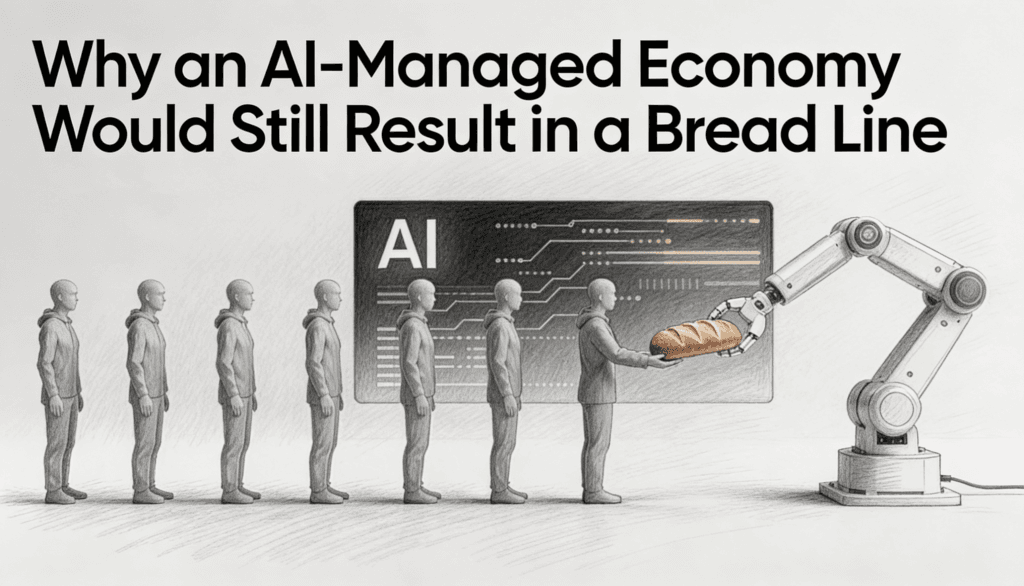
So why would an AI managed economy still produce bread lines? Not because the AI is stupid. Not because it lacks data or processing power. But because the economy is not a problem to be solved. It is a process to be navigated, and the navigation requires the participation of every person in it, each acting on knowledge that only they possess, in circumstances that only they can fully appreciate.
Replace that participation with a central algorithm and you do not get efficiency. You get a very fast system that is optimizing the wrong thing, using incomplete information, while the people it is supposed to serve learn to feed it garbage and wait in line for whatever it decides they should want.
Hayek understood something that the technologists have yet to absorb. The brilliance of a market economy is not that it produces optimal outcomes. It does not. It is messy, wasteful, and often unfair. Its brilliance is that it aggregates knowledge that cannot be aggregated any other way. Destroy that mechanism and you are left with a very expensive, very confident machine producing not bread that people want or need.