Table of Contents
There is a strange comfort in believing that the modern university invented serious education. That somewhere around the 19th century, brilliant minds sat down and designed the four year degree as the ultimate vessel for intellectual development. Four years of lectures, exams, electives, and a capstone project. Then you walk across a stage, shake a hand, and emerge ready for the world.
Except someone already did this. Over two thousand years ago. And he did it better.
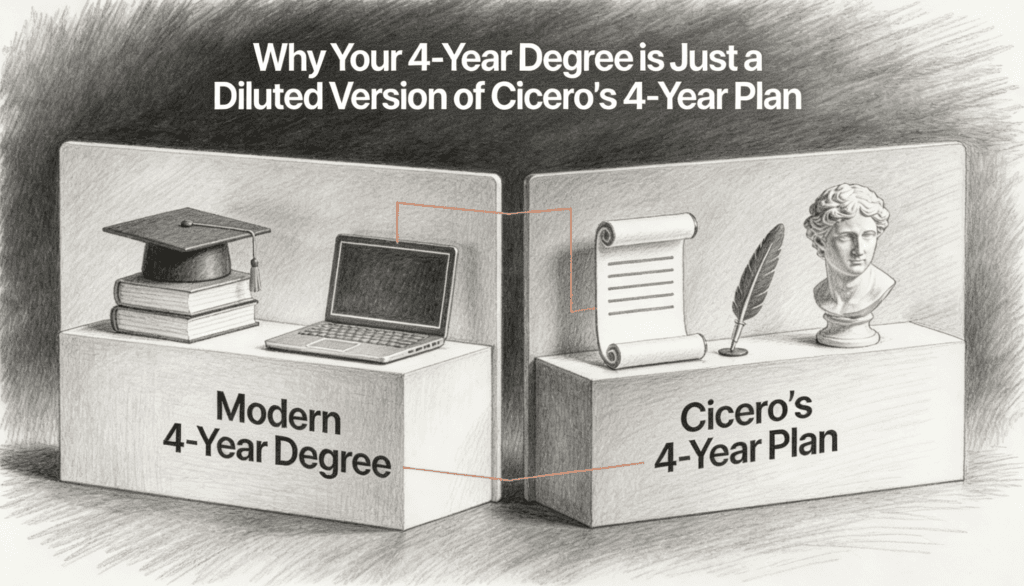
Marcus Tullius Cicero, the Roman statesman, lawyer, philosopher, and arguably the greatest orator who ever lived, laid out a vision for education that makes most modern degree programs look like a photocopy of a photocopy. Faded. Blurry. Missing most of the original detail.
The uncomfortable truth is that the modern four year degree did not improve on classical education. It just repackaged it, stripped out the hard parts, and sold it back to us at a considerable markup.
Cicero Did Not Want to Produce Specialists. He Wanted to Produce Humans.
Cicero’s educational philosophy, most clearly expressed in works like De Oratore and De Officiis, was built on a radical premise. Education should produce a complete person. Not a marketing major. Not a pre-med student who cannot write a coherent paragraph. Not a computer science graduate who has never seriously wrestled with an ethical question.
Cicero called this the ideal of the orator perfectus, the perfect speaker. But do not let the word “speaker” mislead you. His perfect orator was not someone who could deliver a good TED talk. This was a person who had mastered law, philosophy, history, literature, psychology, ethics, logic, and rhetoric. A person who could walk into any room, assess any situation, and respond with precision, grace, and moral clarity.
Now compare that to the average college graduate who cannot explain the difference between a deductive and inductive argument but has strong opinions about market segmentation.
The modern university took Cicero’s integrated vision and shattered it into departments. Philosophy went to one building. Rhetoric went to another (if it survived at all). History got its own wing. Ethics became a single elective you could skip if you took an extra statistics course instead. What was once a unified intellectual formation became a buffet where students load up on whatever looks easy and avoid anything that might cause discomfort.
The Original Four Year Plan
Cicero did not pull his educational framework from thin air. He was drawing on and refining a Greek tradition that already understood something most modern educators have forgotten: learning has a natural sequence.
The first stage was about mastering language and argument. Grammar, logic, and rhetoric. The trivium. Before you could study anything else, you had to learn how to think clearly, argue precisely, and communicate effectively. This was not “Freshman Composition.” This was a rigorous, demanding process designed to give students the intellectual tools they would need for everything that followed.
The second stage introduced broader knowledge. History, law, philosophy, natural science, mathematics. But here is where Cicero diverged from many of his Greek predecessors. He insisted that none of these subjects should be studied in isolation. A student of law who did not understand philosophy would become a technician. A student of philosophy who ignored practical affairs would become irrelevant.
The third and fourth stages were about synthesis and practice. The student was expected to take everything learned, integrate it, and apply it in real situations. For Cicero, this meant entering public life. Speaking in the Forum. Arguing cases. Advising leaders. The final product of education was not a thesis paper reviewed by three professors. It was a life lived in the arena.
There is a beautiful logic here that the modern university has almost entirely abandoned. Learn the tools first. Then learn the subjects. Then put it all together. Then go do something that matters.
What does the modern university do instead? It throws eighteen year olds into introductory courses across six unrelated subjects, asks them to declare a major before most of them have read a serious book, and then funnels them through increasingly narrow specializations until they emerge knowing a great deal about very little.
The Death of Rhetoric and Why It Matters More Than You Think
If Cicero could visit a modern university, the thing that would horrify him most is not the cost of tuition. It is the near total disappearance of rhetoric from the curriculum.
Rhetoric was not, in the classical understanding, the art of manipulation. It was the art of thinking well in the presence of others. It combined logic, ethics, psychology, and language into a single discipline. A trained rhetorician could analyze an argument, detect its flaws, construct a better one, and deliver it in a way that moved people to action.
This was the centerpiece of Cicero’s educational plan. Everything else supported it. Philosophy gave you the ability to reason. History gave you examples and warnings. Law gave you structure. But rhetoric was where it all came together.
The modern university replaced rhetoric with “communication studies,” which is a bit like replacing surgery with a first aid course. Students learn to make PowerPoint slides and give group presentations. They do not learn to construct arguments, read an audience, adapt their reasoning in real time, or defend a position under pressure.
And then we wonder why public discourse is in such poor shape.
There is a direct line from the removal of rhetoric from education to the quality of conversation we see in politics, media, and even corporate boardrooms. When people are never taught how to argue well, they do not stop arguing. They just argue badly.
What Cicero Understood About Interdisciplinary Thinking (Before It Became a Buzzword)
Modern universities love to talk about interdisciplinary programs. They create institutes with names that combine three or four fields. They write mission statements about breaking down silos. They host panels about the importance of cross-pollination between departments.
Cicero would find this hilarious. Not because interdisciplinary thinking is a bad idea, but because it was the default mode of serious education for over a thousand years. You did not need a special program for it. It was simply how educated people thought.
In De Oratore, Cicero has his characters debate a question that still haunts modern education: should you specialize or generalize? The character Crassus argues for broad knowledge. Antonius argues for focused expertise. But Cicero is clearly on the side of Crassus, and his reasoning is worth paying attention to.
A specialist, Cicero believed, is always at the mercy of what they do not know. A lawyer who does not understand human psychology will lose cases. A philosopher who does not know history will repeat its mistakes. A leader who cannot communicate will fail regardless of how sound their ideas are.
The modern university answered this question by choosing specialization and then trying to patch the gaps with general education requirements. Take two science courses. Take a humanities elective. Check the boxes. But checking boxes is not the same thing as integration. A biology major who takes a single philosophy course does not become an interdisciplinary thinker. They become a biology major who once sat through a philosophy course.
The Uncomfortable Parallel with Modern Startups
Here is a connection that might seem unexpected but is hard to ignore once you see it.
The most successful founders in Silicon Valley tend to operate exactly the way Cicero described his ideal educated person. They are not pure specialists. The best ones combine technical knowledge with psychology, storytelling, strategy, design thinking, and an almost intuitive understanding of human behavior. Steve Jobs studied calligraphy. Peter Thiel studied philosophy. Reid Hoffman studied at Oxford as a Marshall Scholar focusing on philosophical questions before building LinkedIn.
These people did not succeed because of their narrow expertise. They succeeded because they could synthesize across domains. They could see patterns that specialists missed. They could communicate their vision in ways that moved people.
Cicero would have recognized them immediately. Not as technologists, but as orators in his sense of the word. People who had mastered the art of combining knowledge, judgment, and expression.
And yet the educational system that produces most graduates today is designed to do the opposite. It is designed to create people who know their lane and stay in it.
What Got Lost in Translation
The four year structure of the modern degree is not a coincidence. It traces back, through many layers of institutional history, to the medieval university, which itself borrowed heavily from the classical trivium and quadrivium. Those frameworks were directly descended from the educational tradition Cicero championed.
But each translation lost something.
The medieval university kept the structure but added theology as the capstone, pushing rhetoric to the side. The Enlightenment era university kept the four year timeline but began emphasizing natural science and empiricism, further marginalizing the humanistic core. The 19th century German research university, which became the model for most American universities, prioritized original research and departmental specialization over integrated learning. And the 20th century American university turned the whole thing into a credentialing system designed to sort people into professional categories.
At each stage, the original purpose of the four year plan got a little more diluted. Like adding water to wine, one cup at a time, until what you are drinking is technically still wine but tastes like nothing much at all.
Cicero designed his plan to produce wisdom. The modern university uses roughly the same timeline to produce employees.
The Counterargument Worth Taking Seriously
Now, a fair objection. The world is vastly more complex than it was in Cicero’s time. The amount of knowledge available in any single field is staggering. You cannot expect a modern medical student to also master rhetoric, philosophy, and law. There are not enough hours. Specialization is not a failure of imagination. It is a response to reality.
This is true. And Cicero, who was nothing if not practical, would probably acknowledge it.
But he would also point out something that the defenders of specialization tend to ignore. The most important problems humans face are never contained within a single field. Climate change is not just a science problem. It is an economic problem, a political problem, a communication problem, and a moral problem. Healthcare is not just a medical problem. It involves ethics, policy, technology, human behavior, and resource allocation.
The people who solve these problems will not be the ones who stayed in their lane. They will be the ones who can think across boundaries. And producing people who can think across boundaries is exactly what Cicero’s plan was designed to do.
So What Do We Do With This?
The point is not that we should all go back to studying Latin and arguing in the Roman Forum. The point is that something essential was lost when education shifted from formation to information, from developing judgment to delivering content, from producing people who can think to producing people who can pass tests.
Cicero understood that education is not about accumulating facts. It is about developing the capacity to use knowledge wisely, to see connections others miss, to persuade without manipulating, and to act with both competence and character.
The four year degree still exists. The timeline is the same. But the soul of the thing has been hollowed out.
If you are currently in a university, the best thing you might do is ignore the structure you have been given and reconstruct something closer to what Cicero had in mind. Read broadly. Study argument. Learn to write and speak with precision. Do not let your major become your identity. Seek out the connections between subjects that your curriculum treats as separate. Find professors who think across boundaries and learn from them even if their courses do not count toward your requirements.
And if you are past the university years, the news is actually better. You are free. No one is going to test you. No one is going to make you declare a major. You can read Cicero alongside a neuroscience paper alongside a business case study and nobody will ask you to justify the combination.
The four year plan was never about four years. It was about a way of approaching knowledge. That approach is still available. It was just never meant to be sold back to you with a six figure price tag and a graduation ceremony.
Cicero spoke to the Roman Senate for free. Something to think about the next time your student loan payment comes due.