Table of Contents
There is something almost theatrical about watching a Fortune 500 company release a statement on social justice. The language is careful. The font is tasteful. The logo gets a seasonal makeover. And somewhere in the background, the same company is lobbying for tax loopholes that would make a Renaissance pope blush.
This is not hypocrisy in the ordinary sense. It is something more interesting. It is rational behavior, and George Stigler saw it coming decades before the first corporate Pride float rolled down Fifth Avenue.
Stigler, the Nobel laureate economist who spent most of his career at the University of Chicago, built his reputation on a deceptively simple observation: industries do not merely respond to regulation. They capture it. They shape it. They wear it like a tailored suit. His theory of regulatory capture, published in 1971, argued that government regulation tends to benefit the very industries it was designed to constrain. The regulators become the regulated, in spirit if not on paper.
But Stigler’s insight runs deeper than lobbying and legislation. Strip it down to its core logic and you find a universal principle about how institutions behave when the costs of appearing virtuous are low and the rewards are high. What we now call virtue signaling is not a departure from economic rationality. It is a textbook example of it.
The Market for Morality
To understand why companies talk about values, you first have to understand that values have become a market. Not a metaphorical market. An actual one, with supply, demand, and price signals.
On the demand side, consumers increasingly report that they want to buy from companies that “share their values.” Consumers, particularly younger ones, say they factor ethics into purchasing decisions. Whether they actually do is a separate and more entertaining question, but the stated preference is real enough to move boardroom strategy.
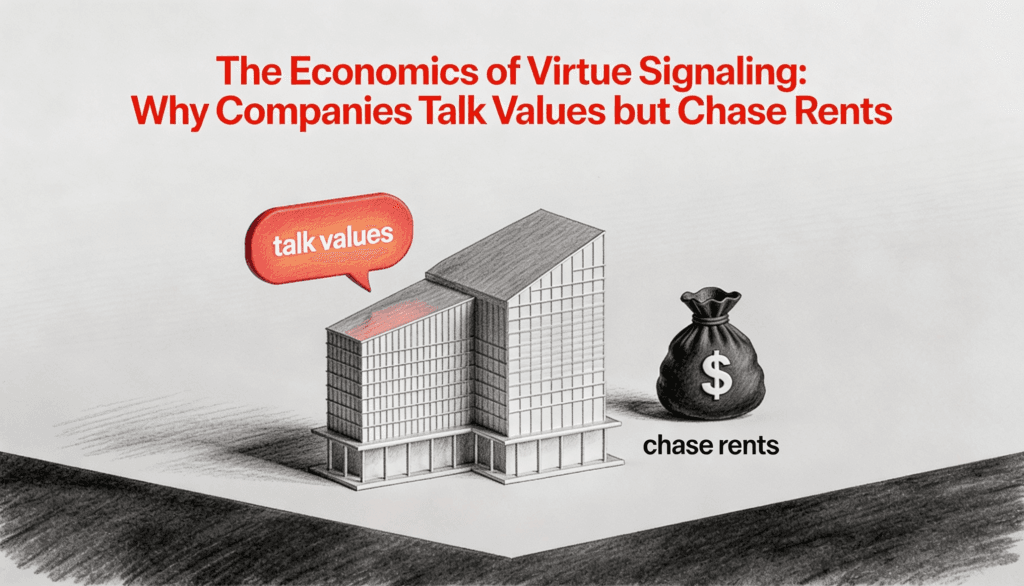
On the supply side, producing the appearance of virtue is remarkably cheap. A statement costs nothing. A social media campaign costs less than a single television ad. Changing your logo for a month is free. Compare this to the cost of actually restructuring a supply chain, raising wages across the board, or voluntarily paying higher taxes. The gap between performing values and practicing them is not a bug in the system. It is the system.
Stigler would have recognized this immediately. In his framework, firms are not moral or immoral. They are calculators. They assess costs and benefits with the same cold precision whether they are choosing a supplier or choosing a cause. When the expected return on a public statement exceeds the expected return on silence, the statement gets made. When it does not, the firm discovers a sudden appreciation for “staying in its lane.”
Regulatory Capture Wears New Clothes
Stigler’s original theory focused on a specific mechanism. Industries lobby regulators. They provide expertise, campaign contributions, and future employment. Over time, the regulatory body begins to see the world through the eyes of the industry it oversees. Rules get written in ways that protect incumbents and raise barriers to entry for newcomers.
Now extend this logic to the cultural sphere. When a large corporation champions a social cause, it is not simply expressing a belief. It is positioning itself within a regulatory and reputational ecosystem. The company that leads the conversation on sustainability gets a seat at the table when sustainability regulations are drafted. The firm that pioneers diversity initiatives gets to help define what diversity means in practice.
Consider the technology sector. The largest tech companies have been among the most vocal advocates for privacy regulation. This sounds paradoxical until you realize that comprehensive privacy laws impose compliance costs that large firms can absorb and small firms cannot. Stigler would have called this a classic case of using regulation to restrict competition. The only difference is that the regulation now comes wrapped in the language of social responsibility.
The same pattern appears in environmental policy. Major oil companies have publicly endorsed carbon pricing. Again, this seems counterintuitive. But a carbon tax, once implemented, becomes a known cost that large incumbents can plan around. The uncertainty of fragmented local regulations is far more dangerous to a multinational than a single, predictable federal rule. Supporting the policy is not altruism. It is risk management dressed in a green jersey.
The Stigler Playbook in Three Acts
If you want to see Stiglerian logic at work in virtue signaling, watch for three moves that repeat across industries like a well rehearsed play.
Act One: Define the Terms. The first move is to get involved in defining what counts as ethical behavior. This is the most valuable piece of real estate in any moral debate, and companies know it. When a coalition of corporations creates a voluntary sustainability standard, they are not submitting to external judgment. They are writing the exam and then grading themselves. The standard will inevitably reflect what these companies are already doing or can easily start doing. Anything that would require painful structural change gets quietly left off the list.
Act Two: Raise the Floor. Once the standard exists, the next move is to advocate for making it mandatory. This is where Stigler’s capture theory becomes almost visible to the naked eye. The company that helped write the voluntary standard now lobbies to make it law. Competitors who were not at the table must now scramble to comply. New entrants face a barrier that looks like social progress but functions like a toll booth.
Act Three: Police the Boundaries. With the standard in place and competitors struggling to meet it, the final move is to position yourself as the authority on compliance. The company becomes a thought leader, a convener, a trusted voice.
Why Sincerity Is Beside the Point
Here is where most discussions of corporate virtue signaling go wrong. Critics focus on sincerity. They ask whether companies “really” care about the causes they champion. This is the wrong question. It is like asking whether a chess player “really” cares about the bishop. The bishop is a tool. Its value depends entirely on its position on the board.
Stigler understood that motivation is irrelevant to economic analysis. What matters is behavior, and behavior responds to incentives. Some executives may genuinely care about climate change or social equity. Some may not. The outcome is the same because the incentive structure points in the same direction regardless of what anyone feels in their heart.
This is actually one of the more uncomfortable implications of Stigler’s framework. It suggests that even genuine corporate virtue is shaped and channeled by the same rent seeking logic that drives cynical virtue signaling. A CEO who sincerely believes in sustainability will still advocate for the version of sustainability that benefits his company. He is not being dishonest. He is being human. People have a well documented tendency to believe that what is good for them is good for the world. Psychologists call this motivated reasoning.
The Consumer Side of the Equation
Virtue signaling would not exist without an audience willing to reward it. This brings us to the demand side, and here the economics get even more interesting.
When consumers say they want ethical products, they are expressing a real preference. But preferences are not the same as willingness to pay. Consumers will tell a surveyor they would pay 20 percent more for sustainably sourced coffee. Then they will walk into a store and buy whatever is on sale.
This gap is not evidence of consumer dishonesty. It is evidence of something Stigler’s colleague, Gary Becker, spent years studying: the economics of information and attention. Ethical consumption requires research. It requires comparing claims, reading labels, and verifying certifications. This is costly, not in dollars but in time and cognitive effort. Most people, most of the time, default to simpler decision rules. Price. Convenience. Brand familiarity.
Companies know this. They know that most consumers will respond to the signal without investigating the substance. A label that says “ethically sourced” does more work than a hundred page supply chain audit that nobody will read. The signal is the product. The virtue is the packaging.
What Stigler Did Not Predict
For all its explanatory power, Stigler’s framework has blind spots. The biggest one is that he treated regulation as the primary arena of competition between firms and the state. He did not fully anticipate a world where public opinion itself becomes a regulatory force, where a viral tweet can do more damage than a government fine.
In this environment, virtue signaling is not just about capturing regulators. It is about capturing narratives. The company that controls the story controls the battlefield. This is a form of soft power that Stigler’s models, built for a world of hard regulatory bargaining, were not designed to accommodate.
But even here, the underlying logic holds. Narrative capture is still capture. It still benefits incumbents over challengers. It still imposes costs on competitors. And it still tends to produce outcomes that look like progress but function like protection. The mechanism has changed. The economics have not.
The Uncomfortable Takeaway
If Stigler were alive today, scrolling through corporate social media feeds with the same dry skepticism he brought to everything, he would probably not be outraged. He would be unsurprised. He spent his career arguing that self interest does not disappear when people put on suits and sit in boardrooms. It does not disappear when they put on lab coats, judicial robes, or nonprofit letterheads either. Self interest is the water. Everything else is the fish.
The uncomfortable takeaway is not that corporations are evil. It is that the incentive to appear good and the incentive to be good are two different things, and markets are far better at rewarding the first than the second. Regulation can help close the gap, but only if regulators are not themselves captured, which, as Stigler showed, is precisely the outcome that powerful firms work hardest to achieve.
This does not mean that corporate social responsibility is worthless. Some of the changes driven by public pressure are real and beneficial. Companies have reduced emissions, improved labor conditions, and diversified their workforces in ways that would not have happened without external pressure. The gains are genuine, even if the motives are mixed.
But it does mean that consumers, voters, and citizens should watch what companies do, not what they say. The statement is cheap. The annual report is expensive. And somewhere in the distance between the two, you will find the actual values of the firm, expressed not in press releases but in budget lines.
Stigler knew that the most important truths about power are the ones that hide in plain sight. Corporate virtue signaling is not a mystery. It is not even a scandal. It is economics, doing exactly what economics does: following the money, even when the money is wearing a halo.