Table of Contents
You have never read the most important book in your life. Nobody has. It was never printed. It has no author, no table of contents, no index. Yet you consult it every single day. You use it when you shake hands instead of bowing. You use it when you laugh at a joke that would get blank stares in another country. You use it when you know, without anyone telling you, that crying at a wedding is fine but crying at a board meeting is a problem.
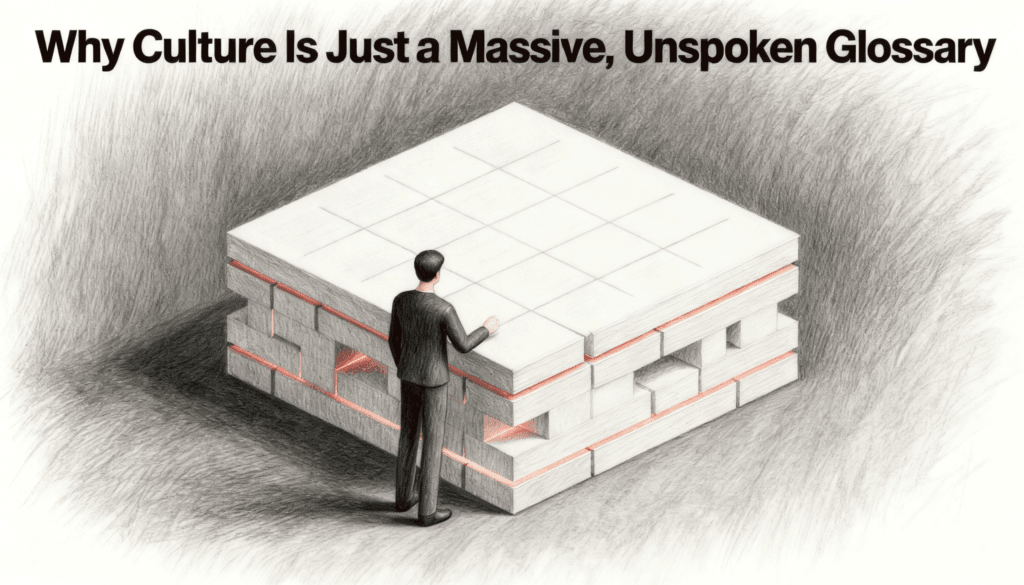
This book is your culture. And if Ludwig Wittgenstein was right, culture is really just a glossary. A massive, evolving, entirely unspoken glossary that defines what everything means, except nobody agrees on what is in it, and nobody can find their copy.
The Philosopher Who Gave Up, Then Started Over
Wittgenstein is one of those rare thinkers who managed to be revolutionary twice. His first major work, the Tractatus Logico-Philosophicus, tried to map the logical structure of language onto the logical structure of the world. It was beautiful, austere, and wrong. Or at least, Wittgenstein himself came to think so. He spent years away from philosophy, working as a schoolteacher and a gardener, apparently content to let his masterpiece stand. Then he came back and dismantled it.
His later work, especially Philosophical Investigations, flipped his earlier ideas inside out. Language, he now argued, does not get its meaning from some invisible logical scaffolding. Words do not point at things the way labels point at jars. Instead, meaning comes from use. A word means what it means because of how people use it, in what situations, according to what habits and agreements and silent traditions.
This is where it gets interesting for anyone who has ever felt confused in a foreign country. Or at a dinner party. Or in their own family.
Language Games: The Rules Nobody Wrote Down
Wittgenstein introduced a concept he called “language games.” The term sounds playful, and it partly is, but there is something serious underneath. A language game is any activity where language and action are woven together. Ordering coffee is a language game. Giving directions is a language game. Flirting is a language game, and one with spectacularly unclear rules.
The key insight is that each game has its own logic. The rules of one game do not automatically apply to another. When a scientist says “theory,” it means something rigorously tested and evidence based. When your uncle says “I have a theory” at Thanksgiving dinner, it means you should brace yourself. Same word. Completely different game.
Now stretch this idea outward. Culture is not one language game. It is thousands of them, layered on top of each other, running simultaneously, and mostly invisible to the people playing them. When you enter a new culture, the disorientation you feel is not really about the language barrier. You can learn vocabulary from an app. What you cannot learn from an app is which game is being played at any given moment, and what the unspoken rules are.
This is why someone can speak flawless French and still be baffled at a Parisian dinner party. The words are correct. The game is wrong.
The Glossary That Writes Itself
Think of every culture as maintaining its own glossary. Not a glossary of words exactly, but a glossary of meanings. What does “respect” look like? In one culture, it looks like direct eye contact. In another, it looks like avoiding eye contact. Both entries are filed under “respect.” Both are correct. Neither is aware that a competing definition exists.
What does “being on time” mean? In Germany, it means arriving five minutes early. In Brazil, it might mean arriving when the event has acquired enough energy to justify your presence. Neither group thinks it is being rude. They are simply reading from different glossaries.
This is Wittgenstein’s insight applied at scale. Meaning is not inherent. It is not stamped into reality like serial numbers on appliances. Meaning is a collective agreement, and the agreement is different in every group, every region, every era. Culture is what happens when millions of people silently coordinate on the same definitions without ever sitting down to negotiate them.
And the most fascinating part is that nobody remembers agreeing. The glossary just sort of showed up.
The Beetle in the Box
Wittgenstein offered a thought experiment that might be the most unsettling party trick in philosophy. Imagine everyone has a box with something inside called a “beetle.” Nobody can look inside anyone else’s box. Everyone can only know what a “beetle” is by looking at their own.
In this scenario, the word “beetle” works fine in conversation. People trade the word back and forth. But nobody actually knows if their beetle looks anything like anyone else’s. The word functions, communication proceeds, and the contents of the box are irrelevant to the public use of the term.
Now replace “beetle” with almost any culturally loaded concept. Honor. Success. Freedom. Love. Everyone uses these words. Everyone nods in agreement. But peek inside the boxes, and the beetles look wildly different.
An American says “freedom” and might picture the open road, minimal government, and the right to say outrageous things on the internet. A Scandinavian says “freedom” and might picture a robust social safety net that frees people from the anxiety of poverty. Both would fight passionately for “freedom.” They might even fight each other, both convinced the other side does not understand the word.
They are both reading from their glossary. The problem is not that one is wrong. The problem is that neither realizes they are holding different dictionaries.
When Glossaries Collide
Most cultural conflict, if you squint at it through this lens, is not really a clash of values. It is a clash of definitions. People rarely disagree about whether respect matters, whether fairness is important, or whether children should be cared for. The fights start when the definitions diverge.
Consider the concept of “family obligation.” In many East Asian and Latin American cultures, the glossary entry for this term is extensive and detailed. It includes financial support, physical proximity, deference to elders, and multi-generational households. In many Northern European and North American cultures, the entry is shorter and more conditional. Family matters, of course, but individual autonomy sits right next to it in the index, and sometimes gets priority.
Neither side is confused about what it values. Both value family. Both value the individual. The glossaries simply rank and define these entries differently. And because the glossary is unspoken, each side assumes the other is either heartless or controlling, rather than simply literate in a different text.
This, by the way, is exactly the kind of misunderstanding that Wittgenstein spent his career trying to diagnose. Not factual errors. Not logical mistakes. But the quiet, structural confusion that comes from assuming everyone is playing the same language game when they are not.
The Glossary Changes When Nobody Is Looking
Here is where things get truly strange. The glossary is not static. It rewrites itself constantly, and it does so without announcing the revisions.
Think about the word “friend.” Thirty years ago, a friend was someone you spoke to regularly, whose home you had probably visited, whose family you might know. Today, “friend” can mean someone whose posts you occasionally react to from a different continent. The glossary entry changed. Nobody voted on it. Nobody sent a memo.
Or think about “work.” A generation ago, work meant a physical place you went to for set hours. Now, for millions of people, work is something that follows you into your kitchen, your bedroom, your vacation. The glossary absorbed a new meaning, and the old one did not fully disappear. It just sits there, creating a vague sense of guilt when you close your laptop at five o’clock.
This is culture evolving in real time. Not through grand proclamations or revolutions, but through the slow, uncredited accumulation of new usages. Wittgenstein would have recognized this immediately. Meaning shifts when use shifts. And use shifts when life shifts. The glossary is always catching up to the world, and the world is always outrunning the glossary.
The Connection to Economics (Yes, Really)
There is a surprising parallel here with how economists think about money. Money, like language, has no intrinsic value. A dollar bill is a piece of paper. A bitcoin is a string of numbers. These things function as money because everyone agrees to treat them as money. The moment the agreement breaks, so does the currency.
Culture operates on the same principle. The meanings encoded in a culture have no foundation in physical reality. A handshake is just two people gripping each other’s hands. It means “deal” or “trust” or “nice to meet you” only because the glossary says so. Change the glossary, and the gesture is just strange physical contact between strangers.
Wittgenstein never wrote about economics, but the structural similarity is hard to ignore. Both money and meaning are collective fictions that work precisely because nobody treats them as fictions. The second you start examining the foundation, you realize there is no foundation. There is only agreement. And agreement, as it turns out, is more powerful than concrete.
Why This Matters Now
We live in an era of colliding glossaries. The internet took communities that used to be separated by oceans and compressed them into the same comment section. People from radically different cultural glossaries now interact constantly, and much of the resulting friction comes not from malice but from what Wittgenstein might have called a misunderstanding of the game being played.
When someone from one culture says something that offends someone from another, the instinct is to assume bad intent. But often what has happened is simpler and harder to fix. Two people consulted two different glossaries and arrived at two different meanings for the same word or action. The offense is real. The intent may not have been.
This does not excuse harm. But it does suggest that a significant portion of cultural conflict could be reduced if people understood one basic Wittgensteinian principle: the meaning of a word is its use in context. Not your context. The speaker’s context. Not your glossary. Theirs.
The Glossary of One
Wittgenstein argued against the possibility of a truly private language. A language only one person speaks, he claimed, would not really be a language at all, because meaning requires public criteria, shared standards, a community of use. You cannot play a game with rules only you know, because then there are no rules. There is just behavior.
And yet, we all carry slightly personal glossaries. Your experience of “home” is not quite the same as mine. Your definition of “enough” is calibrated to a life I have not lived. We share languages, but our inner glossaries have entries written by experience, and those entries are ours alone.
This creates a beautiful and maddening paradox at the heart of human communication. We need shared meaning to connect. We carry private meaning we cannot fully share. Culture gives us the public glossary. Life gives us the private annotations in the margins. And we spend our days trying to bridge the gap between the two, usually by talking, sometimes by arguing, occasionally by writing very long articles about a dead philosopher.
The Entry That Is Always Missing
There is one entry that every cultural glossary lacks. It is the entry for itself. No culture defines “culture” in a way that its members can see while they are inside it. The fish does not have a glossary entry for water. This is perhaps the most Wittgensteinian observation of all. The thing that shapes everything you say and think and mean is the one thing you cannot clearly see.
But you can try. And trying is what makes the whole exercise worthwhile.
The next time you find yourself in a conversation where both sides are clearly using the same words but somehow missing each other entirely, remember the glossary. Remember that meaning is not universal. Remember that the rules of the game are not posted on the wall. Remember that the beetle in your box might look nothing like the beetle in theirs.
And then, if you can, ask what their glossary says. You might be surprised by the entry.