Table of Contents
There is a particular kind of pride people take in being busy. Not productive. Not effective. Just busy. The kind of busy where you stay late at the office not because the work demands it, but because leaving on time feels like a confession of laziness. The kind of busy where you wear your exhaustion like a medal, proof that you are a serious person doing serious things.
Most of us never stop to ask a simple question: what exactly are we working so hard at?
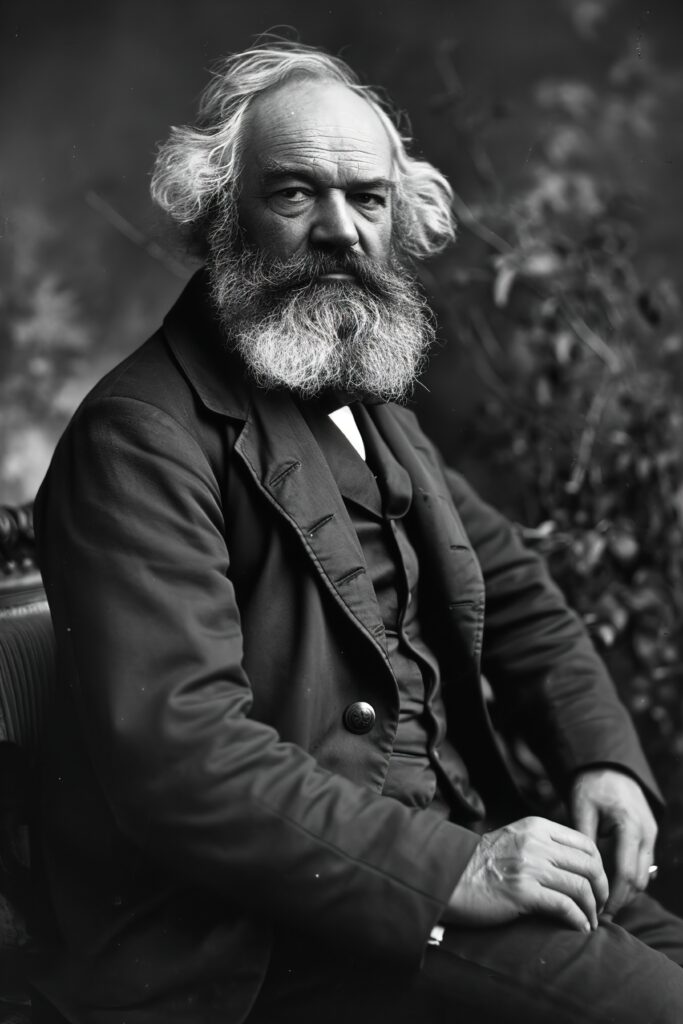
Over a century ago, a strange, socially awkward economist from rural Minnesota asked that question and came up with an answer that made almost everyone uncomfortable. His name was Thorstein Veblen, and his answer, stripped of academic politeness, was this: a enormous amount of what we call “hard work” is not about producing anything useful. It is about performing status. It is theater. And the audience is everyone around us.
The Man Who Noticed the Obvious
Veblen published The Theory of the Leisure Class in 1899, and it landed like a grenade in a gentlemen’s club. The book argued that the wealthy do not simply enjoy their money. They display it. They consume in ways designed to signal their position in the social hierarchy. He called this conspicuous consumption, a term so perfectly descriptive that it entered everyday language and never left.
But here is the part most people skip over. Veblen did not just describe how the rich spend money. He described how entire societies develop a warped relationship with work itself. He noticed that in almost every culture, the most prestigious activities are not the ones that produce the most value. They are the ones furthest removed from anything practically useful.
Think about it. In feudal societies, the aristocracy prided itself on never working. Manual labor was for peasants. The nobleman’s job was to fight, hunt, and attend elaborate social rituals. None of these activities fed anyone or built anything. That was precisely the point. The distance from useful work was the status symbol.
Veblen argued that this instinct did not disappear with industrialization. It just changed costumes.
The Inversion Nobody Talks About
Here is where things get genuinely interesting. You might expect that in a capitalist economy, people would value work based on what it actually produces. More output, more value, more respect. That would be logical. That would make sense.
That is not what happens.
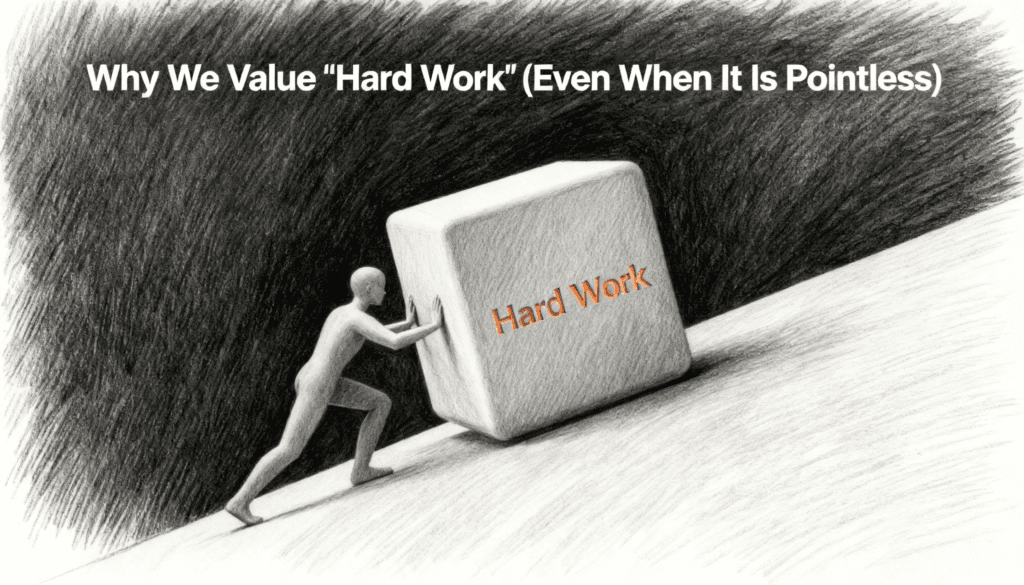
Instead, we developed an almost religious reverence for effort itself, regardless of outcome. The person who works eighty hours a week commands more social respect than the person who achieves the same results in thirty, even though the second person is objectively more efficient. We do not reward output. We reward the appearance of sacrifice.
Veblen would not have been surprised by this. He understood that cultures do not organize themselves around efficiency. They organize themselves around status. And once “hard work” becomes a status marker, the actual content of that work becomes almost irrelevant.
This is how you end up with entire industries built around what the anthropologist David Graeber later called “bullshit jobs,” positions that even the people holding them secretly suspect contribute nothing meaningful to the world. But the jobs persist because they signal the right things. They come with the right titles, the right office locations, the right kind of exhaustion.
Why We Confuse Suffering With Virtue
There is a deeper psychological mechanism at play here, and Veblen was circling around it even if he did not name it explicitly. We have a powerful cognitive bias that equates difficulty with value. If something was hard to do, we assume it must have been worth doing. Psychologists call this the effort heuristic. The more pain involved in a process, the more we value the result, even when the pain was completely unnecessary.
This is why handmade objects feel more “authentic” than machine made ones, even when the machine made version is technically superior. This is why a meal that took six hours to prepare tastes “better” than one that took thirty minutes, even if a blind taste test would reveal no difference. We are not evaluating the product. We are evaluating the story of suffering behind it.
Veblen saw this playing out at the societal level. The industrial economy was producing goods more efficiently than ever before. Logically, this should have led to more leisure, more freedom, more time for people to pursue what they actually enjoyed. Instead, the opposite happened. People worked harder. They invented new forms of work. They created elaborate bureaucracies and professional rituals that consumed enormous amounts of time and energy without producing proportional results.
Why? Because leisure had become suspicious. If you were not visibly struggling, you were not visibly contributing. And in a society where your social standing depends on being seen as a contributor, visible struggle is more important than invisible results.
The Modern Worship Service
Walk into any coworking space or tech startup and you will find Veblen’s observations alive and thriving. The glorification of the “hustle” is not an economic strategy. It is a belief system. Founders brag about sleeping under their desks as if insomnia were a business plan. LinkedIn is an endless scroll of people performing their dedication, broadcasting their 5 AM wake up calls and weekend work sessions to an audience of peers doing the exact same thing.
None of this is really about productivity. It is about membership. When you announce that you worked through the weekend, you are not reporting a fact. You are reciting a creed. You are telling your tribe that you belong, that you take the shared values seriously, that you are willing to sacrifice comfort on the altar of ambition.
Veblen called the older version of this “conspicuous leisure,” the wealthy flaunting their freedom from work. What we have now might be called conspicuous labor, the professional class flaunting their submission to work. The direction flipped, but the underlying logic is identical. You display whatever your social group considers prestigious.
And right now, among the educated professional class, what is prestigious is not wealth itself. It is the grind that supposedly produces wealth. The process became the product.
The Productivity Paradox
Here is a counterintuitive wrinkle that would have delighted Veblen. As technology has made us capable of producing more with less effort, we have not used that advantage to work less. We have used it to invent more work. Economists have been puzzled by this for decades. John Maynard Keynes famously predicted in 1930 that by the early twenty first century, technological progress would reduce the work week to about fifteen hours. He was spectacularly wrong.
But he was only wrong if you assume that work is primarily about production. If you understand, as Veblen did, that work is primarily about social signaling, then the puzzle dissolves. We do not work to produce. We produce to justify working. The work is the point. The output is the excuse.
This explains one of the strangest features of modern professional life: the meeting. Most professionals will privately admit that the majority of meetings they attend are unnecessary. Studies consistently confirm this. Yet meetings multiply. They fill calendars. They become the primary activity of entire management layers. Why? Because meetings are visible work. They are performance. Everyone can see you in a meeting. Nobody can see you thinking quietly at your desk, which might actually be more productive but looks suspiciously like doing nothing.
What Veblen Got Wrong (And What He Got More Right Than He Knew)
Veblen was not perfect. His writing style was deliberately obscure, almost as if he was performing his own version of conspicuous intellectual labor. He sometimes painted with too broad a brush, treating all consumption as status competition when some of it is genuinely about pleasure or utility. Not every person who buys a nice car is trying to intimidate the neighbors. Some people just like nice cars.
He also underestimated the genuine satisfaction that many people derive from hard work. There is real meaning in mastering a craft, solving a difficult problem, or building something that functions well. Not all effort is performance. Some of it is deeply fulfilling in ways that have nothing to do with what anyone else thinks.
But his core insight has only grown more relevant with time. We live in an economy that is phenomenally good at producing things and spectacularly bad at distributing the benefits of that production in ways that allow people to work less. And one of the main reasons we do not demand less work is that we have internalized the belief that constant work is morally necessary. We have confused the means with the end.
The Real Question Veblen Forces Us to Ask
Strip away the academic framework and Veblen is asking something uncomfortably personal: how much of what you do every day is genuinely useful, and how much of it is performance?
This is not a comfortable question. Most of us have built our identities around being hard workers. We have structured our self worth around our willingness to push through fatigue, to sacrifice weekends, to answer emails at midnight. Suggesting that some of this effort might be pointless is not just an intellectual critique. It feels like an attack on who we are.
Which is exactly Veblen’s point. When your identity is wrapped up in performing work, you cannot evaluate work rationally. You cannot ask whether a task is worth doing because the doing itself has become the source of your value as a person. The question “is this useful?” gets replaced by “will this make me look dedicated?” And those two questions lead to very different places.
What Would Actually Change If We Took Veblen Seriously
Imagine, just for a moment, a workplace culture that valued results over hours. Where leaving at three in the afternoon because you finished your work was celebrated rather than side eyed. Where the person who found a way to automate a tedious process was rewarded instead of quietly feared for making others look redundant.
This is not a fantasy. Some organizations have experimented with results only work environments, and the findings are remarkably consistent. Productivity stays the same or improves. Employee satisfaction increases dramatically. People do not become lazy when you stop monitoring their hours. They become focused. They stop performing work and start doing it.
But these experiments remain rare because they threaten something deeper than management practices. They threaten the entire moral economy of effort. They suggest that maybe, just maybe, we have been worshipping at the wrong altar.
Veblen never expected his ideas to change the world. He was too much of a pessimist for that. He understood that social habits are sticky, that status games are hardwired, that people will cling to prestigious suffering long after it stops making sense. He was probably right about that too.
But understanding the game, even if you cannot quit it, is not nothing. The next time you feel guilty for finishing your work early, or anxious about not looking busy enough, or impressed by someone who brags about their punishing schedule, remember that a peculiar economist from Minnesota figured out the trick over a hundred years ago.
The hard work is not always the point. Sometimes the hard work is the disguise.