Table of Contents
There is a man from the early 1800s who would find your savings account hilarious. Not because of the amount in it. Because of what you think it is doing.
His name was Jean-Baptiste Say. French economist. Cotton manufacturer. One of the first people to seriously think about what money does when nobody is looking at it. And what he concluded was something most people still have not absorbed two centuries later: your savings are not resting. They are not “put away.” They are sleeping.
They are working. Or at least, they should be.
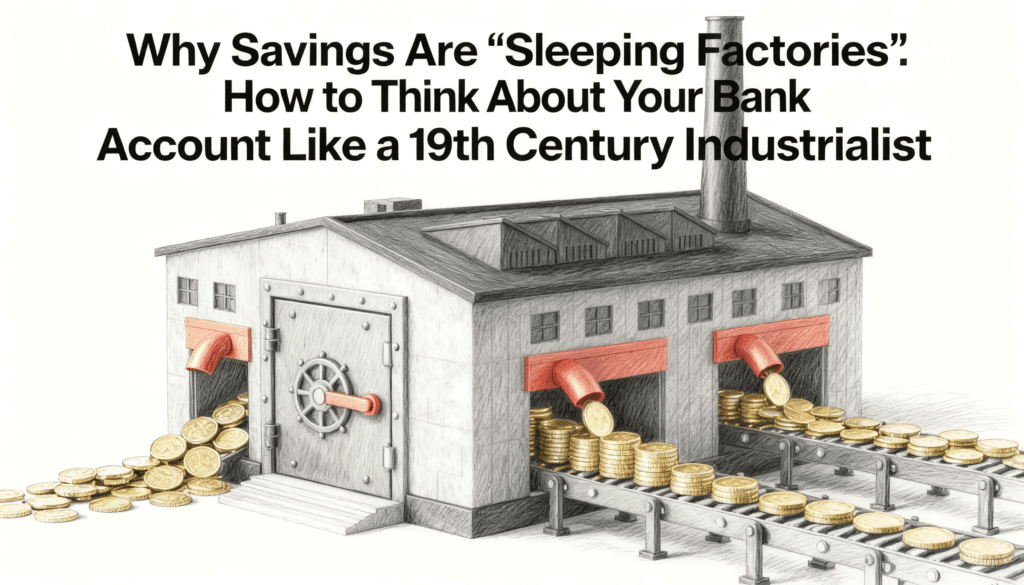
Say did not see savings the way most of us do, as a pile of security sitting in a vault somewhere. He saw them as dormant productive power. Factories that have not been built yet. Machines waiting to be switched on. Every franc sitting idle in a Parisian bank was, to Say, an unspun bolt of cloth. A ship not yet launched. An opportunity with a pulse, being slowly suffocated by inaction.
This might sound like an old idea dressed in old language. But stay with it for a moment, because the implications are stranger and more useful than they first appear.
The Man Who Thought Money Was a Verb
Jean-Baptiste Say was born in 1767 in Lyon, a city famous for silk. He grew up surrounded by production, by looms clacking and merchants arguing over prices. He did not come to economics through theory. He came to it through watching things get made.
This matters. Most economists before Say (and frankly, many after him) treated wealth as a noun. A thing you have. Gold in a chest. Land with a title deed. Say thought this was dangerously wrong. Wealth, to him, was a process. It was not something you accumulated. It was something you did.
His most famous contribution, known later as Say’s Law, boils down to one deceptively simple idea: production creates its own demand. When you make something valuable, you have simultaneously created the means to buy something else valuable. The act of producing is itself the act of generating purchasing power. Supply is not the opposite of demand. Supply is demand, just wearing different clothes.
Now, here is where it gets interesting for your bank account.
If production is the engine of wealth, then anything that could become production but has not yet is a kind of waste. Not moral waste. Not the kind of waste that makes you a bad person. Economic waste. The kind where potential sits in a dark room doing nothing when it could be out building things.
Say looked at savings and saw exactly this. Capital in waiting. Factories curled up inside bank notes like butterflies inside cocoons, except nobody was providing the warmth needed to let them emerge.
Your Savings Account Is Not a Piggy Bank
Here is the modern version of the problem. Most people think of their savings in one of two ways. Either it is an emergency fund, a mattress made of numbers that exists purely to catch you when you fall. Or it is a scoreboard, a number that goes up and makes you feel like you are winning at something.
Both of these views would have made Say wince.
Not because emergency funds are bad. They are not. And not because tracking your net worth is foolish. It is fine. But because both of these views treat savings as fundamentally passive. As something that sits there. As a noun.
Say would tell you that your savings account is not a piggy bank. It is a sleeping factory. And the question you should be asking is not “how much is in there?” but “what could this become?”
This is not some motivational poster philosophy. It is a genuine shift in economic thinking that separates people who build wealth from people who merely guard it.
Think about what actually happens when you deposit money in a bank. The bank does not put your cash in a little drawer with your name on it. It lends that money to someone else. A small business owner. A home buyer. A company expanding its warehouse. Your savings, whether you realize it or not, are already being deployed as productive capital. The bank is the one deciding what factory your sleeping money builds. And the bank is the one collecting most of the profit from that decision.
Say would find this arrangement perfectly logical but slightly tragic. You have capital. Capital wants to become production. But you have handed the steering wheel to an institution whose primary interest is its own margin, not your maximum return.
The Paradox of Thrift, or Why Being Responsible Can Be Economically Reckless
Here is where Say’s thinking intersects with one of the more counterintuitive ideas in economics.
There is a concept called the paradox of thrift, formalized later by John Maynard Keynes but with roots that trace back much further. It goes like this: if everyone in a society decides to save more and spend less, the total amount of savings in the economy can actually decrease. Why? Because one person’s spending is another person’s income. If everyone hoards, demand collapses, businesses contract, people lose jobs, and suddenly there is less income to save from.
Say would not have agreed with every part of Keynes’s framing. The two men stood on opposite sides of a debate that economists are still having today. But Say would have recognized the underlying mechanism. Savings that never transform into investment are not just neutral. They are actively destructive.
This is the part that most personal finance advice completely ignores. We are told to save, save, save. Build the emergency fund. Max out the retirement account. And those are not bad goals. But Say’s framework forces a harder question: saving for what?
If your savings sit in a standard account earning a fraction of a percent in interest while inflation quietly devours their purchasing power, you are not building wealth. You are watching it evaporate in slow motion. Your sleeping factory is not just asleep. It is rusting.
Thinking Like an Industrialist (Without Owning a Factory)
So what does it actually mean to think like Say? To treat your savings as productive capital rather than a static pile?
It does not mean you need to start a cotton mill. Times have changed. But the principle has not.
An industrialist in Say’s era looked at capital and asked: where can this be deployed to produce the greatest output? They did not sentimentally attach themselves to the money. They did not feel safer simply because the pile was big. They understood that capital earns its keep through deployment, not through accumulation.
In modern terms, this means treating every dollar above your essential safety cushion as a worker waiting for a job. Index funds, real estate, a small business, education that increases your earning capacity, even lending platforms where your money funds other people’s ventures. These are all versions of waking the factory up.
But here is the part Say understood that many modern investors forget: the quality of deployment matters enormously. Say was not just pro-investment. He was pro-intelligent investment. He watched plenty of factories go bankrupt in his lifetime. He saw capital destroyed by poor planning, by enthusiasm without skill, by people who confused activity with productivity.
The sleeping factory metaphor cuts both ways. Yes, capital should be put to work. But sending it to the wrong job is worse than letting it sleep. A factory making products nobody wants is not wealth creation. It is wealth destruction with extra steps.
What Darwin Can Teach You About Your Portfolio
There is a connection here that Say himself never made, because Charles Darwin had not yet published when Say died in 1832. But the parallel is striking enough to be worth drawing.
In evolutionary biology, there is a concept called “fitness” that has nothing to do with going to the gym. An organism’s fitness is measured by its ability to survive and reproduce in a given environment. The key phrase is “in a given environment.” A polar bear is supremely fit in the Arctic and completely helpless in the Sahara. Fitness is not absolute. It is contextual.
Your savings work the same way. A strategy that is perfectly adapted to one economic environment can be catastrophic in another. The industrialist who built textile mills in 1810 was a genius. The one who built them in 1910, when the market was saturated and synthetic fabrics were emerging, was throwing money into a bonfire.
Say grasped this intuitively even without the biological vocabulary. He wrote extensively about the importance of the entrepreneur, the person who does not just deploy capital but deploys it intelligently, reading market conditions, anticipating needs, adjusting course. The sleeping factory metaphor is not a blanket instruction to invest everything immediately. It is an instruction to think. To assess. To become the entrepreneur of your own capital, no matter how small that capital might be.
The Uncomfortable Truth About “Safe” Money
Let us talk about what most people consider the safest option: keeping money in a savings account.
In nominal terms, your balance stays the same or grows slightly. In real terms, adjusted for inflation, it shrinks almost every year. Over a decade, the purchasing power of cash savings can decline by 20 to 30 percent depending on the inflation rate. You started with a factory. You end with a shed.
Say would not have been surprised by this. He lived through the aftermath of the French Revolution, a period of wild monetary instability where the government printed assignats, a form of paper currency, until they became essentially worthless. He watched people’s savings evaporate not through spending but through the slow, invisible tax of monetary debasement.
The lesson he drew was not that saving is pointless. It was that saving in the wrong form is a trap. Money is a tool of exchange, not a store of value in itself. When you treat it as a store of value, you are trusting the monetary system to preserve your wealth. And if history teaches anything, it is that this trust is frequently misplaced.
Becoming the Entrepreneur of Your Own Savings
Say coined the word “entrepreneur” as we use it today. Before him, the term existed but did not carry the specific economic meaning he gave it. For Say, the entrepreneur was not just someone who started a business. The entrepreneur was the person who combined land, labor, and capital in new ways to create value. The orchestrator. The person who saw potential where others saw raw inputs.
You do not need employees or a business plan to be an entrepreneur in Say’s sense. You just need to look at your resources and ask what they could become.
This means understanding that every financial decision is a production decision. When you leave ten thousand dollars in a checking account for three years, you have decided to produce nothing with it. That is a choice. It might occasionally be the right choice. But it should be a conscious choice, not a default.
When you invest in an index fund, you are choosing to deploy your capital across hundreds of companies and let their collective production generate returns. When you invest in yourself through education or skill development, you are upgrading the machinery of your own earning power. When you start a side project that might eventually generate income, you are building a small factory of your own.
Say would approve of all of these, with the caveat that each must be done with care, with understanding, and with an honest assessment of the environment you are operating in.
The Factory Awakens
Here is the final thing worth sitting with.
Jean-Baptiste Say died in 1832, nearly two hundred years ago. He never saw the internet, index funds, cryptocurrency, or the gig economy. He never encountered the specific financial instruments you have access to. But his core insight remains as sharp as it was when he first articulated it: capital is not a trophy. It is a tool. And tools are only valuable when they are used.
Your savings are not a monument to your discipline. They are raw material. They are potential energy waiting to become kinetic. They are, in Say’s language, sleeping factories.
The question is not whether to wake them up. Inflation and time will erode them regardless. The question is whether you will be the one to decide what they build, or whether you will leave that decision to banks, to inertia, to the quiet erosion of doing nothing.
Say spent his life arguing that production is the foundation of prosperity. Not consumption. Not hoarding. Production. The act of turning inputs into something more valuable than they were before.
Your bank account is waiting for you to become its industrialist.
It has been sleeping long enough.