Table of Contents
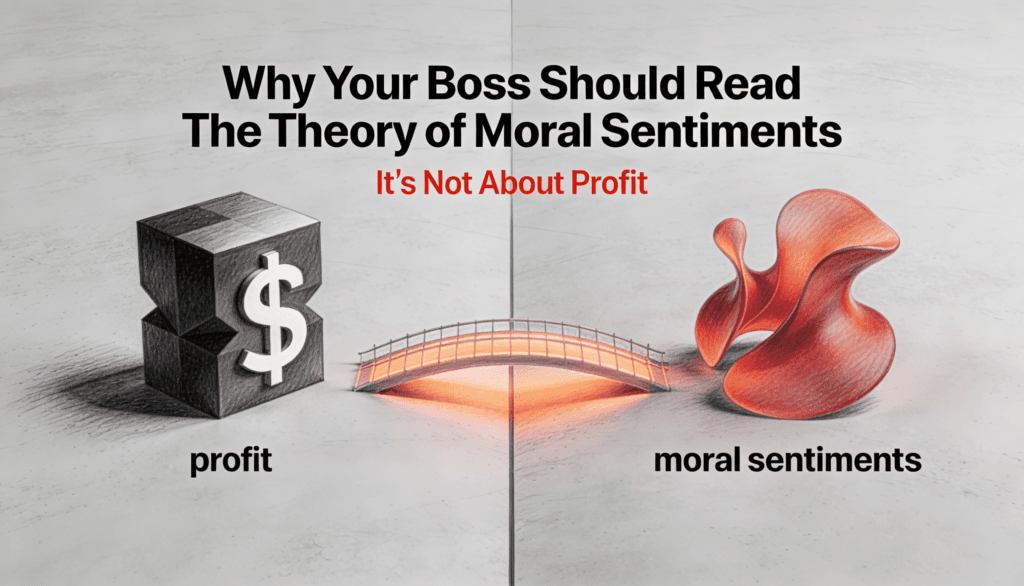
Everyone knows Adam Smith wrote The Wealth of Nations. It is the book that launched a thousand MBA programs and gave economists permission to talk about self interest without blushing. What most people do not know is that Smith wrote another book first. He considered it his better work. And it had nothing to do with supply curves or invisible hands.
The Theory of Moral Sentiments, published in 1759, is a book about why humans care about each other. It is about sympathy, fairness, the desire to be admired, and the quiet torture of being disliked. It is, in other words, a book about everything that actually matters in an office on a Monday morning.
Your boss has probably never heard of it. That is exactly why they need to read it.
The Other Adam Smith
There is a strange irony in how history remembers Adam Smith. He has become the patron saint of greed, the intellectual godfather of “look out for yourself and the market will sort it out.” Wall Street loves to quote him. Silicon Valley founders name drop him in podcast interviews. He is the philosopher you cite when you want to justify ruthless competition.
But Smith was not that person. He was a moral philosopher. He held a chair in moral philosophy at the University of Glasgow. He spent his career thinking about what makes people decent, not what makes them rich. The Wealth of Nations was a side project compared to the work that consumed most of his intellectual life.
The Theory of Moral Sentiments opens with a line that would confuse anyone who thinks Smith was all about self interest. He writes that no matter how selfish a person might be, there is something in their nature that makes them care about the fortune of others. Their happiness matters to the observer, even if the observer gets nothing from it except the pleasure of seeing it.
That does not sound like the architect of cutthroat capitalism. That sounds like someone who understood human beings.
What the Book Actually Says
Smith’s central idea is deceptively simple. Humans have a built in capacity for what he called “sympathy,” which today we would call empathy. We can imagine ourselves in another person’s situation. We feel a version of what they feel. When we see someone suffer, something in us contracts. When we see someone succeed, something in us expands.
This is not sentimentality. Smith was rigorous about it. He argued that this capacity for fellow feeling is the foundation of all moral judgment. We decide what is right and wrong not through abstract reasoning but through an imaginative act. We ask ourselves: if I were in that person’s position, how would I feel? And if I were watching myself from the outside, would I approve of my own behavior?
Smith called this internal observer “the impartial spectator.” Think of it as a mental referee who lives in your head and watches everything you do. This referee is not your conscience exactly. It is more like an imagined version of a fair minded, well informed stranger who evaluates your actions without bias.
Here is where it gets interesting for anyone who manages people.
The Impartial Spectator in the Corner Office
Most leadership advice today comes down to tactics. Communicate clearly. Set expectations. Give feedback. These are useful suggestions in the same way that telling someone to “hit the ball” is useful advice in tennis. Technically correct. Practically insufficient.
Smith offers something deeper. He suggests that good judgment, the kind that earns real respect rather than mere compliance, comes from the habit of imagining how your actions look to a disinterested observer. Not your board of directors. Not your shareholders. Not even your direct reports, who might be too afraid to tell you the truth. An imagined figure who has no stake in your success and no reason to flatter you.
This is a radical concept for modern leadership, where feedback loops are often contaminated by power dynamics. The person who controls your salary is rarely the person you are most honest with. Smith understood this in the 18th century without needing an employee engagement survey to confirm it.
The impartial spectator forces a question that most bosses never ask themselves: would a reasonable, uninvolved person approve of what I just did? Not “did it work” or “did it increase revenue” but “was it fair, decent, and proportionate?”
That question, asked consistently, changes behavior more than any leadership seminar ever could.
The Desire to Be Worthy of Praise (Not Just Praised)
Smith made a distinction that is devastatingly relevant to modern workplaces. He separated the desire to be praised from the desire to be praiseworthy. These sound similar. They are not.
The desire to be praised is the hunger for approval, recognition, applause. It is what drives someone to take credit for a team’s work, to fish for compliments in meetings, to curate a personal brand that looks impressive from the outside regardless of what is happening underneath. Social media has turned this desire into a global industry.
The desire to be praiseworthy is different. It is the wish to actually deserve admiration. To do work that would earn respect even if nobody was watching. To behave in a way that the impartial spectator would approve of, even if the real spectators never notice.
Smith argued that truly good people are driven by the second desire, not the first. They want to be the kind of person who merits respect, whether or not respect arrives.
Now think about the managers you have worked for. The bad ones were obsessed with looking competent. They managed up brilliantly and managed down terribly. They chased praise. The good ones were different. They seemed almost indifferent to recognition. They were focused on doing the right thing, and the recognition, when it came, seemed to mildly embarrass them.
Smith explained this difference 265 years ago. Corporate leadership theory is still catching up.
Why Sympathy Is Not Weakness
There is a persistent myth in business culture that empathy is soft. That caring about how your employees feel is a luxury reserved for companies that can afford beanbag chairs and meditation rooms. Real leaders, the myth goes, make hard decisions without flinching. They do not let emotions cloud their judgment.
Smith would have found this absurd. In his framework, sympathy is not the opposite of good judgment. It is the basis of it. You cannot make fair decisions about people if you cannot imagine their experience. You cannot allocate resources wisely if you do not understand what your team actually needs. You cannot retain talented people if you are constitutionally incapable of understanding why they are unhappy.
The leader who brags about being “purely rational” is usually the leader whose team secretly updates their resumes on Sunday nights.
The Problem with “Rational” Management
Modern management theory has a Smith problem, but it is referencing the wrong Smith book.
The version of Adam Smith that business schools teach is the Wealth of Nations Smith. The one who said that the butcher, the brewer, and the baker provide our dinner not from benevolence but from self interest. This is a useful insight about market dynamics. It is a terrible philosophy for running a team.
When you treat your employees as purely self interested actors, you build systems designed to control rather than inspire. You create elaborate incentive structures, surveillance mechanisms, and performance metrics that assume people will do as little as possible unless bribed or threatened. You get compliance. You do not get commitment.
Smith’s other book suggests a different model. People are not just motivated by self interest. They are motivated by the desire to be seen as good. They want their colleagues to think well of them. They want to feel that their work matters to someone other than the shareholder.
This is not naive optimism. Smith was clear eyed about human selfishness and vanity. He just understood that selfishness is not the whole story. People contain multitudes. A manager who appeals only to self interest is working with a fraction of what motivates their team.
The Corruption of Moral Sentiments (Or, How Good Bosses Go Bad)
Smith was also honest about how the system breaks down. He wrote extensively about what he called the “corruption of moral sentiments,” and his analysis reads like a diagnostic manual for toxic leadership.
The corruption happens, Smith argued, when people start admiring wealth and power for their own sake rather than for the virtue that might (or might not) accompany them. When we assume the rich person is wise, the powerful person is good, and the successful person deserves their success, we have corrupted our moral judgment.
Sound familiar? This is the halo effect that surrounds every CEO who has had one good quarter. It is the reason boards of directors give failing executives golden parachutes while cutting entry level positions. It is the reason a founder who got lucky with timing gets treated like a strategic genius.
Smith saw this tendency as one of the great threats to a just society. He argued that our instinct to admire the wealthy distorts our moral compass and leads us to excuse behavior that the impartial spectator would condemn.
A boss who reads this section of Smith might experience an uncomfortable moment of recognition. The deference they receive is not necessarily earned. The agreement they hear in meetings is not necessarily genuine. The success they attribute to their own brilliance might have more to do with circumstances than they would like to admit.
That discomfort is the point. It is the impartial spectator doing its job.
What This Means Practically
Reading an 18th century philosophy book will not fix a toxic workplace. Let us be clear about that. But ideas shape behavior over time, and Smith’s ideas are particularly well suited to the problems modern managers face.
First, the impartial spectator is a better accountability tool than most performance review systems. A boss who genuinely asks “would a fair minded observer approve of how I handled that?” on a regular basis will make better decisions than one who only asks “did we hit our numbers?”
Second, the distinction between wanting praise and wanting to be praiseworthy is a diagnostic tool for organizational culture. Teams where people chase credit are teams with trust problems. Teams where people focus on doing good work and let the recognition follow are teams that outperform over the long run.
Third, Smith’s understanding of sympathy as a foundation for judgment, not an obstacle to it, gives managers permission to care. You do not have to choose between being effective and being humane. In fact, you probably cannot be the first without being the second.
The Book Your Boss Will Not Read (But Should)
Here is the final irony. The people who most need to read The Theory of Moral Sentiments are the least likely to pick it up. It is not a bestseller. It does not have a catchy subtitle. There is no “5 Steps to Moral Leadership” framework inside. It is a dense, 18th century philosophical text that requires patience and attention.
But the ideas in it are more relevant to modern leadership than anything published in the last decade of business books. Smith understood something that we keep having to relearn: organizations are made of people, and people are not spreadsheets. They have feelings, pride, a sense of fairness, and a deep need to be seen and respected.
A boss who understands this, really understands it at the level Smith describes, does not need a management playbook. They have something better. They have a way of seeing other people that makes good management almost instinctive.
So maybe slip a copy onto your boss’s desk. Do not tell them it is philosophy. Tell them it is the prequel to The Wealth of Nations, the one Adam Smith liked better. Tell them it is about competitive advantage through moral intelligence, if that helps.
Whatever gets them to open it. Smith would understand the strategic framing. He was, after all, a practical man who understood that sometimes you have to appeal to self interest to teach someone about sympathy. He wrote a whole other book about that.