Table of Contents
There is a certain kind of person who, when life falls apart, reaches for Marcus Aurelius. You know the type. They post quotes about controlling what you can control. They journal in the morning. They treat every setback as a character building exercise. And to be fair, there is something admirable about that. Marcus Aurelius wrote one of the most enduring self help texts in human history, and he did it while running an empire and fighting plagues. The man earned his reputation.
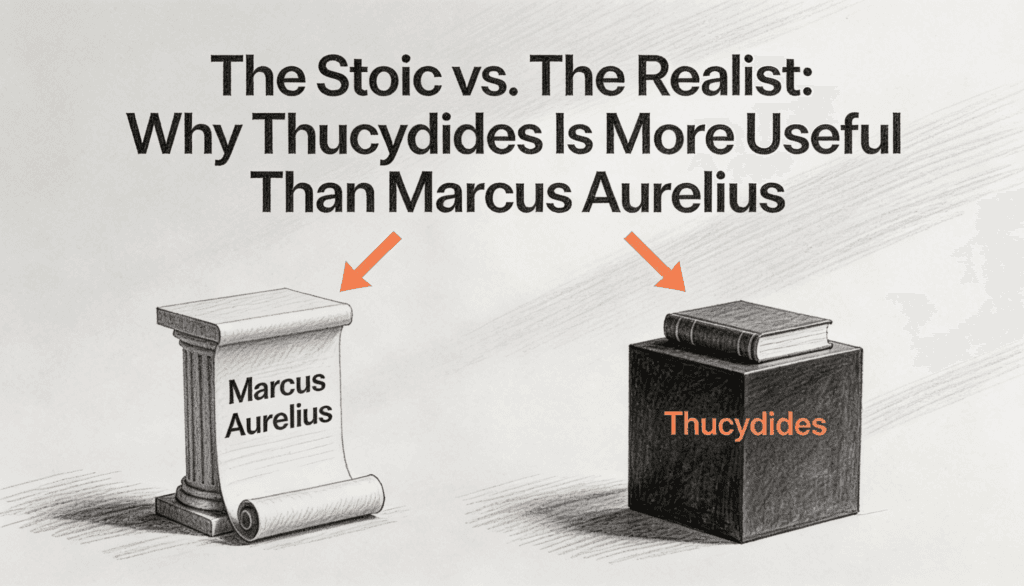
But here is the thing nobody wants to say out loud: Marcus Aurelius is most useful when the problem is you. When the obstacle is your own fear, your own ego, your own reaction to events. Stoicism is an inward philosophy. It fixes the operator, not the machine.
Thucydides does something different. He fixes your understanding of the machine itself. And if you are trying to navigate a world full of competing interests, institutional decay, shifting alliances, and people who will absolutely not be journaling about their emotions before they act against you, Thucydides is the more dangerous and more useful thinker to have in your corner.
The Comfort of Inner Fortresses
Stoicism has had a remarkable second life in the modern era. There are podcasts, bestsellers, leather bound journals with Seneca quotes embossed on the cover. It has become the philosophy of choice for executives, athletes, and anyone who wants to feel like they are handling things with dignity. And it works, up to a point.
Marcus Aurelius tells you that you cannot control external events but you can control your response to them. He tells you that other people’s opinions are not your concern. He tells you that death is natural and not to be feared. These are genuinely powerful ideas if you are struggling with anxiety, with perfectionism, with the tendency to spiral when things go sideways.
But notice what all of these prescriptions have in common. They assume the primary battlefield is inside your own skull. Stoicism is a philosophy of emotional regulation dressed up as a philosophy of life. It tells you how to feel about the world. It does not tell you how the world actually works.
This is where Thucydides walks in, covered in the dust of actual conflict, and politely disagrees.
The Historian Who Was Not Writing History
Thucydides was an Athenian general who got exiled for losing a battle. Most people would have spent their exile sulking or plotting revenge. Thucydides spent his writing the most clear eyed account of power, war, and human nature that the ancient world ever produced. His History of the Peloponnesian War is not really a history book in the way we think of history books. It is a manual for understanding why groups of people do what they do when the stakes are high and the rules start to dissolve.
What makes Thucydides extraordinary is his refusal to moralize. He does not tell you who the good guys are. He does not tell you what people should have done. He shows you what they did, and then he shows you why it was almost inevitable given the pressures they faced. This is a fundamentally different intellectual posture than Stoicism, which is always telling you what you ought to think and feel.
Thucydides is not interested in what you ought to do. He is interested in what you will do, given who you are and what forces are acting on you. That distinction matters more than most people realize.
Fear, Honor, and Interest
There is a passage early in the History where Athenian envoys explain why their empire behaves the way it does. They do not apologize. They do not offer noble justifications. They simply say that three things drive all human action: fear, honor, and interest. That is it. Every alliance, every betrayal, every war, every peace treaty can be traced back to some combination of those three forces.
Now compare that to the Stoic framework. Marcus Aurelius would tell you that honor is a matter of virtue, that fear is a failure of perspective, and that interest should be subordinated to reason. Beautiful sentiments. Completely useless if you are trying to predict what a rival company, a political opponent, or a foreign government is going to do next.
Thucydides gives you a predictive model. Stoicism gives you a coping mechanism. Both have value. But if you had to choose one lens to understand the twenty first century, the choice is not close.
Think about it in terms of game theory, a field that would not exist for another two thousand years after Thucydides wrote. Game theory does not care about your inner peace. It cares about incentive structures, about what rational actors will do when their interests collide. Thucydides was doing game theory with quill and parchment, centuries before anyone gave it a name. He understood that people respond to incentives, not to sermons.
The Melian Dialogue and the Limits of Morality
If you read nothing else from Thucydides, read the Melian Dialogue. It is a conversation between Athenian generals and the leaders of Melos, a small island that wanted to remain neutral in the war between Athens and Sparta. The Melians argue that justice is on their side. The Athenians respond with one of the coldest sentences in all of literature:
the strong do what they can and the weak suffer what they must.
This is not a statement of approval. Thucydides is not cheering for Athens here. He is showing you the logic of power stripped of every comfortable illusion. The Melians believed that being right would protect them. It did not. They were conquered, their men killed, their women and children enslaved.
A Stoic reading of this event would focus on how the Melians could have maintained their dignity in the face of destruction. How they could have accepted their fate. And that is not nothing. Dignity in defeat is a real thing and it matters.
But Thucydides is asking a harder question: why did the Melians put themselves in that position in the first place? Why did they believe that moral arguments would work against a power that had no reason to listen? The Melians made a category error. They brought ethics to a power negotiation. Thucydides does not judge them for it. He simply records the result.
This is the kind of clarity that Stoicism cannot provide because it is not trying to. Stoicism starts after the disaster. Thucydides tries to help you see the disaster coming.
Why Stoicism Flatters Us
Here is something slightly uncomfortable. One reason Stoicism is so popular is that it flatters the reader. It tells you that the most important project in the world is the improvement of your own character. It tells you that if you can master yourself, you have done the essential work. There is a quiet narcissism buried in this, and I say that as someone who has gotten genuine value from Stoic ideas.
Thucydides offers no such flattery. His work suggests that your personal virtue is largely irrelevant to the forces shaping your life. Good people make catastrophic decisions when trapped by circumstance. Wise leaders get swept along by the passions of the crowd. Institutions built over generations can collapse in a season. You can be the most centered, emotionally regulated person in the room and still be destroyed by dynamics you did not understand and could not control.
This is not a cheerful message. It is, however, a more honest one. And honesty, ultimately, is more useful than comfort.
The Plague and Two Kinds of Response
Both thinkers, remarkably, dealt with plagues. Marcus Aurelius governed Rome during the Antonine Plague that killed millions. Thucydides documented the Plague of Athens, which he himself survived. Their responses are instructive.
Marcus Aurelius treated the plague as a test of character. How will you conduct yourself? Will you maintain your composure? Will you continue to do your duty? These are not trivial questions and his answers were genuinely heroic.
Thucydides did something else entirely. He documented how the plague destroyed social norms. People stopped following laws because they figured they would be dead before any punishment could reach them. Religious observance collapsed because the pious died at the same rate as the impious. Social trust evaporated. Thucydides showed that catastrophe does not just test individuals. It reshapes the systems those individuals operate within.
If you are a leader trying to hold a society together during a crisis, Marcus Aurelius tells you to be strong. Thucydides tells you that strength is not enough because the crisis is changing the rules beneath your feet. One of these insights is inspiring. The other might actually save your organization.
Anyone who lived through 2020 should recognize this dynamic immediately. The pandemic did not just test individual character. It rearranged institutions, supply chains, political alliances, and social contracts in ways that no amount of morning journaling could have prepared you for. Thucydides would have recognized every bit of it. Marcus Aurelius would have told you to breathe.
The Trap of Control
The central Stoic teaching is the dichotomy of control. Separate what you can control from what you cannot. Focus only on what you can control. Let everything else go.
This sounds wise. It often is wise. But it also contains a trap.
The dichotomy of control can become an excuse for passivity. If I cannot control the outcome, why bother trying to influence it? If other people’s behavior is outside my control, why study it? If the future is uncertain, why attempt to predict it?
Thucydides would find this absurd. His entire project is about understanding forces that are not fully within anyone’s control so that you can at least anticipate them. You cannot control the weather, but you can learn to read the sky. You cannot control other nations, but you can understand their incentives. You cannot prevent all conflict, but you can recognize the patterns that lead to it.
The Stoic says: accept what you cannot change. Thucydides says: understand what you cannot change, and then figure out how to position yourself within it. The difference between acceptance and understanding is the difference between survival and strategy.
Thucydides as Operating System
Think of it this way. Stoicism is an app. It does one thing well. It manages your emotional state so you can function under pressure. That is valuable. Everyone needs that app sometimes.
Thucydides is more like an operating system. He gives you a framework for processing information about power, conflict, human behavior, and institutional dynamics. He does not tell you how to feel. He teaches you how to see.
You can run the Stoicism app on a Thucydidean operating system. You can understand the forces at work in your environment with clear eyes and then use Stoic techniques to manage your emotional response to what you see. That combination is formidable.
But running Stoicism without Thucydides is like having a meditation app on a phone with no map software. You will be very calm, and you will be very lost.
The Usefulness Test
Both thinkers have survived for roughly two thousand years, which suggests both have something real to offer. I am not arguing that Marcus Aurelius is worthless. I am arguing that in a world of increasing complexity, institutional fragility, and great power competition, the thinker who teaches you how systems behave is more useful than the thinker who teaches you how to behave within systems.
Stoicism answers the question: how do I stay sane? Thucydides answers the question: how do I stay sane and effective and alive?
If you are going through a breakup, read Marcus Aurelius. If you are going through a negotiation, a political transition, or a market collapse, read Thucydides. If you are going through both at the same time, read Thucydides first. You can process your feelings after you have secured your position.
That ordering is not callous. It is strategic. And Thucydides, more than any other ancient thinker, understood that strategy is not the opposite of morality. It is the precondition for it. You cannot be virtuous if you do not survive. You cannot act justly if you do not understand the forces that will punish you for your justice or reward you for abandoning it.
Marcus Aurelius assumed a world where virtue was its own reward. Thucydides lived in a world where virtue without power was just a beautiful way to lose.
Two thousand years later, we still live in that world. We just prefer not to admit it.