Table of Contents
About 2,400 years ago, a retired Athenian general sat down to write about a war. His name was Thucydides. The war was between Athens and Sparta. And the book he produced was not really about that war at all. It was about you.
That sounds like an exaggeration. It is not.
Thucydides wrote The History of the Peloponnesian War with an unusual promise. He said it would be “a possession for all time.” Not a story for his generation, not a patriotic anthem for Athens, but something permanent. Something that would remain true long after the swords rusted and the city walls crumbled. Most authors who make claims like that are delusional. Thucydides was not. His book remains one of the most assigned texts at military academies, political science departments, and foreign policy think tanks across the world. The Pentagon reads him. So does the Kremlin. So does Beijing.
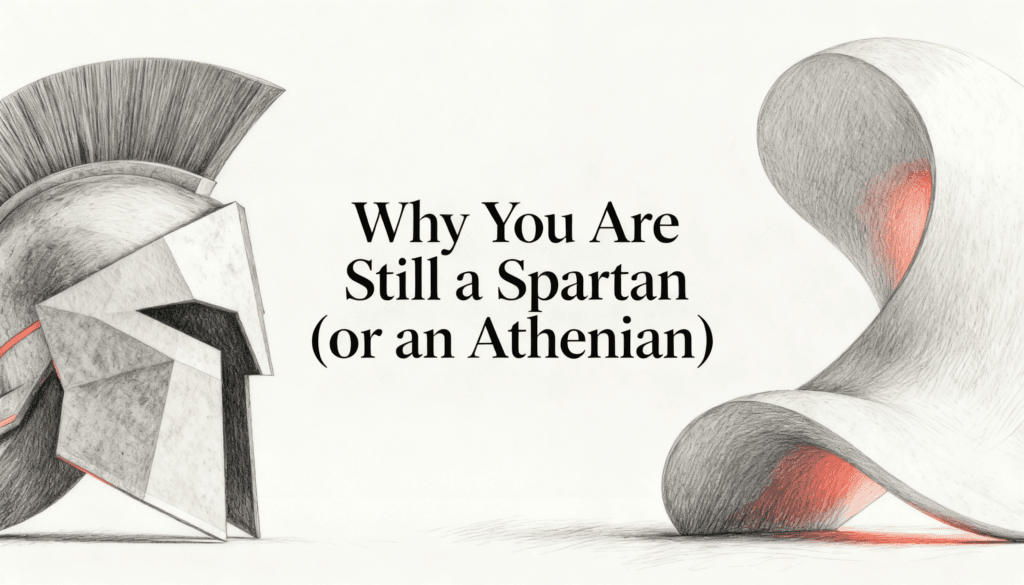
The reason is simple. He identified a fault line in human civilization that has never been repaired. It runs through every society, every boardroom, every dinner table argument about how the world should work. On one side stands the Spartan vision. On the other, the Athenian one. And whether you know it or not, you have already picked a side.
Two Cities, Two Operating Systems
To understand the divide, forget the Hollywood version. Forget the abs. Forget the red capes and the “This is Sparta” theatrics. What Thucydides described was something more subtle and more dangerous: two fundamentally different theories about what holds a society together.
Sparta was a closed system. It valued order, discipline, predictability, and collective identity above all else. Spartans ate the same food. They wore the same clothes. They raised their children through the same brutal training program. Innovation was suspicious. Individualism was a threat. The entire society functioned like a single organism, and every citizen was an organ expected to serve the body. The result was extraordinary military power and almost zero cultural output. Sparta produced no great poets, no philosophers, no architects. It produced soldiers.
Athens was the opposite experiment. It was noisy, chaotic, commercially aggressive, and culturally explosive. Athenians valued individual expression, debate, trade, and novelty. They invented democracy, theater, and philosophy in roughly the same century. They built the Parthenon. They also executed Socrates, lost their empire through arrogance, and spent half their political energy on internal bickering. Athens was a society that believed openness and freedom were the source of strength. It was often right. It was also frequently a mess.
Here is the part that Thucydides understood and that most people still miss. Neither system was purely right. Neither was purely wrong. And the tension between them was not a problem to be solved. It was a permanent feature of human organization.
The Debate That Wears Different Costumes
If you think this is just ancient history, consider the following.
Every major political argument in modern democracies maps onto the Spartan and Athenian divide. Should we have open borders or strict immigration controls? That is Athens versus Sparta. Should we prioritize economic growth through free trade or protect domestic industries? Athens versus Sparta. Should we encourage cultural diversity or insist on a unified national identity? Same argument. Different century.
The Cold War was, in many ways, a replay of the Peloponnesian War at industrial scale. The Soviet Union was Sparta: centralized, militarized, ideologically rigid, suspicious of outside influence. The United States was Athens: commercially expansive, culturally influential, politically messy, and convinced that its model of openness was superior to everyone else’s. The parallels are so striking that American strategists during the Cold War literally cited Thucydides in their policy memos.
But here is where it gets interesting. The roles are not fixed. Countries can switch sides. The United States, which played Athens for most of the twentieth century, has increasingly shown Spartan impulses: suspicion of outsiders, nostalgia for a lost golden age, preference for strength over diplomacy. China, once the most closed major civilization on earth, spent the last four decades playing the Athenian game of trade, openness, and global engagement, only to swing back toward Spartan control under tighter political authority.
Thucydides would not have been surprised by any of this. He saw the same oscillation in his own time.
The Trap Inside the Trap
You have probably heard of the “Thucydides Trap.” It is the idea, popularized by Harvard political scientist Graham Allison, that when a rising power threatens a ruling power, war becomes almost inevitable. The concept comes from one of the most famous lines in the History: “It was the rise of Athens and the fear that this inspired in Sparta that made war inevitable.”
The phrase has become a cliche in foreign policy circles, usually applied to the United States and China. But the real insight is deeper than the headline version suggests.
Thucydides was not saying that rising powers and established powers always fight. He was saying something more uncomfortable. He was saying that fear is a worse strategist than ambition. Sparta did not go to war because Athens attacked it. Sparta went to war because Athens was succeeding. The mere existence of a thriving alternative model was intolerable. Sparta could not look at Athenian prosperity and cultural influence and simply say, “Good for them.” It had to interpret that success as a threat.
This is a pattern that shows up far beyond geopolitics. Think about corporate competition. The companies that start wars, price wars, hostile takeovers, aggressive litigation, are usually not responding to direct attacks. They are responding to the anxiety of watching someone else thrive with a different approach. Think about cultural conflicts. The people who are most hostile to alternative lifestyles are rarely the ones being harmed by them. They are the ones unsettled by the mere existence of a different way of living.
Fear of the other model. That is the Thucydides Trap. And it operates at every level of human interaction, from superpowers down to neighbors.
You, Personally, on the Spectrum
Now bring it closer to home.
Are you a Spartan or an Athenian? Before you answer, recognize that neither label is an insult. Both represent real values that real people hold for real reasons.
If you instinctively believe that discipline creates freedom, that too many choices lead to paralysis, that a society needs shared values and clear rules to function, that security must come before self expression, you lean Spartan. You probably value loyalty, consistency, and sacrifice. You may distrust rapid change. You think that not every tradition is oppressive and that some boundaries exist for good reason.
If you instinctively believe that freedom creates its own discipline, that diversity is a source of strength, that rules should be questioned regularly, that creativity and commerce are the engines of progress, you lean Athenian. You probably value innovation, tolerance, and individual rights. You may distrust authority. You think that not every disruption is dangerous and that some institutions deserve to be challenged.
Most people, if they are honest, carry both impulses. You might be Athenian in your professional life, embracing risk and novelty, but Spartan at home, craving routine and structure. You might be Spartan about national security but Athenian about education. The divide does not run neatly between people. It runs through them.
This is what makes the framework so useful. It is not a personality quiz. It is a diagnostic tool. When you find yourself in a disagreement, whether political, professional, or personal, ask yourself: is this actually a Spartan versus Athenian argument? Surprisingly often, it is. And recognizing that can transform a screaming match into a genuine conversation about trade offs.
The Part Nobody Likes
Here is the counter intuitive truth that Thucydides forces us to confront. Both models, taken to their logical extreme, destroy themselves.
Sparta won the Peloponnesian War. It crushed Athens. And then, within a few decades, Sparta collapsed. Its rigid system could not adapt. It had no cultural influence to project. It had no economic engine to sustain itself. It won the war and lost the peace. The very qualities that made it militarily dominant, inflexibility, conformity, suspicion of change, turned out to be fatal weaknesses once the enemy was gone.
Athens lost the war. But Athenian culture conquered the world. Greek philosophy, drama, art, and political thought spread across the Mediterranean and eventually formed the intellectual foundation of Western civilization. Athens the city state was defeated. Athens the idea was unstoppable. Yet Athens also carried the seeds of its own failure. Its radical openness made it vulnerable to demagogues. Its love of debate sometimes paralyzed decision making. Its confidence in its own superiority led it into catastrophic foreign adventures, most notably the disastrous invasion of Sicily, which reads like a case study in imperial overreach that could have been written yesterday.
The lesson is not that one model is better. The lesson is that every strength, left unchecked, becomes a weakness. Discipline becomes rigidity. Openness becomes chaos. Security becomes paranoia. Freedom becomes recklessness.
The Speech That Explains Everything
There is a moment in the History that captures the entire Athens versus Sparta dynamic in a single scene. It is the Funeral Oration of Pericles.
Pericles, the leader of Athens, stands before the city to honor its war dead. What he delivers is not a eulogy. It is a manifesto. He describes Athens as a place where people are free to live as they choose, where merit matters more than birth, where the city is open to the world, and where this openness is not a vulnerability but the very source of Athenian power.
It is one of the great speeches in human history. It is also, in retrospect, deeply tragic. Because Thucydides places it at the exact moment before everything goes wrong. The plague hits Athens. Pericles himself dies. The democracy descends into faction and demagoguery. The values Pericles celebrates become the values that Athens fails to live up to.
Thucydides was not mocking Pericles. He was doing something more devastating. He was showing that the vision was real, beautiful, and insufficient. That a society can articulate its highest ideals with perfect clarity and still be destroyed by its lowest impulses. That knowing who you are is not the same as being able to sustain who you are.
If that does not sound like a modern problem, you have not been paying attention.
So What Do You Do With This?
You cannot escape the Spartan and Athenian divide. It is built into the structure of collective life. Every family negotiates it. Every company. Every country. The question is not how to resolve it. It is how to manage it without letting either side win completely.
The Spartans among us need to remember that the wall they build to keep danger out also keeps growth from coming in. The Athenians among us need to remember that the door they open to opportunity also opens to threat.
Thucydides did not write his history to tell you which side to choose. He wrote it to show you that the choice itself is permanent. That every generation will face it again. That the specific issues will change but the underlying tension will not.
He called it a possession for all time. He was, annoyingly, correct.
The war between Athens and Sparta ended in 404 BC. The war between the Athenian impulse and the Spartan impulse has not ended. It is happening right now, in your country, your workplace, your head. The only real question is whether you are aware of which side you are arguing from, and whether you have the honesty to admit that the other side might have a point.
That is the gift Thucydides left us. Not answers. Awareness. And in a world full of people who are certain they are right, awareness might be the most dangerous weapon of all.