Table of Contents
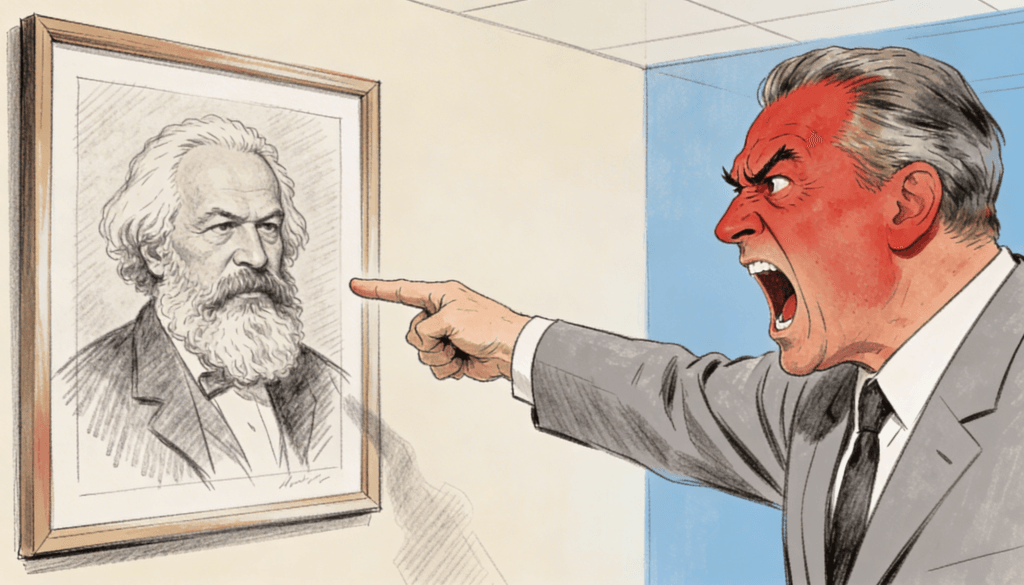
Your boss has probably never read a single page of Das Kapital. They might not even know the difference between Marx and Engels. But they hate Karl Marx. Not the person, necessarily. They hate what he represents. They hate the questions he asked, because those questions have a nasty habit of making the answers uncomfortable.
This article is not about converting you to Marxism. It is about understanding why certain ideas make certain people deeply uneasy, and what that unease reveals about the way work, value, and power actually operate in the modern world.
The Uncomfortable Question Karl Marx Kept Asking
Marx’s central obsession was deceptively simple. He wanted to know: where does profit come from?
Not revenue. Not sales. Profit. The money left over after you pay for materials, rent, electricity, and wages. Where does that surplus come from?
His answer was provocative then and it remains provocative now. He argued that profit comes from the gap between what workers produce and what workers are paid. A software engineer generates $400,000 in value for a company but takes home $120,000. A warehouse worker processes $50 worth of packages per hour but earns $17. The difference, Marx said, is extracted. It does not appear out of thin air. It is taken from the labor of real people.
Your boss hates this framing. Not because it is necessarily wrong in every case, but because it reframes something they consider natural and earned (their profit, their bonus, their company’s growth) as something that depends on paying people less than they are worth.
That is an awkward dinner party conversation.
Why This Makes More Sense Than You Think
Here is where it gets interesting. You do not need to be a socialist to notice that Marx’s observation maps onto the lived experience of most workers. Almost everyone has had the feeling that they produce more than they receive. This is not paranoia. It is arithmetic.
Consider consulting firms. A junior consultant bills out at $300 an hour. Their salary, when you break it down, amounts to roughly $60 an hour. The remaining $240 covers overhead, partner profits, and the general upkeep of expensive office space designed to impress other companies into paying $300 an hour. The consultant does the work. The firm captures the difference. Marx had a word for this. He called it surplus value.
Now, the standard rebuttal goes something like this: “But the firm provides the brand, the clients, the infrastructure. Without the firm, the consultant has nothing to sell.” This is fair. Marx himself acknowledged that capital (machines, tools, organizational structures) plays a role in production. But he argued that capital alone produces nothing. It sits there. It is dead labor, past work crystallized into equipment and systems. Only living labor, actual people doing actual things, activates it and creates new value.
Your boss prefers the version of the story where the company itself is the hero. Marx preferred the version where the workers are.
The Psychology of Ownership
There is a psychological dimension here that Marx only touched on but that modern research has explored extensively.
Behavioral economists have documented something called the endowment effect. People value things more simply because they own them. A coffee mug you own feels worth $7. The same mug on a shelf feels worth $3. Ownership distorts perception.
Now apply this to a business. The moment someone becomes an owner or a manager, the entire enterprise starts to feel like an extension of themselves. The profits feel earned. The growth feels personal. The workers start to look like inputs rather than collaborators. This is not malice. It is a cognitive bias baked into the psychology of possession.
Marx noticed this without having the language of behavioral economics. He saw that the owning class genuinely believed they deserved what they captured, not because they were lying, but because the structure of ownership itself warps how people see contribution. The factory owner watches the factory run and thinks, “I built this.” The workers watch the factory run and think, “We run this.” Both are telling the truth. Both are also leaving something out.
Your boss does not hate Marx because Marx was wrong. Your boss hates Marx because Marx suggested that the boss’s self perception might be incomplete.
The Game Theory of Wages
Let’s step into another intellectual lens for a moment. Game theory.
In any negotiation, the outcome depends on each party’s alternatives. Economists call this BATNA: Best Alternative to a Negotiated Agreement. If you are negotiating a salary and your alternative is homelessness, you will accept almost anything. If your alternative is three other offers from competing firms, you have leverage.
Marx observed that the labor market is structurally tilted. There are usually more workers than jobs. This means employers almost always have better alternatives than employees do. They can replace you. You cannot as easily replace them. This asymmetry is not a bug in the system. It is the system.
Your boss does not frame this as power. They frame it as the market rate. Marx would argue these are the same thing wearing different outfits.
The Religion of Productivity
Here is where Marx connects to something you encounter every single workday.
Modern management culture is obsessed with productivity. There are entire industries built around measuring it, optimizing it, and squeezing more of it from each hour. You have probably sat through meetings about KPIs, OKRs, efficiency metrics, and performance dashboards. These are not neutral tools. They are instruments designed to answer a very specific question: how do we get more output from the same (or fewer) inputs?
Marx would recognize this immediately. He called it the intensification of labor. The goal is always the same: widen the gap between what a worker produces and what a worker costs. Every productivity initiative, every automation tool, every “do more with less” directive is, in Marxist terms, an attempt to increase surplus value extraction.
This does not mean productivity improvements are inherently bad. Many of them make work genuinely better. But the question Marx forces you to ask is: who benefits? When a new tool makes you twice as productive, does your salary double? Almost never. The gains flow upward. Your output increases. Your compensation stays roughly the same. The difference is captured by someone else.
Your boss calls this efficiency. Marx called it exploitation. The word sounds dramatic until you look at the numbers.
The Counter Argument That Actually Has Teeth
Fairness demands we examine the strongest case against Marx’s analysis. And the strongest case is not the one most people make.
The usual objection is that Marx ignored innovation and entrepreneurial risk. Business owners risk capital, take on debt, and face the possibility of total failure. Workers, by contrast, receive a guaranteed wage regardless of whether the company succeeds. This risk premium, the argument goes, justifies the unequal distribution of returns.
This is a reasonable point. But it has a shelf life. The risk argument works well for a small business owner who mortgaged their house to open a restaurant. It works less well for a publicly traded corporation where shareholders bear limited liability and executives receive compensation packages designed to eliminate personal downside. When a CEO gets a $20 million golden parachute after driving a company into the ground, the “risk justifies reward” argument starts to wobble.
The stronger objection to Marx is about coordination. Someone has to decide what to produce, how to produce it, and how to distribute the result. This is genuinely difficult work, and markets, for all their flaws, perform this function with remarkable efficiency in many contexts. Marx underestimated how hard this problem is. Central planning, as the 20th century demonstrated, is not a simple alternative.
But notice what this objection means. It says the current system is better at coordination, not that it is fair. It says markets are efficient, not that they are just. Marx’s critique of distribution remains standing even if his proposed solutions fell short.
The Status Quo Has Its Own Ideology
One of Marx’s most enduring contributions was not economic but philosophical. He argued that every economic system produces ideas that justify itself. Feudalism produced the divine right of kings. Capitalism produces meritocracy.
Meritocracy is the belief that outcomes reflect effort and ability. If you are rich, you earned it. If you are poor, you did not try hard enough. This belief is enormously useful to anyone who benefits from the current arrangement because it transforms structural advantage into personal virtue.
Research in sociology and psychology has repeatedly shown that people who succeed tend to attribute their success to internal factors (hard work, talent, intelligence) while downplaying external ones (family wealth, social connections, timing, luck). This is not dishonesty. It is a well documented cognitive pattern called the fundamental attribution error.
Marx saw this clearly. He argued that the dominant ideas in any society are the ideas of the dominant class. Not because there is a conspiracy, but because the people with the most resources also have the most influence over education, media, and public discourse. The ideas that serve their interests naturally rise to the top.
Your boss does not think of their worldview as ideology. They think of it as common sense. Marx’s point was that “common sense” is always someone’s ideology in disguise.
The Gig Economy: Marx’s Nightmare Made Real
If Marx were alive today, the gig economy would confirm his darkest predictions.
Gig platforms have achieved something remarkable. They have shifted virtually all risk onto workers while retaining almost all control. A rideshare driver owns the car, pays for gas, handles maintenance, and bears the cost of downtime. The platform sets the prices, controls access to customers, and takes a cut of every transaction. The driver is technically independent. In practice, the driver is a worker with none of the protections that workers historically fought for.
This is what Marx called the formal subsumption of labor. Capital does not need to own the tools anymore. It just needs to control the terms. The factory gates have been replaced by app interfaces, but the relationship between the person who works and the person who profits has not fundamentally changed. It has, if anything, become more asymmetric.
The gig economy is a useful test case because it strips away the comforting narratives. There is no company cafeteria, no team building retreat, no illusion of family. It is the employment relationship reduced to its bare transactional minimum. And what you find at that minimum looks remarkably like what Marx described 150 years ago.
Why Your Boss Should Actually Read Marx
Here is the irony. Marx is arguably more useful to bosses than to workers.
Understanding Marx’s critique gives you a clearer picture of the tensions that actually exist inside any organization. Why do employees quietly resent certain policies? Why do unionization efforts gain traction? Why does turnover spike when profits are high but wages are flat? Marx provides a framework for understanding these dynamics that “engagement surveys” and “culture initiatives” never will.
The most effective leaders throughout history have been the ones who understood the forces working against them. Ignoring Marx does not make the tensions he identified go away. It just means you will be surprised when those tensions surface.
There is a reason why some business schools are incorporating Marx into their curricula. Not to advocate for revolution, but to produce managers who understand the structural pressures that shape worker behavior. You do not have to agree with Marx to learn from him. You just have to be willing to sit with ideas that are uncomfortable.
The Bottom Line
Your boss hates Karl Marx because Marx asked a question that has no comfortable answer: is the way we divide the rewards of work actually fair?
Not efficient. Not productive. Not legally permissible. Fair.
Every justification for the current arrangement (risk, coordination, market forces, meritocracy) answers a different question. They explain why the system works or why it persists. They do not address whether the people who do the work receive a just share of what they create.
Marx did not have all the answers. His solutions were often worse than the problems he identified. The 20th century experiments conducted in his name were frequently catastrophic. But his questions remain sharp, relevant, and deeply inconvenient for anyone who benefits from not asking them.
Your boss hates Karl Marx. And now you know why.