Table of Contents
There is a peculiar cruelty in the way we treat people who succeed without our permission.
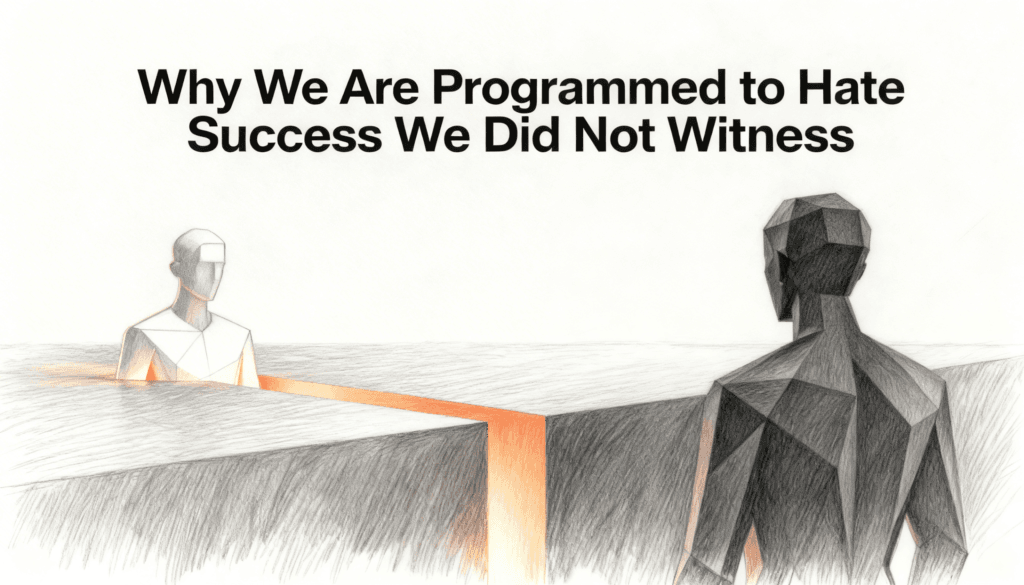
Not without our help. Without our permission. Because somewhere deep in the architecture of human psychology, we have appointed ourselves the gatekeepers of who deserves what. And the fastest way to fail that invisible audit is to show up already successful, with no origin story we personally watched unfold.
Dan Ariely, the behavioral economist who has spent decades cataloging the creative ways humans deceive themselves, touches on something uncomfortable here. We do not just prefer people who struggle. We require it. And when we miss the struggle, we assume it never happened.
This is not a minor quirk. It is a load bearing wall in the structure of how we judge, admire, and resent one another.
The Effort We Need to See
Consider two chefs. One you have watched for years, fumbling through kitchen disasters, burning sauces, nearly quitting, and finally opening a restaurant that earns a Michelin star. The other you discover on Instagram next Tuesday, already starred, already celebrated, already booked out for six months.
You will feel warmth toward the first chef and suspicion toward the second. Not because the second chef did not struggle. You have no idea what the second chef went through. That is precisely the problem. The absence of evidence becomes, in your mind, evidence of absence.
Ariely’s research into effort heuristics reveals something foundational about human evaluation. We do not assess outcomes on their own terms. We assess them through the lens of visible labor. When we see someone sweat, fail, and persist, we assign value not just to their achievement but to them as a person. When we skip that chapter, the achievement floats in midair, unanchored, and our brain does not trust things that float.
This is not laziness of thought. It is an ancient calibration tool. For most of human history, the only way to evaluate someone’s competence was to watch them work. You could not Google a hunter’s success rate. You watched him miss, adjust, and eventually bring something home. The process was the proof. We are still running that software in a world where people can appear fully formed in our awareness overnight, thanks to algorithms and airplane Wi-Fi.
The IKEA Effect, Scaled Up to People
Ariely is perhaps best known for documenting the IKEA effect: the cognitive bias where we overvalue things we helped create. Build a wobbly bookshelf with your own hands, and you will treasure it more than a flawless one delivered to your door. The labor is not incidental to the value. The labor is the value.
Now stretch that principle beyond furniture.
When you witness someone’s journey from the beginning, you are participating in it. Not materially, but psychologically. You were there. You saw the early drafts, the rejected pitches, the years of irrelevance. Their success becomes partially yours, not in an entitled way, but in a narrative way. You are a character in the story, even if your role was simply audience member.
When someone succeeds and you were not there for any of it, you have no stake. No psychological ownership. And a success you have no stake in is not just neutral. It is mildly threatening. Because it implies a world that operates without your awareness, producing winners you did not vet. That is an unsettling idea for a species that likes to believe it understands what is happening.
Why We Invent Explanations We Cannot Verify
Here is where things get genuinely interesting. When confronted with success we did not witness, we do not simply shrug and move on. We build theories. And the theories almost always trend negative.
They must have had connections. Family money. Luck. Some shortcut we would never take because we have integrity, unlike these people who apparently materialized at the top of the mountain via helicopter.
Attribution theory in psychology describes how we explain other people’s outcomes. When we like someone or feel connected to their journey, we attribute their success to internal qualities: talent, grit, intelligence. When we feel no such connection, we reach for external explanations: privilege, timing, the system. The same achievement gets filed under “inspiring” or “suspicious” depending almost entirely on whether we were around to see it happen.
This is not conscious dishonesty. It is the brain doing what it always does, which is constructing a story that protects the ego. Because if someone achieved something remarkable through pure talent and effort, and you had no idea they even existed until last week, then the world is bigger and more competitive than you thought. And that realization is not fun.
So instead of sitting with that discomfort, you build a little courtroom in your head, put the successful stranger on trial, and convict them of having it easy. Case closed. Ego intact.
The Proximity Bias Nobody Talks About
There is a version of this that plays out in every workplace, every industry, every creative field. Call it proximity bias. We trust and celebrate the success of people who are close to us, geographically, socially, professionally, and we distrust the success of people who are far away.
This is why a colleague’s promotion might genuinely make you happy while a stranger’s identical promotion, posted on LinkedIn with a gratitude filled caption, makes you want to close your laptop and stare at a wall. The achievement is the same. The distance is different.
Ariely’s work on social comparison suggests that this is not about jealousy in the simple, green eyed sense. It is about information asymmetry. With your colleague, you have context. You saw them stay late, handle difficult clients, navigate office politics with something resembling grace. You have data. With the LinkedIn stranger, you have a polished announcement and a professional headshot. You have a conclusion with no premises.
And the human brain hates conclusions without premises. It fills in the blanks, and it fills them in with whatever makes the world feel fair and comprehensible. Which usually means: that person did not earn it.
The Fairness Obsession
This connects to something larger and arguably more important than any single bias. Humans are obsessed with fairness. Not actual fairness. Perceived fairness. And those two things are so far apart they might as well be different concepts.
Ariely’s experiments on fairness perception show that people will reject objectively good deals if they believe the process was unfair. In one famous setup, participants in an ultimatum game turned down free money rather than accept a split they considered unjust. They would rather have nothing than feel cheated.
Now apply that wiring to how we process other people’s success. When you witness the full arc of someone’s effort, the outcome feels fair. They put in the work, they got the reward, the universe makes sense. When you only see the reward, the fairness circuit short circuits. Not because the outcome is unfair. But because you lack the information to confirm that it is fair. And in the absence of that confirmation, the default setting is suspicion.
This is, if you think about it, an enormous design flaw. We are walking around with a justice system in our heads that convicts people based on missing evidence. Not contradictory evidence. Missing evidence. The file is incomplete, so the verdict is guilty.
The Social Media Accelerant
It would be incomplete to discuss this phenomenon without acknowledging the machine that has supercharged it beyond anything Ariely could have studied in a lab twenty years ago.
Social media is an engine for presenting conclusions without context. Every platform is optimized to show you the highlight, the announcement, the result. Nobody’s algorithm is designed to show you the fourteen months of silence before the breakthrough. You see the book deal, not the 200 rejections. The startup acquisition, not the three failed companies before it. The transformation photo, not the two years of quiet discipline that made it possible.
The result is a world where we are constantly confronted with successes we did not witness, at a volume and speed that our psychology was never built to handle. And each one triggers the same ancient subroutine: I did not see the work, so the work probably did not happen, so this person probably does not deserve this, so I am justified in feeling resentful or dismissive.
It is an extraordinary feedback loop. The platforms show us decontextualized success. Our brains fill the context gap with suspicion. The suspicion fuels engagement, because outrage and skepticism drive more clicks than admiration. The platforms notice the engagement and show us more decontextualized success. Repeat until everyone is both performing their achievements and resenting everyone else’s.
The Counter Intuitive Escape Hatch
Here is where this gets useful instead of merely depressing.
If you understand this bias, you can do something rare. You can catch yourself in the act. The next time you feel that flicker of irritation at someone’s success, you can pause and ask a genuinely clarifying question: am I reacting to what this person did, or am I reacting to the fact that I was not there to see them do it?
Nine times out of ten, it is the second thing. And the second thing is not about them at all. It is about you and the story you need the world to tell.
Ariely’s broader work suggests that awareness of bias does not eliminate it, but it does weaken its grip. You will still feel the pull. You will still want to explain away the success of strangers. But you will know why you want to, and that knowledge creates a small but meaningful gap between impulse and action.
There is also a practical dimension for anyone who creates, builds, or works toward something. If people are wired to distrust success they did not witness, then one of the most strategically valuable things you can do is let them witness it. Not in a performative, look at my struggle kind of way. But by being transparent about the process. Sharing the early versions. Talking about what did not work. Giving people the narrative scaffolding they need to file your eventual success under “earned” instead of “suspicious.”
This is, in a roundabout way, what every compelling origin story does. It does not just provide information. It provides the emotional infrastructure for people to feel good about your outcome.
What This Says About Us
The deeper reading here is not flattering, but it is worth sitting with.
We like to believe that we evaluate people based on merit. That we are rational judges of talent and achievement. That our admiration goes to those who deserve it and our skepticism goes to those who do not.
But Ariely’s work, and the work of dozens of researchers in behavioral economics and social psychology, tells a different story. We evaluate people based on narrative. Specifically, on whether we have access to a narrative that satisfies our need for fairness, effort, and comprehensibility. When we have that narrative, we are generous. When we do not, we are ruthless.
The person who succeeded without your knowledge is the same person who succeeded with it. Their talent did not change. Their effort did not change. The only thing that changed is your vantage point.
And yet that vantage point changes everything about how you feel, what you assume, and how you talk about them to others.
This is the bias Ariely points us toward. Not because it can be fixed with a five step framework or a morning journaling practice. But because seeing it clearly is the first step toward not being governed by it. The world is full of people who earned what they have in rooms you never entered, during years you were not paying attention, through struggles you will never hear about.
The generous move is to assume the work happened.
The honest move is to admit you will probably have to remind yourself of that every single time.