Table of Contents
Carl von Clausewitz died in 1831. He never saw a smartphone, never doom scrolled through Twitter, and never watched a TikTok video of someone explaining geopolitics over a makeup tutorial. Yet his most famous strategic concept, the “center of gravity,” describes the modern social media landscape with an accuracy that should make every living strategist a little embarrassed.
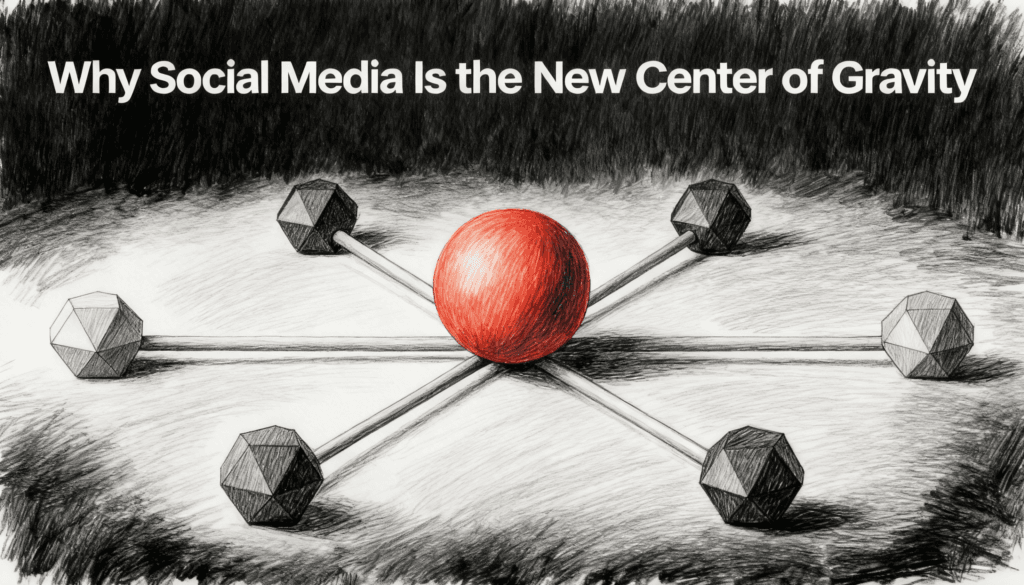
In his treatise On War, Clausewitz argued that every conflict has a center of gravity: the source of power that holds everything together. Destroy it or capture it, and the entire structure collapses. For Napoleon, it was his army. For a nation, it might be its capital or the will of its people. The idea is deceptively simple. Find the thing that matters most. Focus everything on it.
Now look around. What holds together political movements, brand empires, cultural trends, public opinion, and even interpersonal relationships in the 21st century? It is not television. It is not newspapers. It is not even the economy in isolation.
It is social media.
And understanding why requires more than a surface level complaint about kids and their phones.
Power Has an Address Now
Clausewitz was not writing about war for the sake of war. He was writing about power. Where does it concentrate? How does it move? What happens when you lose it? These questions did not retire when muskets became obsolete. They just changed venue.
For most of modern history, the center of gravity in public life was institutional. Governments, corporations, media conglomerates, and religious organizations held the infrastructure of influence. If you wanted to shape opinion, you needed access to a printing press, a broadcast tower, or a pulpit. The barriers to entry were enormous. Power was centralized because the tools of communication were centralized.
Social media demolished that architecture in about fifteen years. Today, a single person with a phone and a wifi connection can reach more people in an afternoon than a 19th century newspaper could reach in a decade. The means of influence have been democratized to a degree that would have stunned Clausewitz, though he probably would have immediately started thinking about how to exploit it.
This is not merely a technological shift. It is a gravitational one. The center of gravity in public discourse, political mobilization, consumer behavior, and cultural production has migrated from institutions to platforms. And platforms are not neutral ground. They are the terrain on which every meaningful contest for attention, loyalty, and belief now takes place.
The Attention Economy Is a Battlefield
Here is where Clausewitz gets uncomfortably relevant. He wrote extensively about what he called the “fog of war,” the confusion and uncertainty that pervades every conflict. Social media has created its own fog, one made of misinformation, algorithmic distortion, outrage cycles, and the sheer overwhelming volume of content. Nobody fully understands the battlefield. Not the users, not the platforms, and certainly not the regulators who are still trying to figure out what a meme is.
In classical strategy, controlling the center of gravity means controlling the outcome. Whoever dominates social media, not just in terms of followers but in terms of narrative, sets the terms of reality for millions of people. This is not an exaggeration.
Consider how protest movements operate now. The Arab Spring did not begin in a parliament. It began on Facebook. The GameStop stock surge of 2021 did not originate on Wall Street. It originated on Reddit. The cultural reckoning of the MeToo movement did not start with a lawsuit. It started with a hashtag. In each case, the center of gravity was the platform itself: the place where collective will formed, organized, and then erupted into the physical world.
Clausewitz would have recognized this pattern instantly. The concentration of force at a decisive point. The only difference is that the decisive point is now a digital space measured in engagement metrics rather than hilltops.
Why Institutions Keep Losing
Governments spend billions on public communications. Legacy media employs thousands of professional journalists. Fortune 500 companies hire enormous marketing departments. And yet a 22 year old with a ring light and a sharp sense of timing can outperform all of them in shaping public conversation.
This is not because institutions are stupid. It is because they are optimized for a gravitational field that no longer exists. They are fighting the last war, to use another Clausewitzian concept. Their playbooks were written for a world where controlling the message meant controlling the channel. But when everyone has a channel, controlling the message requires something entirely different. It requires authenticity, speed, emotional resonance, and a willingness to operate in chaos. These are not qualities that large bureaucracies tend to cultivate.
There is an almost Darwinian logic at work here. Social media selects for adaptability, not size. The organisms that thrive are the ones that can mutate fast enough to match the environment. Institutions, by their nature, are built for stability. This makes them powerful in static environments and nearly helpless in dynamic ones. The irony is thick: the most powerful organizations in human history are being outmaneuvered by individuals armed with nothing more than a smartphone and an opinion.
The Clausewitzian Trinity, Remixed
Clausewitz described a “remarkable trinity” that governs war: passion (the people), chance (the military), and reason (the government). Each force interacts with the others, and the balance between them determines the character of any conflict.
Social media has its own trinity. The people are still the people, millions of users whose collective emotions drive trends, cancel campaigns, and viral moments. Chance is the algorithm, an opaque and constantly shifting force that determines what gets seen and what disappears into the void. Reason, in theory, belongs to the platform companies, the governments that regulate them, and the strategists who try to use them deliberately.
But here is the problem. In Clausewitz’s model, all three forces are roughly legible. A general can study the mood of the population, assess the capabilities of an army, and understand the political objectives of the government. On social media, the algorithm, the equivalent of chance, is a black box. Nobody outside the company fully understands how it works. Sometimes nobody inside the company fully understands how it works. This means the center of gravity is being shaped by a force that is fundamentally opaque to everyone trying to influence it.
This is strategically unprecedented. Imagine fighting a war where the weather was controlled by a private corporation that changed the rules every Tuesday and refused to explain why. That is roughly what operating on social media feels like for anyone trying to use it strategically.
Soft Power Gets Hard
International relations theorists have long distinguished between hard power (military force, economic coercion) and soft power (cultural influence, ideological appeal). Joseph Nye coined the term in 1990, and for three decades it served as a useful framework. Social media has made the distinction almost meaningless.
When a government can use a social platform to run an influence operation that destabilizes another country’s election, is that soft power or hard power? When a consumer boycott organized on Twitter costs a corporation billions in market value within a week, where does cultural influence end and economic coercion begin? The boundaries have dissolved because social media is the space where all forms of power now converge.
This convergence is exactly what makes social media a center of gravity in the Clausewitzian sense. It is not just important for one domain. It is the hub through which political, economic, cultural, and military power all flow. Disrupt someone’s social media presence, and you disrupt their ability to project power in every dimension simultaneously. This is why deplatforming is treated as an existential threat by those who experience it. It is not about losing a profile. It is about losing access to the center of gravity itself.
The Paradox of Decentralization
There is a genuinely strange paradox at the heart of all this. Social media was supposed to decentralize power. It was supposed to take influence away from gatekeepers and distribute it to the masses. In some ways, it has done exactly that. But in doing so, it created new concentrations of power that are arguably more intense than the ones it replaced.
A handful of platforms, owned by a handful of companies, controlled by a handful of individuals, now mediate the information environment for billions of people. The center of gravity has not been eliminated. It has been relocated. And its new landlords are not elected officials or public institutions. They are private companies whose primary obligation is to their shareholders, not to the public interest.
Clausewitz understood that centers of gravity are not static. They shift as conditions change. The center of gravity in a conflict might move from an army to a capital city to the morale of a population as the war evolves. Social media is going through its own version of this evolution. The platforms themselves are the current center of gravity, but within those platforms, the real power often resides with the algorithms, the recommendation systems that decide what billions of people see every day.
This means the true center of gravity might not be the platform or the users. It might be the code. A few thousand lines of software, written by a relatively small team of engineers, exerting more influence over public discourse than any king, president, or general in history. Clausewitz might have found this fascinating. He also might have found it terrifying.
What This Means for Everyone
If social media is the center of gravity, then everyone who operates in public life, whether they are a politician, a business owner, an activist, or just a person trying to understand the world, needs to treat it that way. This does not mean everyone needs to become an influencer. It means everyone needs to understand that the rules of engagement have changed.
For businesses, it means that brand reputation is no longer managed through press releases and customer service departments. It is managed in real time, in public, on platforms where a single viral complaint can do more damage than a year of negative press coverage. For politicians, it means that elections are won and lost not in town halls but in comment sections. For individuals, it means that the information environment they navigate every day is not a neutral space. It is a contested zone where multiple actors are competing for their attention, their belief, and their behavior.
The strategic imperative is clear. You do not have to like social media. You do not have to think it is good for society. But you cannot afford to ignore it, because ignoring the center of gravity is, in Clausewitz’s framework, the fastest way to lose.
The Ghost of Clausewitz Scrolls Through His Feed
There is something almost comical about applying a 19th century military theorist to Instagram and TikTok. But the reason it works is that Clausewitz was never really writing about muskets and cavalry charges. He was writing about the nature of power itself: how it concentrates, how it moves, how it can be seized, and how it can be lost.
Social media is where power concentrates today. It is where movements are born and where reputations die. It is where wars of narrative are fought and where the fog of information is thickest. It is, in every meaningful strategic sense, the center of gravity of modern life.
Clausewitz warned that failing to identify the center of gravity leads to wasted effort, scattered focus, and ultimate defeat. Two centuries later, the warning still holds. The only thing that has changed is the address.
It used to be a fortress on a hill. Now it is an app on your phone.
And somehow, the stakes are even higher.