Table of Contents
You probably grew up believing science works like a town hall meeting. Someone proposes an idea, everyone debates it fairly, the best evidence wins, and humanity marches forward. It is a beautiful story. It is also, according to Thomas Kuhn, almost entirely wrong.
In 1962, Kuhn published The Structure of Scientific Revolutions, a book that did to the philosophy of science what a brick does to a window. Before Kuhn, most people assumed science progressed in a straight line. Each generation of scientists built on the last, adding bricks to an ever growing temple of knowledge. Kuhn looked at the actual history and saw something far stranger. He saw a pattern that looked less like rational progress and more like a series of religious conversions.
And that is where things get uncomfortable.
The Paradigm Is the Party Line
Kuhn introduced a word that has since been beaten to death by corporate consultants and TED speakers: paradigm. But before it became a buzzword, it meant something specific and dangerous. A paradigm is the set of assumptions, methods, and beliefs that an entire scientific community shares at any given time. It is not just a theory. It is the lens through which scientists see reality itself.
Here is the part nobody talks about at graduation ceremonies. Once a paradigm takes hold, it does not survive because scientists keep testing it and finding it correct. It survives because the community agrees to stop questioning it. Scientists working within a paradigm are not exploring the unknown. They are solving puzzles whose answers are already assumed to exist. Kuhn called this “normal science,” and it makes up most of all scientific activity.
Think about that for a moment. The vast majority of science is not about discovery. It is about confirmation. Scientists spend their careers filling in the details of a picture someone else already drew. The frame is fixed. The colors are chosen. Your job is to paint inside the lines.
If that sounds like an intellectually free democracy to you, I have a bridge to sell you.
The Initiation Ritual
Every cult has an initiation process, and science is no exception. It just calls it “graduate school.”
Kuhn pointed out that scientific education is unlike education in almost any other field. In the humanities, students read primary sources, debate interpretations, and learn that reasonable people can disagree. In science, students are handed textbooks that present the current paradigm as settled truth. They do not read Newton’s original papers. They do not study the messy debates, the wrong turns, the political maneuvering that shaped the field. They get the clean, edited, after the fact version.
This is not an accident. It is a feature of the system. Textbooks are designed to make the current paradigm look inevitable, as if the history of science was always pointing toward exactly this conclusion. The struggles, the competing theories, the personalities and power dynamics all get scrubbed away. What remains is a mythology dressed up as a timeline.
By the time a young scientist finishes this process, they have internalized the paradigm so deeply that questioning it feels not just wrong but unthinkable. They have learned not only what to believe but how to think. They have learned which questions are worth asking, which methods are legitimate, and which results count as evidence. They have been, in Kuhn’s polite academic language, “socialized” into the community.
A less polite word would be “indoctrinated.”
Heretics Need Not Apply
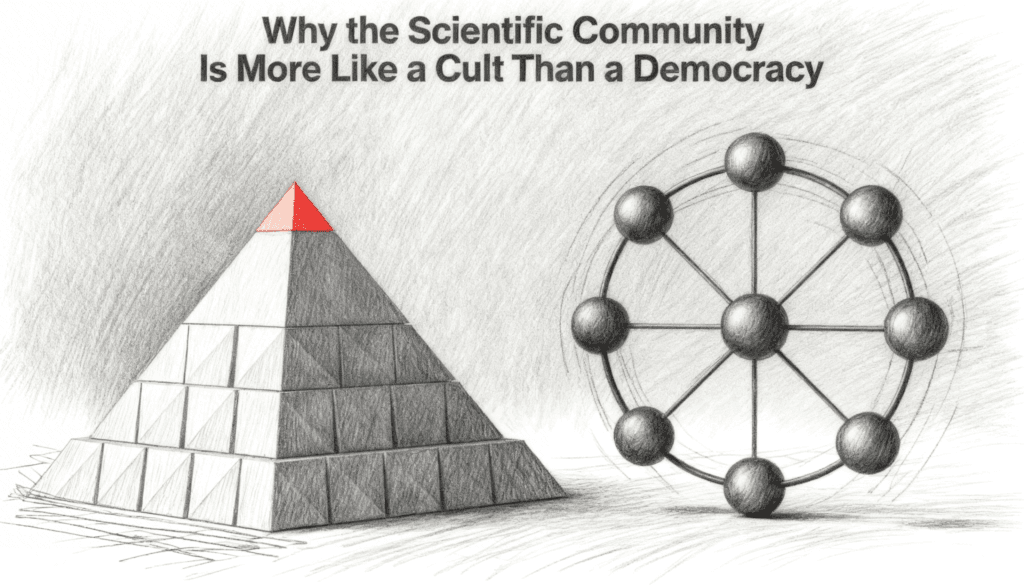
So what happens when someone does question the paradigm? In a democracy, dissent is protected. In a cult, dissent is punished. Kuhn’s history of science suggests that the scientific community often leans closer to the second option.
When anomalies appear, when experiments produce results that do not fit the paradigm, the first response is almost never to question the paradigm. Instead, scientists question the experiment. The instruments must be wrong. The methodology was flawed. The researcher made an error. There is an entire arsenal of reasons to dismiss inconvenient data, and the community deploys them with remarkable efficiency.
This is not because scientists are dishonest. Most of them genuinely believe they are being objective. That is what makes it so effective. The paradigm shapes perception itself. If you believe deeply enough that the earth is the center of the universe, then the strange retrograde motion of planets does not look like evidence against your model. It looks like a puzzle to be solved within it. And for centuries, that is exactly what astronomers did. They invented increasingly baroque mathematical contortions to save a theory that was fundamentally wrong.
Scientists who push too hard against the consensus find themselves marginalized. Their papers get rejected. Their grant applications fail. Their colleagues treat them with the polite condescension reserved for someone who has lost touch with reality. The community does not need to organize a formal inquisition. The social pressure is enough.
Consider Ignaz Semmelweis, the Hungarian physician who in the 1840s proposed that doctors were killing patients by not washing their hands. He had data. He had results. He had dramatically reduced mortality rates in his own ward. The medical establishment responded by mocking him, stripping him of his position, and eventually committing him to an asylum, where he died. His crime was not being wrong. His crime was being right in a way that threatened the paradigm.
The Revolution Will Not Be Peer Reviewed
If normal science is the cult maintaining its doctrine, then what Kuhn called a “scientific revolution” is the moment the cult collapses. And it does not happen the way you would expect.
Revolutions do not start because someone presents overwhelming evidence and everyone nods thoughtfully. They start because the anomalies pile up to the point where the existing paradigm can no longer paper over the cracks. The system enters what Kuhn called a “crisis,” a period of professional insecurity where the old rules stop working but no one has agreed on new ones yet.
During a crisis, something interesting happens. Scientists start doing philosophy. They begin questioning assumptions they had taken for granted for decades. They argue about fundamentals. They get anxious. The neat, orderly world of puzzle solving gives way to something that looks a lot like an existential crisis wearing a lab coat.
Then a new paradigm emerges, usually championed by someone young or someone from outside the mainstream. And here is the part that horrified philosophers when Kuhn first wrote it: the shift from one paradigm to another is not a purely rational process. It cannot be, because the two paradigms are what Kuhn called “incommensurable.” They do not just disagree about answers. They disagree about what counts as a question, what counts as evidence, and what counts as an explanation.
When physics moved from Newtonian mechanics to Einstein’s relativity, it was not simply a matter of adding new information to an existing framework. The entire framework changed. Space, time, mass, energy, all of these words meant something different after Einstein. You cannot stand inside one paradigm and rationally evaluate the other, because the standards of rationality themselves have shifted.
This is why Kuhn compared paradigm shifts to political revolutions and religious conversions. The choice between paradigms is not like choosing between two competing products based on a spec sheet. It is more like choosing between two different ways of seeing the world. And that choice, uncomfortable as it may be to admit, involves aesthetics, intuition, social pressure, and sometimes nothing more than generational turnover.
As Max Planck reportedly said, science advances one funeral at a time.
The Uncomfortable Parallel With Startups
There is a striking resemblance between Kuhn’s description of scientific revolutions and what happens in the business world with disruptive innovation. Clayton Christensen described how established companies fail not because they are incompetent but because they are too good at what they already do. They optimize for the existing game so effectively that they cannot see when the game itself is changing.
This is normal science in a lab coat swapped for a suit. Established players solve puzzles within the accepted framework. They hire people trained in the current paradigm. They build systems that reward incremental improvement and punish radical departure. And then some upstart in a garage, working with fewer resources but fewer assumptions, changes the entire landscape.
The old guard does not adapt. They get replaced. The parallel is almost too neat.
Democracy Requires Something Science Does Not Have
To understand why science cannot function as a democracy, you need to understand what a democracy actually requires. It requires that participants share a common framework for evaluating claims. They need to agree, at minimum, on what counts as evidence and how disputes get resolved. They need a constitution, written or unwritten, that sits above any particular disagreement.
In science, there is no such constitution. Or rather, the paradigm is the constitution, and it gets rewritten every time a revolution occurs. There is no stable ground from which to adjudicate between competing worldviews. During normal science, this does not matter, because everyone agrees on the rules. But during a revolution, the absence of neutral ground becomes painfully obvious.
This is why scientific debates during paradigm shifts get so bitter. The participants are not just disagreeing about facts. They are disagreeing about what a fact is. They are speaking different languages while believing they are speaking the same one. It is not a debate. It is two monologues happening in the same room.
A democracy can survive disagreement because the rules for resolving disagreement are shared. A scientific community during a crisis has no such luxury. The old rules are broken, and the new ones have not been agreed upon yet. What fills the gap is not rational deliberation. It is rhetoric, reputation, institutional power, and time.
The Counterintuitive Defense
Now here is the part that Kuhn himself would want me to include, because he was more subtle than his critics gave him credit for. The cult like structure of normal science is not a bug. It is, in a strange way, a feature.
If every scientist spent their time questioning fundamental assumptions, nothing would ever get done. Progress requires focus, and focus requires boundaries. Normal science, with its rigid paradigms and social enforcement, allows thousands of researchers to coordinate their efforts on problems that can actually be solved. The paradigm acts as a filter, directing attention toward productive questions and away from philosophical rabbit holes.
The system works precisely because it is not democratic. A democracy of ideas would be chaos. Every experiment would require starting from first principles. Every paper would need to justify the existence of gravity before getting to its actual point. The paradigm provides a shared foundation that makes collaborative work possible.
The price of this efficiency is intellectual rigidity. But the alternative, a community of free thinkers with no shared assumptions, would produce not progress but paralysis.
So Where Does That Leave Us?
Kuhn did not write his book to attack science. He wrote it to describe how science actually works, as opposed to how scientists like to think it works. The idealized image of the lone genius following evidence wherever it leads, fearlessly overturning old ideas in the name of truth, is a myth. A useful myth, perhaps, but a myth nonetheless.
The reality is messier and more human. Scientists are social creatures operating within institutions that reward conformity and punish deviation. They see the world through lenses they did not choose and often cannot recognize. They mistake the boundaries of their paradigm for the boundaries of reality. And when those boundaries finally break, the transition is not a calm, rational process but a turbulent, often generational upheaval.
This does not mean science is broken. It means science is human. And understanding the difference between the mythology and the reality is not just an academic exercise. It is essential for anyone who wants to think clearly about how knowledge actually works.
The next time someone tells you to “trust the science,” remember that Kuhn would have asked a different question. Which science? Which paradigm? And who decided that the current one was the last one we would ever need?
Because if history teaches us anything, it is that every generation of scientists believed they were the ones who finally got it right.
Every single one of them was wrong.