Table of Contents
There is a peculiar instinct in politics that surfaces every time an industry starts to die. Someone stands at a podium, voice full of conviction, and promises to save jobs. The crowd cheers. The cameras flash. And nobody stops to ask the uncomfortable question: what if saving those jobs is the very thing that prevents better ones from being born?
Joseph Schumpeter would have asked that question. In fact, he spent much of his intellectual life answering it. The Austrian economist, writing in the early twentieth century, proposed an idea so unsettling that most politicians still pretend it does not exist. He called it creative destruction, and it remains one of the most important and most ignored concepts in economic thought.
The core idea is deceptively simple. Economic progress does not happen by preserving what already exists. It happens by replacing it. New industries rise. Old ones fall. The process is messy, painful, and absolutely essential. When you try to freeze the economy in place to protect existing jobs, you do not save the economy. You suffocate it.
Schumpeter and the Gale That Never Stops Blowing
Schumpeter was not a cold man cheering for unemployment from an ivory tower. He was a realist who understood something most people would rather not face: economies are living systems, not museums. They grow by changing, not by staying the same.
In his landmark work, Capitalism, Socialism and Democracy, published in 1942, Schumpeter described capitalism as a process of industrial mutation that “incessantly revolutionizes the economic structure from within, incessantly destroying the old one, incessantly creating a new one.” He was not celebrating destruction for its own sake. He was pointing out that destruction and creation are two sides of the same coin. You cannot have one without the other.
Think about what the world looked like before this process was allowed to run. For most of human history, economic life barely changed from one century to the next. A farmer in the year 800 used roughly the same tools as a farmer in the year 1400. Progress was glacial precisely because there was no mechanism for replacing the old with the new. The moment that mechanism appeared, living standards began to climb in ways that would have seemed miraculous to prior generations.
The engine of that climb was not protection. It was disruption.
The Seen and the Unseen
One of the great tricks of the “save jobs” argument is that it focuses entirely on what is visible. A factory is closing. Workers are losing their livelihoods. Families are in distress. These are real people with real problems, and it would take a sociopath to dismiss their pain.
But Schumpeter’s insight, which echoes the much earlier work of the French economist Frédéric Bastiat, is that you must also account for what you cannot see. When you pour resources into keeping a dying industry alive, those resources do not appear from thin air. They come from somewhere. They come from taxes that could have funded education or infrastructure. They come from capital that could have flowed into emerging industries. They come from the future.
Every dollar spent propping up a buggy whip factory in 1910 was a dollar that did not go toward building the automobile industry. Every subsidy sent to protect a failing steel mill in the 1980s was capital that did not reach the computing revolution. The jobs that were “saved” are easy to count. The jobs that were never created because the resources were misallocated? Those are invisible. And that invisibility is what makes the “save jobs” argument so politically irresistible and so economically destructive.
This is not just an abstract point. It plays out in specific, measurable ways. Countries that have aggressively protected declining industries have consistently underperformed countries that allowed the churn to happen while investing in transitions. The evidence is not subtle.
The Graveyard of Protected Industries
History is generous with examples, if you are willing to look.
Consider the British coal industry. For decades, the United Kingdom poured enormous sums into keeping coal mines open long after they had become economically unviable. The motivations were understandable. Entire communities depended on those mines. But the result was not salvation. It was prolonged decline. The money spent sustaining an industry that could not sustain itself did not prevent the eventual collapse. It merely delayed it while simultaneously starving other sectors of investment.
Or consider the story of Kodak. Here was a company that actually invented digital photography in 1975 but chose not to pursue it aggressively because doing so would have cannibalized its enormously profitable film business. Kodak tried to save its existing business model. It succeeded for about two decades. Then it went bankrupt. Meanwhile, the companies that embraced digital photography created entirely new industries, new job categories, and new forms of value that Kodak could have led but instead watched from the sidelines.
Japan offers perhaps the most instructive case. After its spectacular economic boom in the 1970s and 1980s, Japan entered a prolonged period of stagnation often called the Lost Decade, which actually stretched into two decades. A significant contributing factor was the government’s reluctance to let failing firms fail. Zombie companies, kept alive by banks that refused to write off bad loans, continued to occupy market space, absorb labor, and consume capital without producing meaningful innovation. The result was an economy that looked stable on the surface but was slowly losing its vitality underneath.
The pattern is consistent. Protecting dying industries does not save them. It simply spreads the damage over a longer period while preventing new growth from taking root.
The Uncomfortable Truth About Jobs
Here is where the conversation gets genuinely difficult, and where intellectual honesty demands we resist easy answers.
Jobs are not just economic units. They are identities. A coal miner is not simply a person who extracts coal from the ground. That work is woven into a sense of self, a community, a way of life that stretches back generations. When Schumpeter talks about creative destruction, he is describing a process that does not just eliminate product lines. It eliminates ways of being in the world. The human cost of that is real, and anyone who waves it away with cheerful talk of “market efficiency” is not paying attention.
But here is the counter intuitive part. Acknowledging that cost does not mean the answer is to prevent the change. It means the answer is to manage the transition. There is an enormous difference between saying “we will keep this factory open forever” and saying “we will help these workers build new skills and find new opportunities.” The first approach treats workers as static objects to be preserved in place. The second treats them as capable people who can adapt and thrive in new circumstances. One is condescending dressed up as compassion. The other is genuine investment in human potential.
The countries that have handled creative destruction best are not the ones that tried to stop it. They are the ones that built robust systems for helping people navigate it. Denmark’s flexicurity model, which combines a flexible labor market with strong social safety nets and active retraining programs, is frequently cited as an example. Workers lose jobs. They also find new ones relatively quickly because the system is designed for movement, not stasis.
The Politician’s Dilemma
If creative destruction is so clearly beneficial in the long run, why do politicians keep promising to prevent it?
The answer is painfully simple. Creative destruction operates on a timeline that does not align with election cycles. The benefits are diffuse and delayed. They show up years later, spread across industries that may not even exist yet, benefiting people who do not yet know they will benefit. The costs, on the other hand, are immediate, concentrated, and photogenic. A closed factory makes the evening news. A startup that will employ twice as many people in five years does not, because it has not been founded yet.
This creates a structural bias in democratic politics toward preservation and against transformation. The politician who promises to save the factory wins votes today. The politician who says “that factory needs to close, but here is our plan to invest in the future” sounds heartless, even if the second position is far more beneficial to the very workers it claims to abandon.
Schumpeter himself was deeply pessimistic about this dynamic. He believed that capitalism’s greatest threat was not economic failure but political success. As economies grew richer, he argued, the intellectual and political classes would increasingly turn against the very process that made them rich. They would demand stability, predictability, and protection from the discomfort of change. And in doing so, they would gradually strangle the engine of progress.
Reading Schumpeter today, it is hard not to notice how accurately he predicted certain tendencies in modern economic policy.
The AI Parallel
It would be dishonest to discuss creative destruction in 2026 without mentioning the elephant in every room: artificial intelligence.
The current conversation around AI and employment follows the exact same script that has played out with every major technological shift. There are dire predictions of mass unemployment. There are calls to slow down or restrict the technology. There are promises to protect existing jobs from automation.
And if Schumpeter were alive, he would likely point out that we have heard this exact song before. The power loom was going to destroy all employment. The automobile was going to leave millions destitute. The personal computer was going to make office workers obsolete. In every case, the immediate disruption was real. And in every case, the new industries created by the technology eventually generated far more employment than the old ones lost.
This does not mean the transition will be painless. It never is. But the answer is not to ban the loom to protect the hand weavers. The answer is to ensure the hand weavers have a path to becoming something new.
The most dangerous response to AI is not fear. It is the well intentioned effort to preserve the pre-AI economy in amber. That path leads to the same place it has always led: stagnation dressed up as stability.
What Schumpeter Got Wrong
No intellectual framework is perfect, and Schumpeter’s is no exception.
His model tends to treat creative destruction as a somewhat automatic process. Old industries die, new ones rise, and the net result is positive. But this overlooks the very real possibility that transitions can go wrong. Communities can be devastated for decades. Workers can fall through the cracks of inadequate safety nets. The “creative” part of creative destruction is not guaranteed. It requires infrastructure, education, capital markets, and institutional support that do not materialize on their own.
Schumpeter also underestimated the degree to which market power can distort the process. When large corporations use their dominance not to innovate but to acquire and eliminate potential competitors, the destruction happens without the creation. This is not creative destruction. It is just destruction. And it represents a genuine failure of the framework to account for the difference between competitive markets and monopolistic ones.
These are important caveats. But they do not undermine the central insight. They refine it. The answer to imperfect creative destruction is not to prevent change. It is to build better systems for managing it.
The Real Question
The debate over saving jobs versus allowing creative destruction is ultimately a debate about what we believe people are capable of.
If you believe that workers are fragile creatures who can only do one thing and must be protected from change at all costs, then the “save jobs” position makes perfect sense. Build walls around dying industries. Subsidize the past. Keep everything the same.
But if you believe that people are adaptable, resourceful, and capable of learning new skills and building new lives, then the Schumpeterian position is not cruel. It is optimistic. It says that humans are not defined by the specific job they hold today. They are defined by their capacity to grow, change, and create value in ways that nobody can predict.
The greatest economies in history were not built by protecting the old. They were built by trusting people to build the new.
Schumpeter understood that the gale of creative destruction is frightening. It uproots things. It causes real suffering. But he also understood something that the “save jobs” crowd never quite grasps: the alternative is worse. An economy that does not destroy and rebuild is not an economy that stays the same. It is an economy that slowly dies.
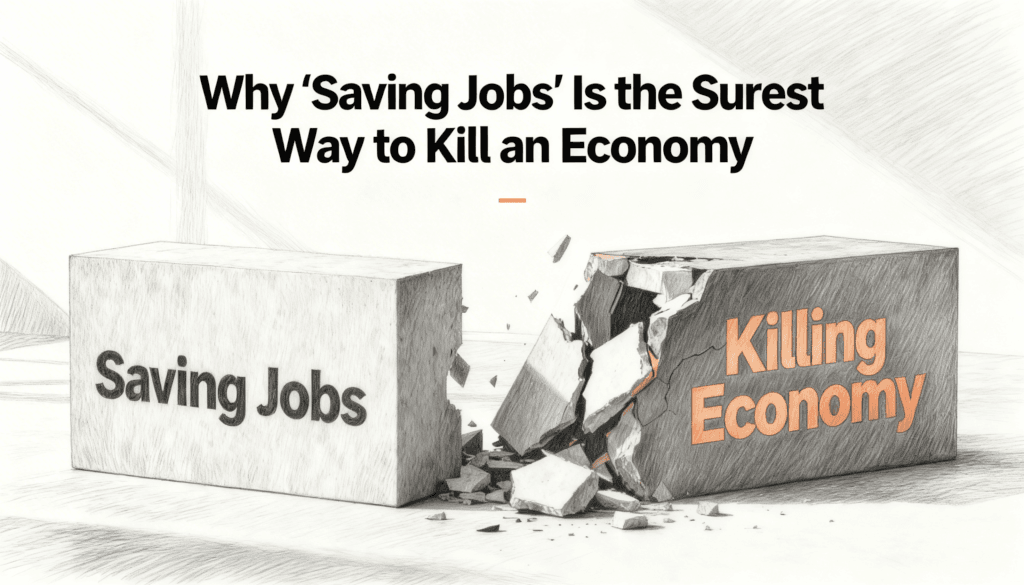
The surest way to kill an economy is to try to keep it alive exactly as it is.