Table of Contents
Most people think of economic progress as a straight line going up. More jobs, more wealth, more comfort. A rising tide that lifts all boats. It is a pleasant image. It is also completely wrong.
Joseph Schumpeter knew this. The Austrian economist, writing in the middle of the twentieth century, looked at capitalism and saw something that most of his colleagues refused to see. He saw a system that does not grow by building. It grows by destroying. And the destruction is not a bug in the system. It is the system.
He called it creative destruction. The phrase sounds almost poetic, which is fitting, because Schumpeter had a flair for the dramatic. But beneath the elegant language sits one of the most uncomfortable truths in economics: the engine of prosperity runs on the wreckage of what came before it.
The Blacksmith and the Factory
Consider a simple example. For centuries, blacksmiths were essential members of every community. They made tools, shoed horses, repaired metal goods. They had skills, status, income. Then the industrial revolution arrived, and factories began producing metal goods faster, cheaper, and in greater quantities than any blacksmith ever could.
What happened to the blacksmiths? They did not get absorbed into the new system overnight. Many of them simply lost everything. Their skills became irrelevant. Their shops closed. Their children had to find entirely different ways to make a living. The economy grew. The blacksmiths did not.
This is the part of progress that nobody puts on a poster. When we celebrate innovation, we are celebrating the winners. The new factory owners, the engineers, the investors who bet on the right horse. We do not celebrate the people who were standing where the new road needed to go.
Schumpeter understood that this was not a failure of capitalism. This was capitalism working exactly as intended. The old must die so the new can live. The question is not whether this is painful. The question is whether the pain is worth it.
Schumpeter Against the Grain
To appreciate how radical Schumpeter was, you have to understand the intellectual landscape he was walking through. In the early twentieth century, economics was dominated by two camps. On one side, you had the classical economists who believed markets naturally tend toward balance. Supply meets demand. Prices adjust. Everything finds its level, like water in a bathtub.
On the other side, you had the Marxists, who believed capitalism was a doomed system that would eventually collapse under the weight of its own contradictions. Workers would revolt. The whole thing would come crashing down.
Schumpeter looked at both sides and essentially said: you are both wrong, and you are both right. Capitalism is not stable. The Marxists got that part correct. But it is not going to collapse because of its failures. It is going to keep transforming because of its successes. Every success plants the seeds for the next upheaval.
This is a deeply counterintuitive idea. We are trained to think that success leads to stability. You build a successful business, you settle in, you enjoy the rewards. But Schumpeter argued that the opposite happens. Success attracts competition. Competition drives innovation. Innovation destroys the very conditions that made the original success possible. The entrepreneur who disrupts an industry today will be disrupted by someone else tomorrow.
It is a treadmill. And nobody gets to step off.
The Entrepreneur as Hero and Villain
Schumpeter placed the entrepreneur at the center of his theory, but not the entrepreneur as we imagine them today. He was not talking about someone who opens a coffee shop or launches an app. He was talking about a force of nature. Someone who sees the existing order and decides to tear it apart and rebuild it in a new shape.
This kind of entrepreneur does not optimize the current system. They replace it. Henry Ford did not make a better horse carriage. He made the horse carriage irrelevant. Steve Jobs did not make a better flip phone. He made the flip phone a museum piece.
But here is where Schumpeter gets uncomfortable. The entrepreneur, in his framework, is not a moral figure. They are an economic one. They do not destroy old industries because they want to help people. They destroy old industries because they see an opportunity. The benefit to society is a side effect, not a goal.
This makes the Schumpeterian entrepreneur a strange kind of hero. They create enormous wealth and progress, but they also leave enormous damage in their wake. Towns built around a single industry get hollowed out when that industry becomes obsolete. Workers who spent decades developing specialized skills find those skills worthless. Communities that organized their entire existence around one way of doing things discover that the world has moved on without asking their permission.
The entrepreneur does not lose sleep over this. That is not their job. But someone should.
Why Governments Cannot Fix This (And Why They Try Anyway)
One natural reaction to creative destruction is to try to stop it. If progress destroys jobs and communities, then maybe we should slow progress down. Protect the old industries. Subsidize the struggling sectors. Build walls around the economy and keep the disruptors out.
Schumpeter would have found this deeply misguided. Not because he was heartless, but because he understood something about economic systems that politicians often do not: you cannot freeze an economy in place. An economy that does not destroy and rebuild is not stable. It is stagnant. And stagnation is not a gentle plateau. It is a slow decline.
Look at what happened to economies that tried to prevent creative destruction. The Soviet Union attempted to plan every aspect of its economy, eliminating the chaos of competition and innovation. For a while, it worked. Growth was impressive. But without the mechanism of destruction and renewal, the system calcified. Old technologies stayed in use long past their expiration date. Inefficient factories kept running because there was no competitive pressure to shut them down. By the time the system finally cracked, the gap between the Soviet economy and the Western economies was enormous.
The lesson is brutal but clear. You cannot have creation without destruction. Trying to keep the old alive artificially does not save it. It just delays the collapse and makes it worse when it finally comes.
This does not mean governments should do nothing. But it means the right response is not to prevent change. It is to help people survive the change. Retrain workers. Support displaced communities. Build safety nets. The destruction is going to happen regardless. The question is whether you let people fall through the floor or catch them on the way down.
The Paradox Nobody Talks About
Here is something strange that Schumpeter noticed, and that most discussions of his work tend to skip over. He believed that capitalism would eventually undermine itself. Not through economic failure, but through cultural success.
As capitalism produces more wealth and more comfort, it also produces a class of people who are insulated from the harsh realities of economic life. Intellectuals, academics, journalists. People who benefit from the prosperity that capitalism creates but who have the luxury of criticizing the system from a safe distance.
Schumpeter argued that these groups would gradually erode public support for capitalism. Not because their criticisms were wrong, necessarily, but because they would shift the cultural mood against the very forces that made progress possible. The entrepreneur, once admired, would become a villain. Risk taking, once celebrated, would become suspect. The messy, painful, unequal process of creative destruction would become politically unacceptable.
And when that happened, capitalism would not be overthrown. It would be regulated into paralysis. Slowly, carefully, with the best of intentions, society would sand down all the rough edges that made the system work. And the result would not be a kinder, gentler capitalism. It would be a slower, weaker one.
There is a striking parallel here with evolutionary biology, and it is worth pausing on. In nature, species do not evolve because conditions are comfortable. They evolve because conditions are harsh. Predators, competition for resources, changing environments. These pressures force adaptation. Remove the pressure, and you do not get a better species. You get a species that is perfectly adapted to a world that no longer exists. Resistance to change becomes a death sentence when the environment shifts.
Schumpeter was essentially making the same argument about economies. The pain of creative destruction is not incidental to progress. It is the mechanism through which progress happens. Take away the pain, and you take away the progress.
What Schumpeter Gets Wrong
It would be dishonest to present Schumpeter as a prophet who got everything right. He did not.
His biggest blind spot was people. In his framework, workers and communities are essentially inputs in a larger economic process. They get displaced, they adapt, the economy moves on. But real people are not economic inputs. They are parents who cannot feed their children during a transition period. They are fifty year old factory workers who are told to learn to code. They are entire towns that lose their reason for existing.
Schumpeter was right that creative destruction drives progress. But he underestimated the human cost, or at least, he did not spend enough time thinking about how to manage it. His theory explains what happens. It does not do a great job of explaining what we should do about it.
There is also a valid criticism that Schumpeter romanticized the entrepreneur. Not every act of destruction is creative. Some companies destroy competitors not through genuine innovation but through monopoly power, political connections, or sheer financial muscle. When a large corporation buys out a smaller competitor and shuts them down, that is destruction. But it is not the kind of destruction that leads to progress. It is the kind that leads to concentration of power.
Schumpeter did not fully account for this distinction. In his model, the market sorts everything out. In reality, markets can be rigged, captured, and distorted. Destruction without creation is just destruction.
The Modern Echo
Schumpeter died in 1950, but his ideas have never been more relevant. We are living through one of the most intense periods of creative destruction in human history. Artificial intelligence is poised to reshape entire industries. Automation is eliminating jobs that people assumed would exist forever. The gig economy has replaced the stable career with a patchwork of temporary arrangements.
Every one of these changes follows Schumpeter’s pattern. New technologies emerge. Old industries collapse. Workers get displaced. Wealth concentrates among the innovators and their investors. Society struggles to keep up.
The political reactions are also following his script. On both the left and the right, there are growing calls to slow things down. Regulate the tech companies. Protect existing jobs. Put guardrails on innovation. The impulse is understandable. The disruption is real, and real people are getting hurt.
But Schumpeter’s warning echoes across the decades. You can slow down destruction, but you will slow down creation along with it. The two are not separable. They are the same process, viewed from different angles.
This does not mean we should accept suffering as the price of progress and move on. It means we should be honest about the tradeoffs. Progress is not free. It never has been. Every leap forward leaves someone behind. The measure of a society is not whether it avoids this pain. It is whether it acknowledges the pain and takes responsibility for the people who bear it.
The Uncomfortable Truth
Schumpeter’s great contribution was not a policy prescription or an economic model. It was a way of seeing. He forced us to look at the full picture of economic progress, not just the shiny parts. The new products, the growing GDP, the technological marvels. But also the closed factories, the abandoned towns, the workers who became statistics.
Most economic thinkers want to tell you a clean story. Capitalism is good. Capitalism is bad. The market will sort it out. The government must intervene. Schumpeter refused to pick a side. He said: this is a system that creates enormous wealth through enormous disruption, and if you are not willing to accept both sides of that equation, you do not understand what you are dealing with.
It is not a comforting message. But the best ideas rarely are.
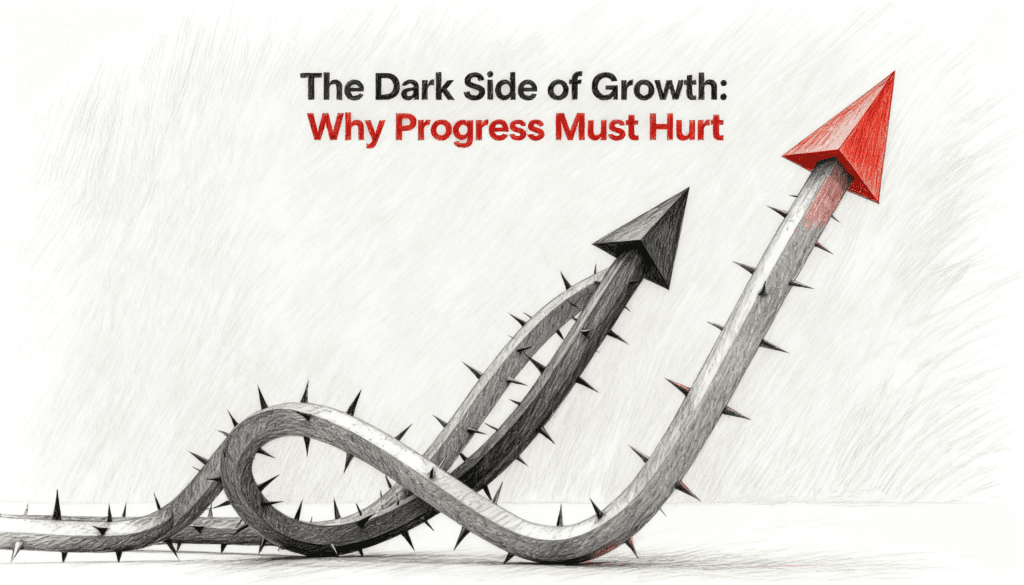
The dark side of growth is not a flaw to be fixed. It is a feature to be managed. And the first step in managing it is admitting that it exists.
Schumpeter did that almost a century ago.