Table of Contents
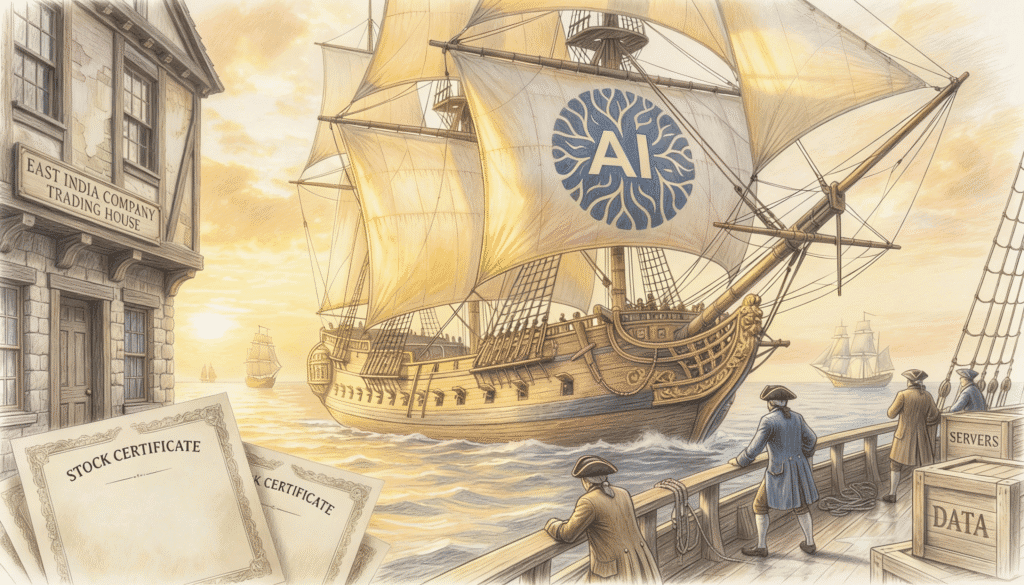
In 1600, merchants convinced Queen Elizabeth I to grant them a monopoly on trade with the East Indies. The pitch: we’ll bring back exotic goods, expand English influence, and share profits with the Crown.
In 2015, technologists convinced Silicon Valley that AI should be developed as a nonprofit for humanity’s benefit. The pitch: we’ll build safe AI, prevent corporate capture, and share the technology with everyone.
David Ricardo never met Sam Altman. But observing OpenAI’s journey from nonprofit to a $500 billion company, he’d recognize the pattern. This is rent extraction dressed as innovation. This is the East India Company reborn.
The Charter Game
The British East India Company didn’t start as an empire. It started with paperwork. A royal charter granted exclusive trading rights. The pitch to the Crown was compelling: let us handle the messy business of long distance trade, and everyone benefits. We take the risk, you get the rewards, the realm gets rich. The arrangement worked beautifully until it didn’t.
OpenAI’s original charter reads like a mirror image. Founded as a nonprofit in 2015, it promised to develop artificial general intelligence “for the benefit of humanity as a whole, unconstrained by a need to generate financial return.” The pitch to Silicon Valley and the world was equally compelling: let us handle the messy business of AI safety, and everyone benefits. We take the risk, humanity gets the rewards, the future gets secured.
Both charters shared a common feature. They turned a public good into a private operation while maintaining the language of public benefit. The East India Company would civilize while extracting spices. OpenAI would align superintelligence while extracting, well, we’ll get to that.
Ricardo understood that real economic action happens in the distribution of surplus. Who gets the profits? Who earns the wages? Who collects the rents? The charter is just the opening move. It establishes who has the right to extract value and under what pretense. The charter creates legitimacy for what comes next.
The genius of the charter structure is that it converts a contested claim into an accepted fact. Once granted, the charter becomes the baseline. Questions shift from “should this entity have these rights” to “how should this entity exercise its rights.” The frame changes. The game is already won.
David Ricardo Rent Theory and the Data Commons
Here’s where Ricardo becomes essential. His theory of rent explains how landowners extract value not through productive labor but through ownership of a scarce resource. The landowner doesn’t make soil fertile. He just owns it. As population grows and demand increases, rents rise. The landowner gets richer without producing anything additional.
Now replace “land” with “training data.”
OpenAI trained its models on the internet. Not parts of it. All of it. Books, articles, code, conversations, creative works. This wasn’t land they purchased. This was a commons they enclosed.
The legal term is “fair use.” The economic term is enclosure. The Ricardian term is rent seeking.
Content creators spent decades building the internet. Writers wrote. Programmers programmed. Artists created. They did this under certain assumptions about how their work would be used. Then OpenAI (and others) retroactively changed the deal.
Your blog post from 2015? Training data now. Your GitHub repository? Model weights. Your photography? Fuel for image generation.
The creators earned wages for their labor, if anything. OpenAI collects rents on the land. And like Ricardo’s landowners, they extract this rent not through superior productivity but through positional advantage. They were first to fence the commons at scale.
Here’s the counterintuitive part. This might be economically efficient in a narrow sense. If OpenAI’s models generate enormous value, maybe everyone benefits even if distribution is wildly unequal. Ricardo himself argued that trade benefits all parties.
But Ricardo also warned what happens when landowners capture too much surplus. It chokes capital formation. It reduces returns to productive labor. It creates a rentier class that contributes nothing but extracts everything.
The deeper problem is incentives. If creating content just feeds someone else’s training data, why create? If writing code just makes AI better at replacing programmers, why program? The rent extraction eventually undermines the productive base it depends on.
The Microsoft Arrangement and Comparative Advantage
Microsoft invested over $13 billion in OpenAI. On paper, it’s a partnership. In practice, it’s something else.
Ricardo’s comparative advantage theory assumed capital couldn’t move between countries. Each nation specialized and traded. But when capital is perfectly mobile and one party is stronger, comparative advantage becomes vassalage.
Microsoft holds 27% of OpenAI. They have exclusive IP rights until AGI arrives. OpenAI committed to $250 billion in Azure purchases. OpenAI runs almost entirely on Microsoft infrastructure.
The East India Company had the same dynamic with the Crown. The Company needed military support. The Crown needed revenue. Neither could exit. When crisis hit in 1773, the Crown intervened but kept the Company operating. Private profits, public backstop.
When Altman was fired in November 2023, Microsoft nearly absorbed OpenAI’s entire staff. The crisis resolved, but the power structure remained clear. OpenAI operates at Microsoft’s pleasure, regardless of the formal agreements.
Diminishing Returns and the Compute Trap
Ricardo’s law of diminishing returns applies perfectly to AI. Adding more compute to fixed architectures eventually yields smaller gains.
OpenAI spent roughly $8.65 billion on inference in nine months of 2025. That’s just running the models, not training them. The scaling laws that worked from GPT-2 to GPT-4 are hitting limits. Like farmers cultivating marginal land, AI companies face rising costs and shrinking returns.
OpenAI needs Microsoft’s compute. Microsoft needs OpenAI’s models to justify its AI investments. Both are locked in an arrangement where costs rise while marginal returns shrink. The East India Company faced the same trap, expanding into less profitable territories while needing more Crown support. The cycle reinforced itself until collapse.
The AGI Endgame and Economic Rent
OpenAI’s partnership with Microsoft includes provisions for when AGI is “declared.” An independent panel will verify it. Microsoft’s rights extend through 2032 and include post-AGI models.
This is the ultimate rent-seeking mechanism. If OpenAI builds AGI, they own the most productive “land” in history. Every economic activity becomes derivative. Every AI-using business pays rent to the landowner.
Ricardo worried that rising rents would claim ever-larger shares of output at the expense of profits and wages. The economy would stagnate under unproductive extraction.
Apply that to general intelligence. One entity controlling the most capable AI systems collects rents on nearly every transaction. The landowner captures the surplus while producers and laborers fight over scraps.
The counterargument: AGI creates such enormous surplus that everyone benefits despite unequal distribution. This is possible. But extreme concentration of economic power creates political problems that overwhelm efficiency gains. The East India Company’s monopoly generated wealth and corruption in equal measure. Short-term efficiency proved less important than long-term instability.
The Labor Question
OpenAI’s models are built on multiple layers of human labor. Training data from millions of creators. Reinforcement learning from contractors in Kenya and the Philippines rating outputs for pennies per task. The future economic activity AI will automate or transform.
Creators of training data earned wages or nothing. RLHF workers earn subsistence wages. Knowledge workers earn salaries, for now. OpenAI captures rents on all of it.
Ricardo worried about technological unemployment. He observed machines displacing workers, at least in the short run. His usual optimism about markets wavered when considering whether displaced laborers would find new employment or sink into poverty.
If models can do knowledge work at near-zero marginal cost, what happens to knowledge worker wages? Ricardo’s wage theory suggested competitive markets push wages toward subsistence. Workers earn just enough to survive and reproduce. Anything above that gets competed away or captured by capital and land.
AI accelerates this dynamic. As models improve, they compress the returns to human cognitive labor. The value doesn’t disappear. It just flows to whoever owns the models.
The humans whose labor made the models possible don’t share in the rents. Writers whose articles trained GPT-4 get no royalties. Programmers whose code taught Codex get no residuals. They were paid once, in wages, for labor whose value keeps accruing to the landowner.
The East India Company had the same relationship with Indian producers. Low prices paid, value extracted through trade, profits reinvested in expansion. Producers stayed poor while the Company grew rich. The economic surplus flowed in one direction.
This creates a paradox. The more successful AI becomes at augmenting or replacing knowledge work, the less valuable that work becomes. But the AI only exists because of that work. The system consumes its own foundation.
Protectionism vs. Open Models
Ricardo advocated free trade and fought the Corn Laws protecting British agriculture. His insight: protectionism makes everyone worse off. Specialize, trade freely, and total wealth increases.
AI faces a similar debate. Should model weights be public? Should training data be free? Should research be shared?
OpenAI’s trajectory tells the story. They started with “Open” in their name and shared research. GPT-2 was released openly. Then GPT-3 went closed. Then GPT-4, more closed. Now models are accessible only through APIs.
From a Ricardian view, this is protectionism. OpenAI protects market position by preventing competitor access to resources. Like landowners supporting Corn Laws to keep grain prices high, OpenAI keeps models closed to keep AI access expensive.
The safety argument is real. So is the profit motive. When safety arguments align perfectly with economic incentives, Ricardo would tell us to examine who benefits.
The Monopoly Question and Its Limits
The East India Company had a royal charter granting monopoly power. OpenAI doesn’t. There’s Anthropic, Google, Meta. But look closer.
OpenAI had first-mover advantage in large language models. They captured mindshare with ChatGPT. They locked in distribution through Microsoft. They’re valued at over $500 billion. The moat isn’t legal. It’s structural.
But here’s the counterintuitive part: this concentration might be temporary. Monopolies sow seeds of their own disruption. High rents attract entry. Innovations reduce dependency. Customers revolt.
Smaller models are getting competitive. Open source alternatives improve. Customers fear lock-in. Regulators watch. The question is whether competition emerges fast enough to prevent consolidation that makes one entity too powerful to dislodge.
What Ricardo Would Say
Ricardo would start by admiring the productive capacity. The models generate real value. They’re making workers more productive. This is genuine innovation.
Then he’d ask about distribution. Who captures the surplus? Content creators? RLHF workers? Users? Or the entity controlling access?
He’d note returns flow overwhelmingly to the landowner. OpenAI and investors capture rents. Microsoft extracts its share through infrastructure dependency. Actual producers earn wages or nothing.
He’d observe this arrangement is unstable. High rents discourage complementary investment. Why create content if it becomes training data? Why build on a platform that can change terms arbitrarily?
He’d warn about diminishing returns. Scaling laws hit limits. Easy gains are exhausted. Continuing returns require genuine innovation, not just more inputs.
And he’d conclude the arrangement needs restructuring before collapsing under its own weight. The East India Company didn’t reform voluntarily. It took crisis, pressure, and nationalization.
The Reform Question
The East India Company’s charter was revoked in 1858 after 258 years. Direct Crown control replaced it.
Ricardo would say the fundamental problem isn’t structure. It’s concentration of returns. Any arrangement allowing one entity to collect disproportionate rents on a general technology creates problems markets can’t solve alone.
Break up OpenAI? Mandate open models? Tax AI rents? Create public infrastructure? Each has problems. Ricardo described dynamics, not prescriptions.
The comparison isn’t perfect. OpenAI has no army. It’s not colonizing. The violence is absent. But the economic pattern is strikingly similar.
A private entity gets privileged access to a critical resource. It extracts value while claiming public benefit. It creates costly dependencies. It concentrates power while diffusing risk. It earns rents while calling them profits.
Ricardo’s theories show why this emerges and where it leads. Comparative advantage becomes vassalage when power is asymmetric. Rents rise when resources are scarce. Diminishing returns set in when easy gains are exhausted. Labor’s share shrinks when returns flow to landowners.
The East India Company’s story ended badly. Rebellion, crisis, intervention. The question for OpenAI is whether we learn from history before repeating it.
Ricardo believed in markets but understood their limits. Power and distribution matter as much as efficiency. Economic arrangements encode political relationships that eventually demand political solutions.
We’re watching this in real time with AI. The technology is revolutionary. The economic structure is familiar. Whether we recognize the pattern before it’s too late to change it remains to be seen.
The East India Company started with a charter promising mutual benefit. It ended with direct rule after centuries of extraction. OpenAI started promising to benefit humanity. Where it ends depends on whether we can build better economic structures for general technologies than our ancestors built for global trade.
Ricardo gives us the tools to see clearly. Whether we use them is up to us.