Table of Contents
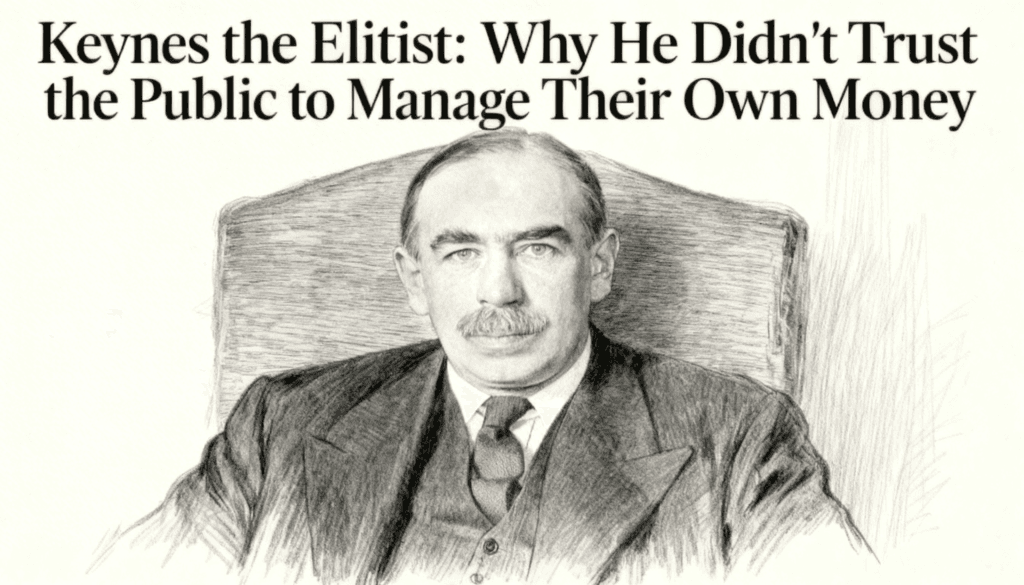
John Maynard Keynes thought you were bad with money. Not you specifically. Everyone. The whole public. He believed that ordinary people, left to their own devices, would make financial decisions so poor that entire economies would collapse. And the frustrating part is that he was mostly right.
This is the story of one of the twentieth century’s most influential economists and his deeply uncomfortable conviction: that democracy works fine for picking leaders but fails miserably when it comes to managing money. Keynes did not arrive at this view because he was cruel or indifferent. He arrived at it because he watched people panic, hoard, speculate, and destroy wealth with a consistency that bordered on ritual.
The Man Behind the Theory
To understand why Keynes distrusted the public’s financial judgment, you have to understand where he came from. He was born in 1883 into the intellectual aristocracy of Cambridge, England. His father was an economist. His mother became the city’s mayor. He attended Eton and then King’s College, Cambridge, where he fell in with the Bloomsbury Group, a circle of writers, artists, and thinkers who considered themselves the cultural vanguard of Britain.
This was not a man who spent his weekends at the pub. Keynes moved through a world of private dinners, philosophical debates, and government advisory rooms. He spoke multiple languages. He married a Russian ballerina. He speculated in currency markets before breakfast. When he talked about “the public,” he was talking about people he genuinely believed he understood better than they understood themselves.
And here is the thing that makes Keynes so difficult to dismiss: he put his money where his mouth was, literally. He speculated in markets and made a fortune, lost most of it, then made it back again. He was not some ivory tower academic theorizing about money he had never touched. He was a practitioner who also happened to be a theorist.
The Paradox of Thrift and the Problem With Common Sense
Keynes’s most famous attack on public financial instinct comes in the form of something called the paradox of thrift. The idea is simple and devastating. When times get tough, every individual person does the sensible thing: they save more and spend less. They tighten their belts. They prepare for the worst. This is what your grandmother would tell you to do. It is what every piece of conventional financial wisdom supports.
And according to Keynes, it is precisely what makes recessions worse.
When everyone saves at once, spending drops. When spending drops, businesses lose revenue. When businesses lose revenue, they fire workers. When workers get fired, they spend even less. The economy spirals downward, not because people made irrational choices, but because they all made the same rational choice at the same time. Individual prudence becomes collective catastrophe.
This is the core of Keynes’s elitism, and it is more nuanced than it first appears. He was not saying people are stupid. He was saying something far more unsettling: that people can be individually smart and collectively disastrous. The public’s instincts about money, honed through generations of household budgeting, simply do not scale. What works for a family does not work for a nation. But good luck telling that to a family that is watching its savings evaporate.
Animal Spirits and the Irrational Market
Keynes had another concept that revealed his dim view of public financial behavior. He called it “animal spirits.” The phrase sounds almost affectionate, like he was describing golden retrievers rather than investors. But the implication was sharp. Keynes believed that most investment decisions were driven not by careful calculation but by waves of optimism and pessimism that swept through markets like weather systems.
People did not invest because they had run the numbers and found a reasonable return. They invested because everyone else was investing and because it felt like the right time. Then they panicked and sold because everyone else was panicking and selling. The market, in Keynes’s view, was not a rational machine for pricing assets. It was a beauty contest.
He actually used that metaphor. Keynes compared the stock market to a newspaper competition where readers had to pick the prettiest face from a set of photographs. The trick was that you did not pick the face you found prettiest. You picked the face you thought everyone else would find prettiest. And the really sophisticated players tried to guess what the average person thought the average person would pick. Investing, for Keynes, was not about finding value. It was about predicting crowd behavior. And crowds, he believed, were not to be trusted.
There is a striking parallel here to something completely outside economics. In game theory, there is a concept called the tragedy of the commons, where individuals acting in rational self interest destroy a shared resource. Keynes saw the same dynamic in financial markets. Each investor acting alone makes sense. Together, they create bubbles and crashes. The parallel suggests something uncomfortable: that the problem is not cultural or educational. It might be hardwired.
The Great Depression as Proof
If Keynes needed evidence for his case against public financial competence, the 1930s handed it to him on a silver platter. The Great Depression was, in many ways, a masterclass in everything Keynes warned about. Banks collapsed because depositors rushed to withdraw their money all at once. Markets crashed because investors all tried to sell at the same time. Governments, listening to the conventional wisdom of the public and the orthodox economists who echoed it, cut spending precisely when they should have increased it.
The public wanted balanced budgets. The public wanted austerity. The public wanted the government to behave like a household, tightening its belt in hard times. Keynes looked at this and saw a patient demanding that the doctor stop the medicine because it tasted bad.
His solution was radical for its time. He argued that governments should spend more during recessions, not less. They should run deficits. They should borrow and invest in public works, even if it meant piling up debt. The logic was straightforward: if the public would not spend, the government had to spend for them. Someone had to put money into the economy, and if everyone in the private sector was hiding under their financial beds, the state was the only actor big enough and brave enough to act.
This was elitism dressed in policy clothing. Keynes was essentially saying that the government, guided by trained economists, should override the collective financial instincts of millions of people. He was saying that the experts knew better. In the 1930s, this was controversial. In our current era of populist distrust toward experts, it is practically heresy.
Keynes the Investor and His Own Contradictions
Here is where the story gets interesting, and where Keynes’s elitism starts to look a little shakier. Keynes himself was not immune to the animal spirits he diagnosed in others. In the late 1920s, he was heavily leveraged in currency and commodity speculation. When the crash came, he lost roughly 80 percent of his net worth. The great diagnostician of financial irrationality had fallen victim to the exact disease he described.
He recovered, of course. He shifted his strategy from speculation to value investing, focusing on companies he believed were fundamentally undervalued. His later track record was exceptional. But the fact remains that Keynes, the man who warned the world about the dangers of animal spirits and herd behavior, had to learn that lesson the hard way, through his own wallet.
This does not invalidate his theories. If anything, it strengthens them. If even Keynes, with all his intelligence and training and access to information, could get swept up in market mania, what chance did an ordinary person have? His personal losses were not a contradiction of his elitism. They were an argument for it. The problem, he might have said, was not that he was as foolish as the public. It was that the forces of irrationality were powerful enough to overcome even the most informed minds. If they could catch him, they could catch anyone.
The Liquidity Trap and the Stubbornness of Fear
Another piece of Keynes’s intellectual framework reveals his distrust of public financial behavior. He described something that economists now call a liquidity trap. This is a situation where interest rates are so low that they cannot effectively go any lower, and yet people still refuse to spend or invest. They hoard cash instead. They sit on their money like dragons guarding gold, not because it earns them anything, but because they are terrified of losing it.
In a liquidity trap, the normal tools of monetary policy stop working. You can make borrowing essentially free, and people still will not borrow. You can flood the system with money, and it just pools up in bank accounts and mattresses. The public, gripped by fear, becomes economically paralyzed.
Keynes saw this not as a temporary glitch but as a fundamental feature of human psychology. People, in his view, had an almost spiritual attachment to liquidity, to having cash on hand, to the comfort of money they could see and touch. This preference for liquidity over productive investment was, to Keynes, one of the great obstacles to economic stability. And it was a preference that no amount of education or information could fully overcome.
If you have ever panic sold a stock during a market dip, or kept too much money in a savings account earning almost nothing because the market felt “uncertain,” you have experienced exactly what Keynes was talking about. The instinct feels rational. It feels responsible. And from the perspective of the broader economy, it is part of the problem.
What Keynes Got Wrong
It would be easy to read all of this and conclude that Keynes was simply an arrogant snob who looked down on ordinary people. That reading is too simple. But it is also too simple to accept his framework without challenge.
The most significant gap in Keynes’s thinking was his faith in the competence of the elites who would replace public judgment. He assumed that governments, guided by well trained economists, would make better decisions than the crowd. But governments are made up of politicians, and politicians respond to incentives that have little to do with optimal economic policy. They run deficits during booms because spending is popular. They cut spending during recessions because austerity sounds responsible. They do precisely the opposite of what Keynes recommended, not because they lack his books on their shelves, but because elections happen every few years and voters have short memories.
The irony is thick here. Keynes distrusted the public to manage their own money but implicitly trusted the public to elect leaders who would manage it better. The chain of delegation he proposed, from public to politicians to economists, has weak links at every joint.
Friedrich Hayek, Keynes’s great intellectual rival, made exactly this point. Hayek argued that no group of central planners, no matter how brilliant, could match the distributed intelligence of millions of people making individual economic decisions. The market, for all its irrationality, contained more information than any committee ever could. Hayek did not deny that markets were messy. He argued that the alternatives were messier.
The Legacy That Will Not Quit
Keynes died in 1946, but his ideas about public financial incompetence have never gone away. Every time a central bank steps in to rescue markets, it is acting on a fundamentally Keynesian assumption: that the public cannot be trusted to sort this out on their own. Every time a government launches a stimulus package, it is channeling Keynes’s belief that sometimes the adults in the room need to overrule the crowd.
The 2008 financial crisis and the 2020 pandemic response were both profoundly Keynesian moments. Governments spent billions. Central banks slashed interest rates and bought assets. The logic was pure Keynes: left to its own devices, the public would save, hoard, and freeze, and the economy would collapse. So the state stepped in, just as Keynes prescribed.
Whether this worked is a matter of heated debate. What is not debatable is that Keynes’s basic insight about human financial behavior has proven remarkably durable. People do panic. They do hoard. They do follow crowds. They do confuse what is good for their household with what is good for the economy. These are not moral failures. They are cognitive ones, built into the way human beings process risk and uncertainty.
Keynes the elitist was not wrong about the problem. Where he was arguably naive was in his faith in the solution. Trusting experts to override public instinct works only if the experts are both competent and insulated from political pressure. History suggests they are rarely both.
So here we are, nearly a century after Keynes laid out his case. We still panic. We still hoard. We still follow the crowd off cliffs. And we still turn to governments to catch us, governments staffed by people who got their jobs by telling us what we wanted to hear. Keynes would have found that deeply predictable. He might even have found it amusing, in the dry, Cambridge sort of way that passed for humor in his circle. The public, as always, is doing exactly what he expected.