Table of Contents
There is a phrase that floats around self help culture like a benevolent ghost, showing up in graduation speeches, Instagram captions, and the bios of people who sell online courses. That phrase is “follow your passion.” It sounds noble. It sounds liberating. It sounds like the kind of advice that could never steer you wrong.
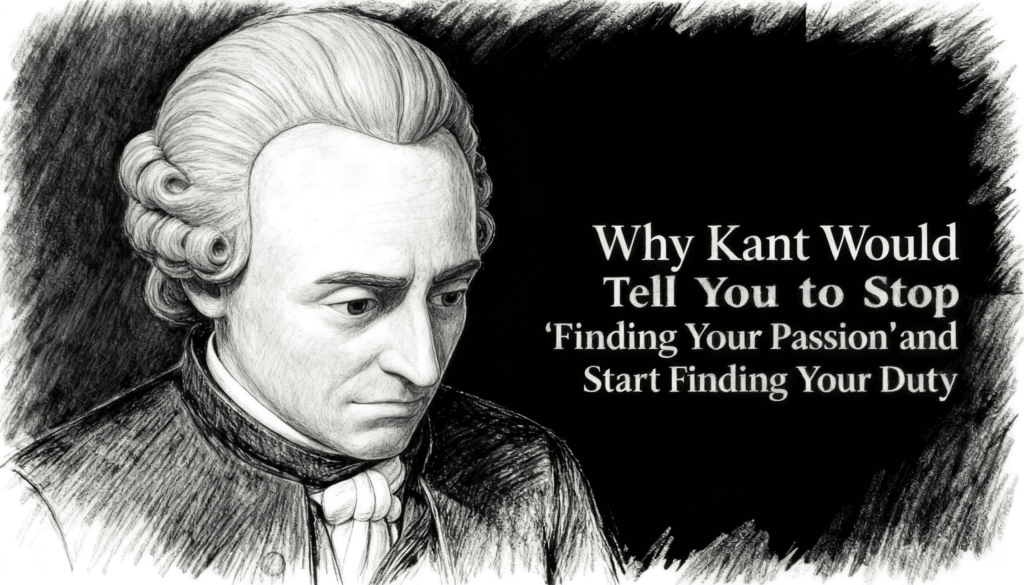
Immanuel Kant would have hated it.
Not because he was a joyless man, although his daily routine was so rigid that neighbors in Königsberg reportedly set their clocks by his afternoon walk. And not because he thought passion was evil. He simply believed that building your entire moral and practical life around what makes you feel good is a remarkably fragile way to live. Feelings change. Passion fades. Tuesday morning arrives, and suddenly that thing you were so passionate about feels like a chore. Then what? You abandon it and go hunting for the next burst of inspiration?
Kant had a different proposal. Instead of chasing what excites you, figure out what you owe. Find your duty. It is less glamorous advice. It does not fit neatly on a motivational poster. But it might be the most honest framework for building a life that actually holds together when things get difficult.
The Problem With Passion as a Compass
Let us be fair to the passion crowd for a moment. The idea is not entirely without merit. Passion can be a useful signal. If you are deeply curious about something, that curiosity is worth paying attention to. But there is a difference between treating passion as a signal and treating it as a GPS system for your entire existence.
The trouble with passion as a primary guide is that it is, by nature, self referential. It points inward. What do I love? What makes me feel alive? What gives me energy? These are not bad questions, but notice how every single one of them orbits around one gravitational center: you. Kant would point out that a life organized entirely around your own emotional states is not a moral life. It is just sophisticated self interest dressed up in spiritual language.
Think about it this way. When someone says they followed their passion and became a successful painter, we applaud. When someone says they followed their passion and became a successful con artist, we do not. The passion was equally real in both cases. The emotion itself has no moral content. It is just energy looking for a direction. Without some external framework to guide it, passion is morally blind.
This is where Kant gets interesting, and where most people stop reading about him, which is unfortunate.
What Kant Actually Meant by Duty
Duty, in Kant’s framework, is not about doing things you hate because suffering builds character. That is a common misreading, and it makes Kant sound like the philosophical equivalent of a strict boarding school headmaster. His concept of duty is more subtle and, frankly, more radical than that.
For Kant, duty means acting according to principles that you could rationally will to be universal laws. That is the famous categorical imperative, stripped of its academic packaging. The test is straightforward. Before you act, ask yourself: could I want everyone in this situation to act the same way? If the answer is yes, you are probably on solid ground. If the answer is no, you are making a special exception for yourself, which is the root of most ethical failures.
Here is where it gets counterintuitive. Kant argued that an action only has genuine moral worth when you do it because it is right, not because it makes you feel good. If you help someone because helping people gives you a warm glow inside, that is nice. Kant would not condemn you for it. But he would say the action does not have full moral significance. You were just following your inclination, the same way a dog follows a scent. The person who helps others even when it brings them no pleasure, even when they would rather be doing something else, that person is acting from duty. And that, Kant believed, is where real moral dignity lives.
This is the part that irritates people. It sounds like Kant is saying you should be miserable while doing good things. But that is not quite right. He is saying that your feelings about the action are irrelevant to its moral value. You can enjoy doing your duty. You just cannot depend on that enjoyment as your reason for doing it. Because the moment the enjoyment disappears, so does your commitment. And a commitment that evaporates when the feelings do is not really a commitment at all.
The Passion Economy and Its Quiet Casualties
We live in an era that has turned passion into an economic ideology. The creative economy, the passion economy, the creator economy. These phrases all carry the same underlying promise: monetize what you love and you will never work a day in your life.
The research tells a more complicated story. A study found that people who believe passion is something you discover, rather than something you develop, are more likely to abandon new interests at the first sign of difficulty. The “find your passion” mindset creates an expectation that the right path should feel effortless. When it does not, people assume they picked the wrong path rather than recognizing that difficulty is a normal feature of anything worth doing.
Kant would have predicted this. If your motivation depends on a feeling, then your motivation is only as durable as the feeling. And feelings, as anyone who has ever been alive can confirm, are not known for their consistency.
There is something almost paradoxical here. The passion framework, which promises freedom and fulfillment, often leads to a kind of paralysis. People cycle through interests, careers, and identities, always searching for the one that will finally click. The duty framework, which sounds restrictive and old fashioned, often produces the opposite result. When you commit to something because you believe it matters, not because it thrills you, you develop the kind of persistence that eventually generates its own satisfaction.
Duty Does Not Mean Drudgery
At this point, it is worth addressing the obvious objection. Does not a life built around duty sound bleak? Like eating plain oatmeal every morning for forty years because fiber is important?
Not necessarily. And this is where Kant’s thinking connects with something modern psychology has been circling for decades. The concept of meaning.
Viktor Frankl, the psychiatrist who survived Auschwitz and went on to write “Man’s Search for Meaning,” argued that the primary human drive is not pleasure but purpose. People can endure astonishing amounts of suffering if they believe their suffering serves something larger than themselves. Frankl was not a Kantian in any strict sense, but the resonance is hard to miss. Both thinkers recognized that anchoring your life to your own emotional states makes you vulnerable. Anchoring it to something that transcends your feelings makes you resilient.
Modern research on well being supports this. Studies consistently show that people who report high levels of meaning in their lives also report high levels of satisfaction, but the reverse is not always true. You can have plenty of pleasure and very little meaning. And meaning, it turns out, often comes from the kinds of activities that involve obligation, responsibility, and yes, duty. Raising children. Committing to a craft. Showing up for your community even when no one is watching.
The irony is that doing your duty often makes you happier than chasing happiness directly. Psychologists call this the hedonistic paradox. The more aggressively you pursue pleasant feelings, the more they elude you. Happiness tends to arrive as a side effect of engagement with something that matters. Kant did not use the language of positive psychology, but he understood the underlying structure. Do what is right. Let the feelings sort themselves out.
What This Looks Like in Practice
Abstract philosophy is only useful if it can survive contact with real life. So what does it actually look like to find your duty rather than your passion?
It starts with a shift in the questions you ask. Instead of “what do I love doing,” try “what needs to be done that I am capable of doing.” Instead of “what career would make me happy,” try “what contribution can I make that would matter even if no one congratulated me for it.” Instead of “what is my calling,” try “what am I willing to commit to even on the days when it feels like a grind.”
These questions are harder to answer. They do not produce the immediate dopamine hit of imagining yourself living your best life on a beach with a laptop. But they tend to produce answers that are more durable. Because they are grounded in reality rather than fantasy.
Consider the doctor who chose medicine not because she felt a burning passion for biology but because she recognized that her aptitude for science could reduce suffering. Consider the teacher who stays in a difficult school not because classroom management is thrilling but because those students need someone who will not leave. Consider the engineer who works on water filtration systems not because pipes are exciting but because clean water is a basic human need that millions of people still lack.
These people might also be passionate about their work. Many of them are. But the passion is not the foundation. It is the weather. Some days it is there, warm and energizing. Some days it is not. The foundation is something sturdier. It is the recognition that this work matters and that mattering is enough of a reason to keep going.
The Unexpected Connection to Creative Work
Here is something that will annoy the creative class. Kant’s framework might actually produce better art than the passion model does.
The romantic image of the artist is someone who creates from pure inspiration, driven by an inner fire that cannot be contained. The reality of most successful creative work is far less cinematic. It involves showing up at the desk or the studio every day whether you feel inspired or not. It involves revision, discipline, and the willingness to do tedious work in service of something you believe in.
Mason Currey’s book “Daily Rituals,” which catalogs the working habits of hundreds of artists, writers, and composers, reveals a striking pattern. The most prolific creators were not the most passionate in any obvious emotional sense. They were the most disciplined. They treated their work as an obligation. Some of them openly described it as a kind of duty. Tchaikovsky once wrote that he worked every day regardless of mood because inspiration does not visit the lazy. He could have been paraphrasing Kant.
The passion model tells aspiring creators to wait for inspiration. The duty model tells them to sit down and work. One of these approaches produces manuscripts. The other produces Pinterest boards about writing.
Where Kant Gets It Wrong, or at Least Incomplete
No philosophical framework is perfect, and Kant’s is no exception. His rigid emphasis on duty can, if taken to extremes, produce a kind of moral inflexibility that ignores context. The famous example is Kant’s claim that you should never lie, even to a murderer asking where your friend is hiding. Most people find this position absurd, and they are probably right to.
Duty without compassion can become tyranny. Duty without practical wisdom can become rigidity. Kant gives us a powerful corrective to the excesses of passion culture, but he does not give us the whole picture. A complete life probably requires both a sense of obligation and the emotional intelligence to know when the rules need to bend.
But as a starting point, as a foundation for making decisions about how to spend your limited time on this planet, duty has a resilience that passion simply cannot match. Passion says “do what you love.” Duty says “do what matters.” And what matters has a way of surviving long after the initial excitement has packed its bags and left.
The Uncomfortable Bottom Line
Finding your passion is easy. Scroll through enough career quizzes and personality tests, and something will light up. Finding your duty requires something more demanding. It requires you to look beyond yourself, to ask what the world needs from you rather than what you need from the world.
Kant was not trying to make anyone miserable. He was trying to make ethical life possible on terms that do not collapse the moment your feelings change. In a culture that treats emotion as the highest authority, that is a radical position. It is also, for many people, a quietly liberating one.
Because here is the thing about passion. It asks you to feel something. Duty only asks you to show up. And showing up, day after day, for something that matters more than your mood, is the closest most of us will ever get to freedom.
You do not need to find your passion. You need to find what you are willing to do whether you feel like it or not. Kant figured this out in the eighteenth century, in a small Prussian city, on his perfectly timed daily walk. The rest of us are still catching up.