Table of Contents
You have probably been in this situation before. You are sitting across from someone at dinner, or scrolling through a comment thread, and someone says something that is obviously, demonstrably wrong. So you do what any reasonable person would do. You pull out the facts. You cite the numbers. You present the evidence like a lawyer delivering a closing argument to a jury that surely must see reason.
And nothing happens.
The other person does not change their mind. In fact, they seem more convinced than before. You walked in with a loaded gun of data and somehow shot yourself in the foot.
Welcome to one of the most frustrating features of being human. Facts, it turns out, are remarkably bad at winning arguments. And the person who has done more than most to explain why is Dan Ariely, the behavioral economist who has spent decades studying how spectacularly irrational we are, especially when we believe we are being rational.
The Illusion of the Rational Mind
The Western intellectual tradition has spent roughly two thousand years building a monument to human reason. From Aristotle to the Enlightenment to the modern university, the assumption has been clear: present people with good information and they will make good decisions. It is a beautiful idea. It is also mostly wrong.
Ariely’s work, particularly in books like Predictably Irrational, reveals something uncomfortable. We do not process information the way a computer does. We do not weigh evidence, calculate probabilities, and arrive at the most logical conclusion. Instead, we feel our way to a position and then go shopping for evidence to support it. The decision comes first. The reasoning comes second. And the reasoning is not really reasoning at all. It is decoration.
This is not a flaw in a few unintelligent people. This is the architecture of the human mind. Everyone does it. Physicists do it. Philosophers do it. The person reading this article is doing it right now, evaluating these claims not purely on their merit but on whether they confirm or threaten something they already believe.
Why Facts Bounce Off Beliefs
To understand why facts fail in arguments, you need to understand what beliefs actually are. They are not filing cabinets of verified information. They are closer to identity markers. What you believe about politics, health, economics, or even which brand of phone is superior is tangled up with who you are, who your friends are, and which group you belong to.
Ariely’s research shows that when you present someone with a fact that contradicts a deeply held belief, you are not simply correcting an error in their mental spreadsheet. You are threatening their identity. And the brain treats identity threats the same way the body treats physical threats. It fights back.
This is what psychologists call the backfire effect. Show someone evidence that their political candidate lied, and they do not trust the candidate less. They trust the candidate more. Show a parent evidence that vaccines are safe, and their intention to vaccinate does not increase. It decreases. The facts do not just fail. They actively make things worse.
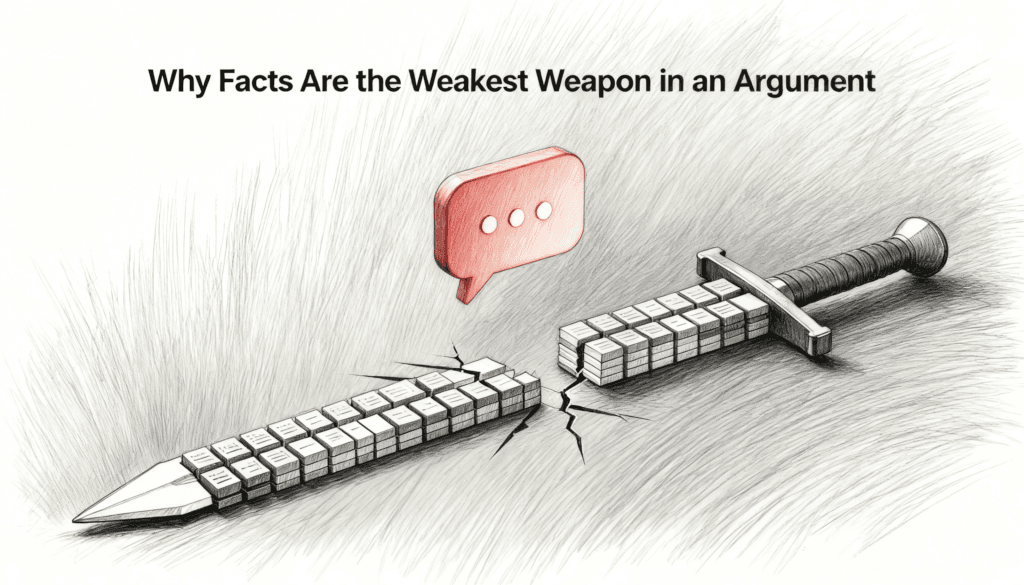
Think about that for a moment. The very tool we consider most powerful in rational discourse, the verified fact, can function as a boomerang. You throw it expecting to hit the target and it comes back and hits you instead.
The Emotional Immune System
Ariely describes a kind of emotional immune system that protects our existing beliefs the way our biological immune system protects against infection. When a foreign fact enters the system, the mind mobilizes its defenses. It questions the source. It finds exceptions. It reinterprets the data. It changes the subject.
This is not stupidity. It is survival. For most of human history, belonging to a group was more important than being correct about any particular fact. If your tribe believed that the river spirits demanded a certain ritual, questioning that belief did not make you a critical thinker. It made you an outcast. And outcasts did not survive.
Our brains evolved in an environment where social cohesion was a matter of life and death. Being right was a luxury. Fitting in was a necessity. And while we no longer live in small tribes on the savanna, the software has not been updated. We still process disagreement as a form of social danger.
This is where Ariely’s work intersects with something fascinating from an entirely different field. In evolutionary biology, there is a concept called costly signaling. Animals sometimes engage in behaviors that seem wasteful or irrational, like a peacock growing an absurdly large tail, because those behaviors signal something valuable to the group. Holding a belief that defies evidence can function the same way. It signals loyalty. It says: I am so committed to this group that I will believe what the group believes even when the evidence says otherwise. The more irrational the belief, the stronger the signal.
This means that in many arguments, the person you are debating is not trying to find the truth. They are performing allegiance. And no amount of data will outperform loyalty.
The Stories We Tell Ourselves
Ariely points to another critical insight. Humans are not fact processors. We are story processors. We do not remember data points. We remember narratives. And when facts conflict with a good story, the story wins every time.
Consider how medical misinformation spreads. A clinical study with a sample size of fifty thousand people finds that a treatment is safe. A single mother posts a video saying the treatment harmed her child. Which one moves people more? The study is abstract, statistical, and impersonal. The video is concrete, emotional, and unforgettable. One is data. The other is a story. And the story will be shared a million times before the study gets read once.
This is not because people are foolish. It is because storytelling is the oldest technology for transmitting information. Long before we had writing, we had campfires and narratives. Our brains are literally wired to absorb stories. They activate more regions of the brain than facts do. They trigger empathy, emotion, and memory in ways that a spreadsheet never will.
Ariely understood this, which is why his own work is full of stories. He does not just tell you that humans are irrational. He shows you through experiments that read like parables. He tells you about the locksmith who got better tips when he was bad at his job because people could see him struggling. Each finding is wrapped in a narrative because he knows that the narrative is what will stick.
The Messenger Problem
There is another layer to why facts fail, and Ariely’s work touches on it indirectly. We do not evaluate information in a vacuum. We evaluate it based on who delivers it. The same fact, presented by someone we trust and someone we distrust, will be received in completely opposite ways.
This is the messenger problem. A climate scientist presenting data on global temperatures will be heard very differently depending on the audience. To one group, she is a credible expert. To another, she is a member of an elite institution with an agenda. The data has not changed. The messenger has changed. And the messenger changes everything.
Ariely’s experiments on trust and dishonesty reveal just how contextual our relationship with truth really is. We do not have a fixed commitment to facts. We have a flexible commitment that bends depending on who is talking, what they look like, whether they seem like one of us, and how the information makes us feel.
This is deeply inconvenient for anyone who believes that truth should stand on its own. It should. But it does not.
So What Actually Works?
If facts are weak weapons, what are the strong ones? Ariely’s research, along with a growing body of work in behavioral science, suggests several approaches that are far more effective than simply throwing data at someone.
The first is emotional connection. Before you can change someone’s mind, you need to make them feel safe. Not intellectually safe. Emotionally safe. If someone feels attacked, judged, or condescended to, their defenses go up and nothing gets through. The most persuasive people in history were not the ones with the best arguments. They were the ones who made others feel heard.
The second is narrative. If you want to change a belief, do not argue against it. Tell a better story. This is why public health campaigns that use personal testimonials outperform campaigns that use statistics. It is why a documentary changes more minds than a textbook. The story does not replace the facts. It carries the facts in a vehicle the brain is designed to accept.
The third, and perhaps the most counterintuitive, is asking questions. Ariely and other researchers have found that people are more likely to change their own minds than to have their minds changed by others. When you ask someone to explain how a policy actually works, step by step, something interesting happens. They discover their own gaps. They realize they do not understand it as well as they thought.
You are not telling them they are wrong. You are letting them discover it. And that makes all the difference.
The Paradox of Knowledge
Here is where things get truly interesting. Ariely’s work, combined with research from figures like Philip Tetlock and Daniel Kahneman, points to a strange paradox. The more knowledgeable someone is, the better they are at defending wrong beliefs.
This sounds backwards. Surely education and expertise should make people more open to evidence. But think about it. A well educated person has more cognitive tools at their disposal. They can construct more sophisticated arguments. They can find more creative ways to dismiss contradicting evidence. They can cite counter studies, question methodologies, and deploy rhetorical strategies that a less educated person simply does not have access to.
Intelligence, in this context, is not a flashlight that helps you find the truth. It is a defense attorney that helps you achieve your preferred conclusion. The smarter you are, the better lawyer you have working for your existing beliefs.
This is why some of the most intractable disagreements happen not between ignorant people but between highly educated ones. Each side has the intellectual firepower to resist the other indefinitely. The facts become ammunition for both sides, and the argument becomes an arms race with no possible winner.
What This Means for How We Communicate
If you write for a living, or teach, or lead, or parent, or do anything that involves trying to move another human mind from one position to another, Ariely’s insights are not just interesting. They are essential.
They tell you to stop leading with your evidence. Stop treating arguments like court cases where the side with the most exhibits wins. Stop assuming that the other person is simply uninformed and that more information will fix the problem.
Instead, start with empathy. Start with curiosity. Start with a question, not a claim. Wrap your facts in a story that connects with something the other person already values. Make the truth feel like their discovery, not your imposition.
This is not manipulation. It is communication that actually works. Because the goal was never to prove that you are right. The goal was to help someone see something they could not see before. And if your method of helping them see it causes them to close their eyes tighter, then your method has failed no matter how accurate your facts were.
The Hardest Fact of All
Dan Ariely spent his career studying human irrationality, and the findings paint a portrait of a species that is brilliantly creative at avoiding the truth when the truth is inconvenient. We are not rational beings who occasionally get emotional. We are emotional beings who occasionally get rational. And the sooner we accept that, the better we become at actually reaching each other.
The hardest fact to accept is the one about facts themselves. They are necessary. They are important. They are the foundation of science, medicine, law, and progress. But in the arena of human persuasion, they are the weakest weapon in the arsenal. Not because they lack power, but because we lack the wiring to receive them cleanly.
The next time you are in an argument and you feel the urge to pull out the perfect statistic, the undeniable study, the fact that will surely end the debate, pause for a moment. Ask yourself whether you are trying to win or trying to connect. Because the data is clear on this one, even if nobody will believe it.
Facts do not change minds. People change minds. And they only do it when they feel safe enough to let go of what they were holding.