Table of Contents
There is something almost comic about the way we argue. We gather our facts. We line them up neatly like soldiers. We march them toward the opposing view with full confidence that the sheer weight of evidence will do the work. And then nothing happens. The other person blinks, nods politely, and goes right on believing what they believed before breakfast.
This is not a failure of intelligence. It is not stubbornness in the ordinary sense. It is something far more interesting. And one of the clearest explanations for it came from a historian of science named Thomas Kuhn, who in 1962 published a slim book called The Structure of Scientific Revolutions. The book was meant to describe how science works. What it actually described was how all of us think, whether we are physicists or plumbers or people arguing about diet on the internet.
Kuhn’s central claim was deceptively simple. Science does not progress the way we imagine it does. We picture a straight upward line. Each generation of scientists discovers new truths, corrects old errors, and hands down a cleaner, more accurate map of reality to the next. This is the story science tells about itself, and it is mostly a fairy tale.
What actually happens, Kuhn argued, is something far more disorienting. Science moves through periods of calm, which he called “normal science,” punctuated by violent upheavals he called “paradigm shifts.” And the mechanics of those shifts reveal something uncomfortable about the human relationship with truth.
The Paradigm Is Not a Theory. It Is a World.
To understand Kuhn, you first need to understand what he meant by a paradigm. The word has been so overused in corporate boardrooms that it now means almost nothing. But in Kuhn’s hands it meant something very specific and very radical.
A paradigm is not just a set of ideas. It is the entire framework through which a community sees reality. It includes the assumptions that are so foundational nobody thinks to question them. It includes the methods considered legitimate, the questions considered worth asking, and the answers considered satisfying. It is the water the fish swim in.
Before Copernicus, European astronomers did not simply believe the Earth was at the center of the universe. They experienced it that way. Their entire system of observation, calculation, and explanation was built on that assumption. When they looked up at the night sky, they literally saw a different sky than we do. Not because the stars were in different positions, but because the framework interpreting what those positions meant was completely different.
This is the first counterintuitive move Kuhn makes. What you see depends on what you already believe. Observation is never neutral. You do not collect facts and then form a theory. You form something like a theory first, and then the facts become visible. This is not a flaw in human cognition. It is how cognition works.
Think about how a radiologist reads an X ray. A layperson sees gray blobs. The radiologist sees a fracture, a shadow on a lung, the early signs of arthritis. The same image produces entirely different perceptions because the viewers are operating inside different paradigms. Neither is hallucinating. Both are genuinely seeing what their framework allows them to see.
Normal Science: The Quiet Years
Most of the time, science operates within a settled paradigm. Kuhn called this “normal science,” and he meant the term without any judgment. Normal science is puzzle solving. The big questions have already been answered. What remains is filling in the details, extending the model, applying the framework to new cases.
This is where the vast majority of scientific work gets done, and it is genuinely productive. Nobody needs a revolution to measure the boiling point of a new compound or to map another gene. The paradigm provides the tools, the vocabulary, and the criteria for success. Researchers know what counts as a good question and what counts as a good answer. They can make progress precisely because they are not questioning everything all the time.
Here is where an interesting parallel emerges with everyday life. Most of us, most of the time, are doing something like normal science with our own beliefs. We are not re-examining our fundamental assumptions about politics, relationships, health, or meaning. We are operating within an existing framework and solving puzzles. Should I take this job or that one? How do I handle this conflict with a friend? What should I eat for dinner? These are questions that make sense only inside a prior set of commitments about what matters.
And this is perfectly functional. You cannot go through a Tuesday if every decision requires you to first resolve the question of what constitutes a good life. Some things have to be taken for granted.
But there is a cost. The same framework that makes everyday thinking efficient also makes it resistant to change. And that resistance is not accidental. It is structural.
Anomalies: The Cracks You Learn to Ignore
Every paradigm encounters facts that do not fit. Kuhn called these anomalies. In the history of science, anomalies are everywhere. Before Einstein, the orbit of Mercury did not quite match what Newtonian physics predicted. Before the germ theory of disease, doctors noticed that washing hands reduced infection rates but had no mechanism to explain why.
Here is the surprising part. Anomalies do not, by themselves, overthrow a paradigm. Not even close. The natural response to an anomaly is not to abandon the framework. The natural response is to explain it away, to set it aside, to assume the problem lies with the measurement or the experimenter rather than with the theory.
This is not dishonesty. It is rationality of a particular kind. If you have a framework that explains ninety five percent of what you observe, and one stubborn fact refuses to cooperate, the reasonable move is to trust the framework and assume you will eventually figure out the outlier. Abandoning a paradigm over a single anomaly would be like divorcing your spouse because they forgot to buy milk.
And this is where the analogy to everyday belief becomes almost uncomfortably precise. When someone encounters a fact that contradicts their political views, their reaction is not to question their politics. Their reaction is to question the fact. They look for the flaw in the study. They challenge the source. They find an interpretation that preserves their existing view. This is not something unique to the uneducated or the ideological. It is what humans do. It is, in a very real sense, what rational agents do when they have a working model of the world.
Psychologists have given this phenomenon several names. Confirmation bias. Motivated reasoning. The backfire effect. But Kuhn’s framework suggests that these are not bugs in human software. They are features of how knowledge works at every level, from particle physics to dinner table arguments.
Crisis: When the Cracks Get Too Wide
Anomalies accumulate. That is the second act of Kuhn’s drama.
Over time, the unexplained facts pile up.
Kuhn called this stage “crisis.” It is the period when the paradigm is visibly straining, when the leading practitioners begin to feel uneasy, when some of them start to entertain wild alternatives. Not because they want to. Because the old answers are no longer satisfying.
This maps onto personal experience with precision. Think about someone in a relationship that is not working. The anomalies come first. Small inconsistencies. Broken promises. Moments that do not match the story they have been telling themselves. For months or years, they explain these away. They make excuses. They adjust the narrative. And then, at some point, the weight of accumulated evidence becomes too much, and the whole picture shifts. Not gradually. All at once. What was loyalty becomes denial. What was patience becomes avoidance. The facts did not change. The framework changed.
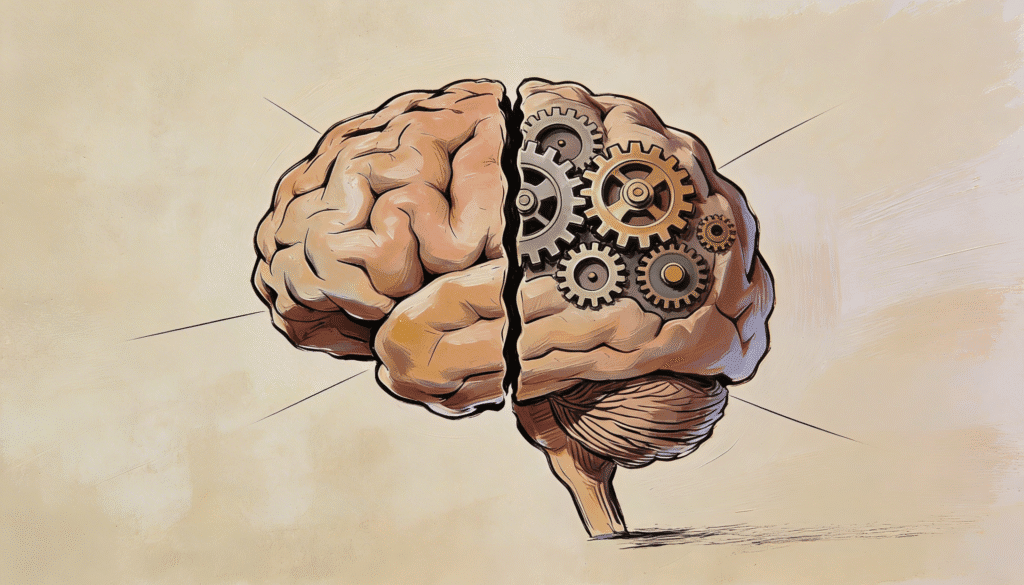
This is what Kuhn meant by a paradigm shift. It is not the addition of new information to an existing structure. It is the collapse of one structure and its replacement by another. And the experience, for the person going through it, is less like learning and more like conversion.
The Shift: You Do Not Argue Your Way Into a New Paradigm
This is perhaps Kuhn’s most provocative claim, and the one most relevant to anyone who has ever tried to change someone’s mind. Paradigm shifts do not happen through rational persuasion. They do not happen because someone presents a decisive argument. They happen for reasons that are partly rational, partly aesthetic, partly sociological, and partly generational.
When the Copernican model replaced the Ptolemaic model, it was not because someone found the one killer piece of evidence. The Copernican model, in its early versions, was not even more accurate. It had its own anomalies, its own awkward patches. What it had was elegance. Simplicity. A feeling of rightness that the old model had lost.
Kuhn pointed out something that made many scientists uncomfortable. When a paradigm shift occurs, the people who adopt the new framework often cannot prove it is better by the standards of the old one. The two paradigms are, in an important sense, incommensurable. They do not share enough common ground for a straightforward comparison. They define different problems as important. They use different standards of evidence. They even use the same words to mean different things.
This has a startling implication. If two people are operating inside different paradigms, they are not simply disagreeing about the facts. They are disagreeing about what counts as a fact, what counts as relevant, and what counts as an explanation. They are, in a very real sense, living in different worlds. And no amount of evidence marshaled from within one world will be compelling to someone who lives in the other.
This is why political arguments feel so futile. The progressive and the conservative are not looking at the same evidence and reaching different conclusions. They are looking at different evidence because their frameworks direct their attention to different things. They are asking different questions. And when they use words like “freedom” or “fairness” or “progress,” they often mean fundamentally different things. They are speaking different languages while using the same vocabulary.
Conversion, Not Persuasion
Kuhn noted that scientists who switch paradigms often describe the experience in language that sounds religious. They talk about scales falling from their eyes. They talk about suddenly seeing what was always there. They talk about a gestalt shift, like the famous image that is either a duck or a rabbit but never both at the same time.
This is deeply relevant for anyone trying to understand why facts alone do not change minds. You cannot argue someone out of a paradigm because the paradigm determines what arguments are valid. You cannot show someone evidence that contradicts their view because the paradigm determines what counts as evidence. You cannot appeal to logic because the paradigm shapes what feels logical.
What you can do, and what Kuhn’s history suggests actually works, is something much slower and less satisfying. You can create the conditions for crisis. You can keep pointing to the anomalies. You can offer an alternative framework that is ready when the old one collapses. And you can wait.
Max Planck, the physicist, put it more bluntly. Science advances one funeral at a time. Kuhn would not have phrased it that harshly, but the data supports the general idea. New paradigms often win not because they convert the old guard, but because the old guard eventually retires.
Beyond Science: Kuhn in the Wild
The reason Kuhn’s ideas have spread so far beyond the history of science is that they describe something universal about how belief systems work.
Consider the world of business. Clayton Christensen’s theory of disruptive innovation is essentially Kuhn’s paradigm shift applied to markets. Established companies fail not because they are incompetent, but because their entire framework for understanding what customers want and what products should be prevents them from seeing the disruption coming. Kodak understood photography. They understood it so well that they could not understand digital imaging. Their expertise was their blindfold.
Consider therapy. The process of changing deep beliefs about oneself, about relationships, about what is possible, looks remarkably like a paradigm shift. You cannot simply tell someone with depression that their thoughts are distorted and expect them to get better. The depression is the paradigm. It organizes all incoming information to confirm its own conclusions. Recovery involves a shift so fundamental that it feels like becoming a different person.
Consider even something as mundane as changing your diet. Anyone who has gone from eating one way to eating another knows the feeling. At some point, the old food stops looking like food. The shift is not just in behavior. It is in perception. The paradigm has changed.
What Kuhn Did Not Say
It is worth noting what Kuhn did not claim, because his ideas are often misused. He did not say that truth does not exist. He did not say that all paradigms are equally valid. He did not say that science is just politics by another name. He was describing a process, not making a relativist argument.
The history of science shows that paradigm shifts generally move toward greater accuracy, broader explanatory power, and deeper understanding. The Copernican model really was better than the Ptolemaic one. Einstein really did improve on Newton. The process is messy and human and often irrational in its mechanics, but the destination is real.
This matters because the fashionable misreading of Kuhn, the one that says your truth is just as good as my truth, actually undermines the more interesting and more useful lesson. The useful lesson is not that truth is relative. The useful lesson is that our access to truth is always mediated by frameworks, and those frameworks are sticky, and changing them requires more than evidence.
So What Do You Do With This?
If Kuhn is right, and the accumulated weight of evidence from psychology, sociology, and plain everyday experience suggests he is, then the implications for how we communicate and argue are significant.
First, stop leading with facts. Facts are only persuasive within a shared framework. If the framework is not shared, the facts will bounce off. They will not even register as facts.
Second, try to understand the other person’s paradigm. Not to agree with it. To understand what the world looks like from inside it. What problems does it solve? What questions does it make important? What fears does it address? A paradigm is not random. It is a response to real needs and real experiences.
Third, accept that the deepest changes happen slowly. They happen through accumulated anomalies, through the gradual erosion of confidence in old frameworks, through exposure to alternatives that might, over time, seem more livable. Nobody switches paradigms in a single conversation. If they seem to, the groundwork was laid long before you showed up.
Fourth, and this is the hardest one, apply this to yourself. Your own beliefs are organized inside paradigms too. You too are filtering evidence, ignoring anomalies, and experiencing your framework as reality rather than as a framework. The ability to recognize this is not the same as the ability to escape it. But it is a start.
Kuhn showed us that the advancement of knowledge is not a clean, linear process of adding true beliefs and discarding false ones. It is a lurching, human, sometimes painful process of building worlds and then, when the time is right, letting them collapse and building new ones. The facts matter. But they are never the whole story. The structure that holds the facts together matters more. And changing that structure is not an intellectual exercise. It is something closer to an act of courage.