Table of Contents
There is a peculiar kind of cruelty that disguises itself as compassion. It shows up in boardrooms and legislatures, in university policies and dinner table arguments. It says: everyone should end up in the same place, regardless of what they did to get there. It sounds generous. It sounds humane. And according to Ayn Rand, it is one of the most destructive ideas ever planted in the human mind.
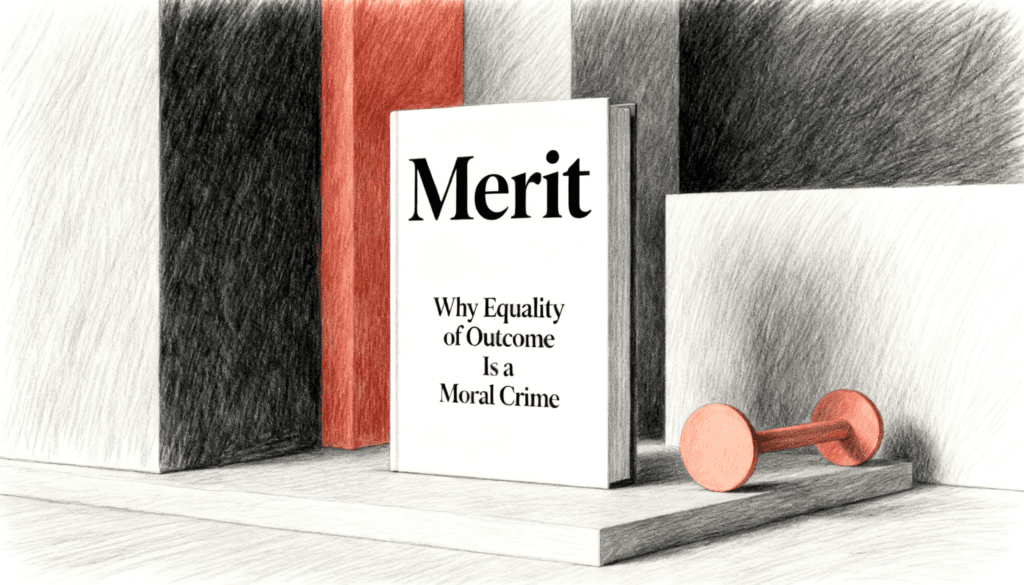
Rand did not mince words. She rarely did. For her, the push toward equality of outcome was not just bad economics or misguided policy. It was a moral crime. Not a metaphorical one. A literal assault on the individual, on reason, on the very engine that makes civilization possible. That engine, in her view, was merit.
Before you dismiss this as the cold calculus of someone who never struggled, consider the argument on its own terms. Because whether you end up agreeing with Rand or wanting to throw this article across the room, the questions she raised are not going away. If anything, they have become more urgent.
The Difference That Changes Everything
Let us start with a distinction that gets blurred so often it might as well not exist anymore. Equality of opportunity and equality of outcome are not the same thing. They are not even distant cousins. They are opposing philosophies that lead to radically different worlds.
Equality of opportunity says: clear the obstacles. Let people compete on a level field. Do not rig the game based on birth, race, or connections. It is a principle rooted in fairness, and most reasonable people across the political spectrum can find something to agree with here.
Equality of outcome says something else entirely. It says: regardless of effort, talent, discipline, or choice, everyone should arrive at the same destination. The engineer and the person who never opened a textbook should have comparable lives. The entrepreneur who risked everything and the person who risked nothing should share similar rewards.
Rand saw this second idea as an abomination. Not because she lacked empathy, though her critics would certainly argue that point. She opposed it because she believed it required the systematic punishment of ability. To make outcomes equal, you must take from those who produce and give to those who do not. And that transaction, repeated across an entire society, does not create fairness. It creates a machine that devours its best parts first.
The Looters and the Makers
In Atlas Shrugged, Rand constructed an entire fictional world around this tension. The producers, the thinkers, the creators gradually withdraw from a society that punishes them for their competence. What remains is a civilization running on fumes, coasting on the achievements of people it drove away.
It is fiction, yes. But fiction with a disturbing echo. Consider how many skilled professionals leave overtaxed regions for friendlier jurisdictions. Consider how many talented people in heavily regulated industries quietly decide that the effort is not worth the penalty. Rand would not have been surprised by any of it. She would have said she wrote the script decades ago.
Her villains were not monsters with obvious fangs. They were bureaucrats with good intentions. Politicians who spoke about the common good while dismantling the conditions that made good things common. She called them looters and moochers, terms that sound harsh until you watch a system actively discourage the people it depends on most.
The provocation here is deliberate. Rand wanted you to feel uncomfortable with the idea that compassion, taken to its logical extreme, becomes parasitism. That a society which refuses to reward excellence will eventually run out of excellence to redistribute.
Merit as a Moral Principle
Here is where Rand parts company with most modern thinkers, and where her argument becomes genuinely interesting rather than merely provocative.
For Rand, merit was not just a practical consideration. It was a moral one. She built an entire ethical system, which she called Objectivism, around the idea that the rational, productive individual is the highest moral agent. Not the self sacrificing saint. Not the dutiful servant of the collective. The person who uses their mind, creates value, and refuses to apologize for it.
This is not, despite what critics claim, a philosophy of greed. Rand distinguished sharply between earning and taking. The businessman who builds something people voluntarily pay for is not the same as the thief who takes at gunpoint. But in Rand’s view, a government that forcibly redistributes the businessman’s earnings is morally closer to the thief than most people are comfortable admitting.
Merit, in this framework, is sacred. Not because wealthy people deserve worship, but because the principle of rewarding achievement is what makes achievement possible. Destroy that principle and you do not get equality. You get stagnation dressed in the language of justice.
Think of it the way a biologist might think about evolution. An ecosystem that punished successful adaptation would not produce a richer variety of life. It would produce a swamp. Rand saw forced equality of outcome as precisely this kind of evolutionary punishment applied to human society. The organisms that figure out how to thrive get cut down so the ones that did not bother can feel less inadequate. It is a strategy with a one hundred percent failure rate in nature. Rand argued it does not perform any better in civilization.
The Compassion Trap
Now, here is where the argument gets genuinely difficult. Because the case for equality of outcome does not come from nowhere. It comes from a real observation: people do not start from the same place. Some are born into wealth. Some are born into misery. Some have access to education, nutrition, stability. Others do not. Pretending that outcomes reflect pure merit in a world this uneven is, at best, naive.
Rand knew this objection. She was born Alisa Rosenbaum in St. Petersburg, watched the Bolsheviks confiscate her father’s business, and fled the Soviet Union with almost nothing. She understood disadvantage from the inside. And she still concluded that the answer was not to flatten outcomes, but to remove the barriers that prevent people from rising.
The distinction matters enormously. Removing barriers is an act of liberation. Flattening outcomes is an act of control. One says: you are free to become what you can. The other says: you will become what we allow. Rand saw the second message hiding inside every policy that promised to make things fair by making things equal.
And here is the counter intuitive part. Policies designed to equalize outcomes often hurt the people they claim to help. When you tell someone that their results will be guaranteed regardless of their effort, you have not empowered them. You have robbed them of the single most important thing a human being can possess: a reason to try. Rand would have called this the deepest cruelty of the welfare state. Not that it fails to provide. But that it succeeds in removing the need to strive.
The Aristocracy Nobody Voted For
Rand used the word “aristocracy” intentionally, and it is worth pausing on why. Traditional aristocracies were based on blood. You were born into power or you were not. Merit had nothing to do with it. Rand proposed a different kind of aristocracy. One based entirely on what you do rather than who you are.
This is, when you think about it, the most democratic idea imaginable. An aristocracy of merit does not care about your last name, your skin color, or your postal code. It cares about what you bring to the table. It is blind in the way that justice is supposed to be blind but never quite manages.
The irony is that many people who oppose meritocracy do so in the name of democracy. But forced equality of outcome is not democratic at all. It requires a ruling class to decide what equal looks like, who gets cut down and who gets propped up. It requires, in other words, an aristocracy of administrators. And unlike Rand’s aristocracy of merit, this one is accountable to nobody and produces nothing.
Rand would have found it darkly amusing that the people most loudly opposed to elitism tend to create the most entrenched and unaccountable elite of all. The planner. The regulator. The committee member who has never built a thing in their life but holds absolute power over those who have.
The Real Crime
Still, the core of Rand’s argument remains stubbornly powerful. When a society decides that outcomes must be equal, it necessarily declares war on the people who would have risen above the average. It tells the gifted student that his achievement is a problem to be solved. It tells the brilliant entrepreneur that his success is evidence of someone else’s failure. It tells the artist, the inventor, the relentless worker that their exceptional results are a form of injustice.
This is what Rand meant by moral crime. Not a crime of violence, though she argued it often led there. A crime of spirit. A crime against the idea that human life has purpose, that effort matters, that the mind is sovereign. When you make equality of outcome the goal, you do not raise the bottom. You lower the ceiling. And eventually, everyone is standing in the same room, equally diminished, wondering why nothing works anymore.
There is a passage in The Fountainhead where the character Ellsworth Toohey explains his strategy for control. He does not destroy greatness by attacking it directly. He destroys it by convincing people that greatness does not exist. That everything is the same. That the brilliant architect and the hack are interchangeable. It is the most chilling passage Rand ever wrote, because it does not describe a fantasy. It describes a strategy we can see playing out in real time, in every institution that replaces standards with quotas and achievement with compliance.
What We Owe Each Other
Rand is often accused of advocating selfishness, and she did, though her definition of selfishness was not what most people assume. She did not mean trampling others. She meant refusing to sacrifice your mind, your work, and your life to the demands of people who have no claim on them.
The question she forces us to confront is uncomfortable but necessary: what do we actually owe each other? Do we owe each other opportunity? Most people would say yes. Do we owe each other equal results? Rand said absolutely not.
Societies that have pursued equality of outcome most aggressively have produced neither equality nor prosperity. The Soviet experiment that Rand fled did not create a workers paradise. It created a system where everyone was equally miserable except the party officials, who were more equal than others. Orwell noticed the same pattern from a completely different political vantage point. When two thinkers as different as Ayn Rand and George Orwell arrive at the same conclusion, it might be worth taking seriously.
The aristocracy of merit is not perfect. No human system is. But it has one virtue that no alternative has matched: it rewards the thing that makes civilizations rise rather than the thing that makes them fall. It rewards the act of creation. It rewards the mind at work. And it trusts individuals to be the architects of their own lives rather than the raw material for someone else’s utopian blueprint.
Rand would not have wanted you to agree with her because she said so. She would have wanted you to think about it. To reason your way through the argument and arrive at your own conclusion. That, after all, was the whole point.
The mind, working freely, accountable to reality, and unchained from the guilt of being excellent. That was her aristocracy. And whatever you think of the woman who proposed it, the idea refuses to die.