Table of Contents
There is a comfortable story we tell ourselves about the Enlightenment. It goes something like this: brave thinkers stood up against kings and priests, championed the common people, and lit the fuse that would eventually explode into democracy. Voltaire sits near the center of this story, usually holding a quill and looking defiant. The problem is that Voltaire himself would have found this narrative ridiculous.
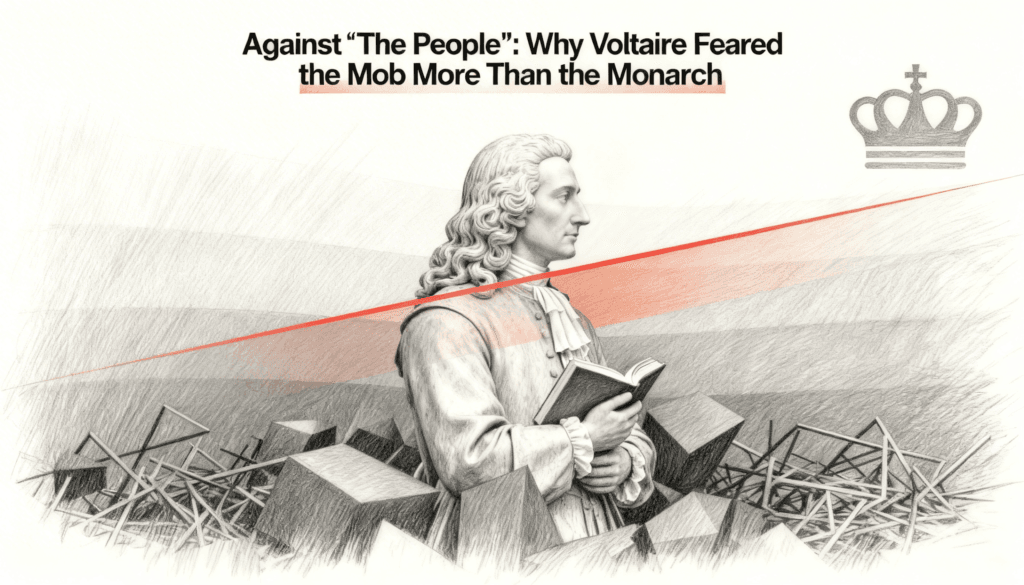
The man who spent his life attacking tyranny was also, without apology, terrified of the masses. He did not want the people to rule. He did not think they could. And if you read him carefully rather than selectively, you find an argument that is not only coherent but uncomfortably relevant to anyone watching politics in the twenty first century.
The Philosopher Who Loved a King
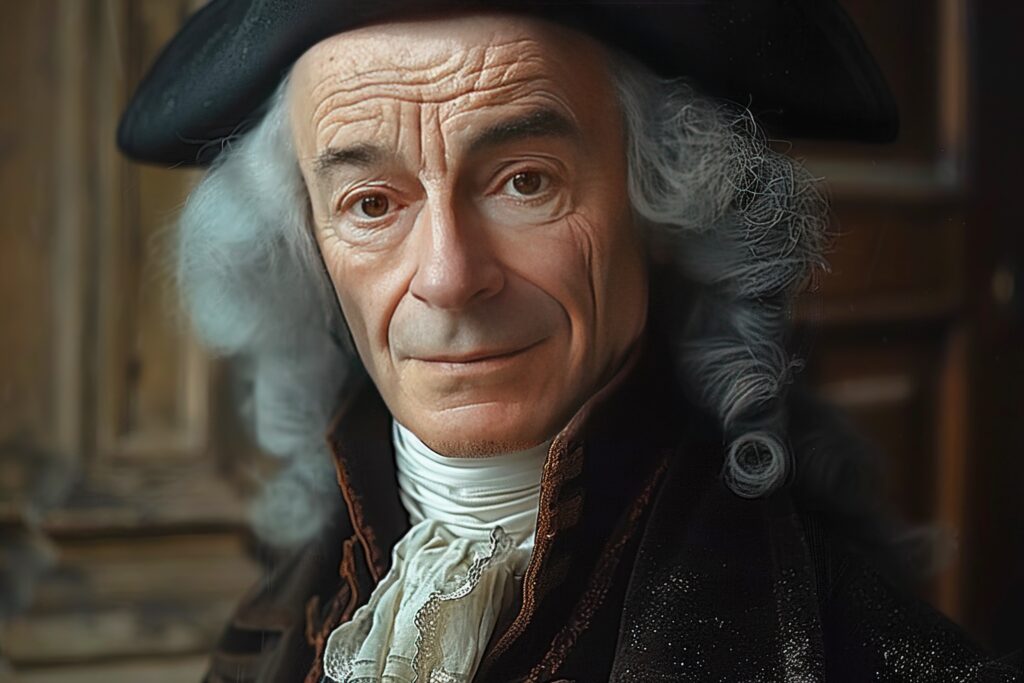
Voltaire did not hide his preferences. He spent years at the court of Frederick the Great of Prussia, not as a prisoner or a reluctant guest, but as an enthusiastic collaborator. He corresponded warmly with Catherine the Great of Russia. He admired enlightened monarchs the way a coach admires talented athletes. They had power, and he believed he could shape how they used it.
This was not hypocrisy. It was strategy. Voltaire looked at the political landscape of eighteenth century Europe and made a calculation. Reform, he concluded, was more likely to come from the top than from below. A single educated ruler could abolish torture, reform the courts, protect religious minorities, and promote science. The people, left to their own instincts, were more likely to burn a heretic than build a library.
This is the part of Voltaire that modern admirers tend to skip over. We quote his wit, his attacks on the Church, his defense of tolerance. We do not quote his repeated insistence that the “rabble” was unfit to govern, or his frank admission that philosophy was not for everyone. “When the populace meddles in reasoning,” he wrote, “everything is lost.”
That line is not a throwaway remark. It is a thesis.
What Voltaire Actually Saw
To understand why Voltaire thought this way, you have to understand what he witnessed. He did not live in an age of public education and widespread literacy. The France of his time was a country where the vast majority of people could not read, had never traveled more than a few miles from their birthplace, and received their understanding of the world almost entirely from local priests. Superstition was not a metaphor. It was the operating system of daily life.
Voltaire saw mobs celebrate public executions. He saw crowds cheer when alleged witches were punished. He watched as Jean Calas, a Protestant merchant in Toulouse, was tortured and executed on a wheel in 1762, convicted of murdering his own son based on little more than anti Protestant hysteria whipped up among the local population. It was not the king who killed Calas. It was the enthusiasm of ordinary people, channeled through a corrupt local court, that made the execution possible.
The Calas affair became one of Voltaire’s great causes. He campaigned for years to rehabilitate the dead man’s name. But the lesson he drew from it was not that the system needed more democracy. It was that the system needed more reason. And reason, in his view, was not evenly distributed.
This is where Voltaire’s position becomes genuinely interesting rather than merely elitist. He was not arguing that common people were inherently inferior in some biological sense. He was arguing that ignorance, which was a product of circumstance, made people dangerous when they acted collectively. The mob did not think. It reacted. It followed whoever shouted loudest. And the things it was most passionate about were often the things it understood least.
The Paradox of Popular Passion
There is a pattern in Voltaire’s thinking that connects surprisingly well to modern behavioral psychology. He noticed, long before anyone had the vocabulary for it, that groups of people behave differently than individuals. A single peasant, encountered on a road, might be perfectly reasonable. Put a thousand of them together, give them a grievance and a target, and something else takes over.
Daniel Kahneman, writing more than two centuries later, would describe this as the difference between slow, deliberate thinking and fast, emotional reaction. Voltaire did not have Kahneman’s framework, but he had eyes. He could see that collective action was almost always driven by passion rather than reflection. The crowd at an execution was not weighing evidence. It was experiencing a communal emotion, something closer to religious ecstasy than to rational judgment.
This observation put Voltaire in an awkward position. He believed in reason above all things. He also believed that most people, most of the time, did not use it. The solution could not be to simply hand power to the majority, because the majority was precisely the group most vulnerable to manipulation by demagogues, priests, and anyone else skilled at inflaming passions.
Here is where a modern reader might object: is this not just snobbery dressed up in philosophical language? Perhaps. But Voltaire would point out that snobbery and accuracy are not mutually exclusive.
Enlightened Despotism: The Least Bad Option
Voltaire’s preferred system, what historians call enlightened despotism, sounds almost absurd to modern ears. The idea is simple: give power to a single ruler, but make sure that ruler is educated, rational, and advised by philosophers. The philosopher whispers in the king’s ear, and the king makes good policy. The people benefit without having to participate in decisions they are not equipped to make.
The obvious problem is also simple: what happens when the despot is not enlightened? What happens when the king is a fool, or a tyrant, or simply loses interest in being reasonable? Voltaire knew this was a risk. He experienced it firsthand when his friendship with Frederick the Great soured. Frederick turned out to be a brilliant military strategist and a ruthless political operator who was not always interested in taking advice from French intellectuals.
But Voltaire never fully abandoned the model. He adjusted his expectations rather than his theory. A flawed king guided by good advisors was still, in his calculation, better than an ungoverned crowd guided by superstition. The risk of one bad ruler was preferable to the certainty of collective irrationality.
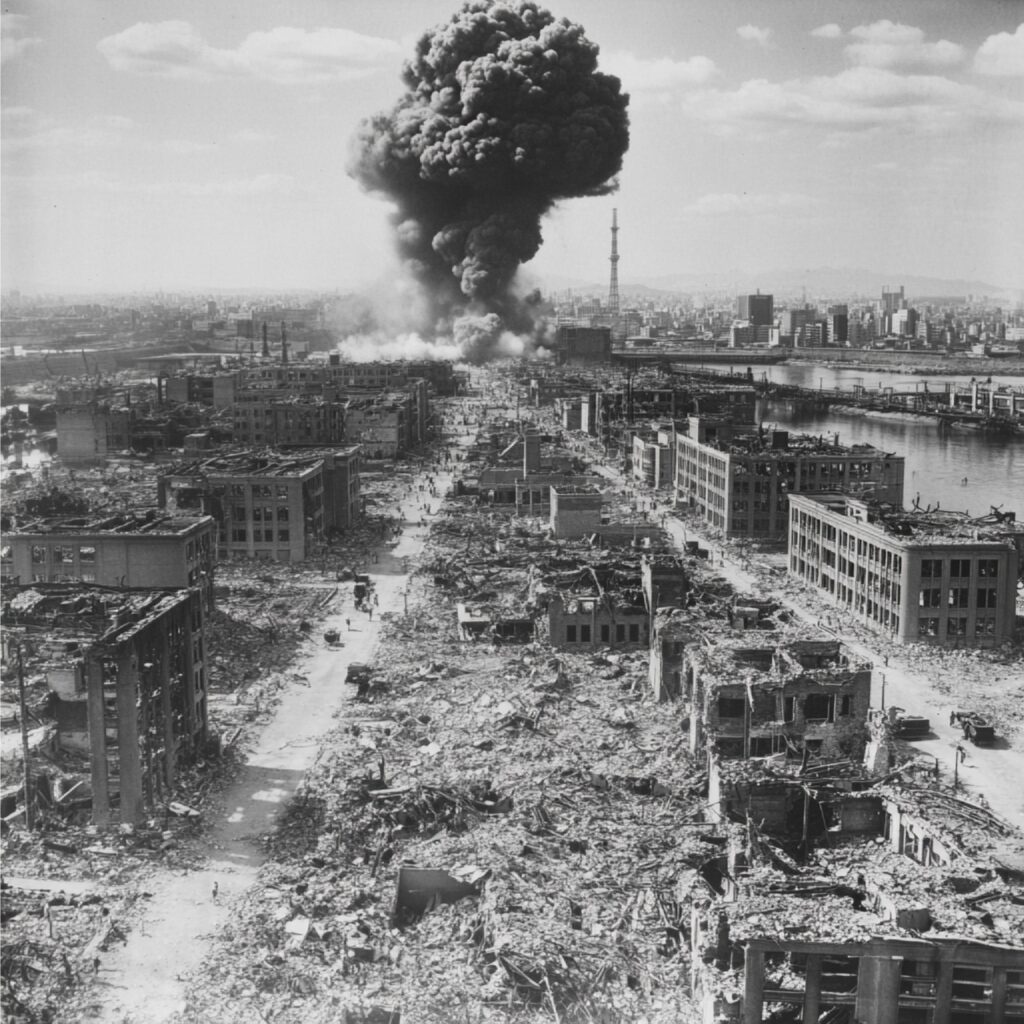
This is a genuinely difficult argument to dismiss. Not because it is right in some absolute sense, but because the alternatives have their own catastrophic failure modes. Democracy can produce demagogues. Mob rule can produce terror. The French Revolution, which arrived just eleven years after Voltaire’s death, would demonstrate exactly the kind of popular violence he had feared. The very people who stormed the Bastille in the name of liberty would, within a few years, be cheering as the guillotine worked overtime.
Voltaire did not live to see the Terror. But it is hard to read his warnings about the mob and not feel that he saw it coming.
The Religion Problem
You cannot separate Voltaire’s distrust of the masses from his war against organized religion. For Voltaire, the two problems were deeply connected. The Church kept people ignorant. Ignorant people were easy to manipulate. Manipulated people formed dangerous mobs. The cycle was self reinforcing.
But here is the counterintuitive twist: Voltaire did not want to take religion away from ordinary people. He famously argued that if God did not exist, it would be necessary to invent him. This was not a statement of personal faith. It was a statement of social engineering. The common people needed something to keep them in line, and religion, properly managed, could serve that function better than philosophy ever would.
This is Voltaire at his most cynical and, depending on your perspective, his most realistic. He understood that you cannot govern a society purely through rational argument. People need stories, rituals, and moral frameworks. The problem was not religion itself but religion in the hands of fanatics. A state controlled, reasonable, watered down version of faith was fine. Enthusiasm was the enemy.
There is something almost corporate about this vision. Voltaire wanted to manage belief the way a modern executive might manage a brand. Control the message. Keep it simple. Do not let anyone get too excited. It is a cold way to think about human spiritual life, but it has a certain brutal pragmatism to it.
What Voltaire Got Wrong
The most obvious criticism of Voltaire’s position is that he underestimated people. History has shown, unevenly and imperfectly, that ordinary citizens can participate meaningfully in self governance when given education, information, and functioning institutions. The literacy rates that horrified Voltaire in eighteenth century France are no longer the norm in most of the world. The superstitions he railed against have retreated, though they have not disappeared.
Voltaire also failed to account for the ways in which concentrated power corrupts even the most enlightened rulers. His model depended on the philosopher having access to the king, and the king having the wisdom to listen. In practice, power tends to insulate itself from criticism. The very qualities that make someone effective at seizing and holding power are often the qualities that make them least receptive to advice from intellectuals. Frederick the Great did not keep Voltaire around because he wanted honest counsel. He kept him around because having a famous philosopher at court was good for his reputation.
There is also a deeper philosophical problem. If you believe, as Voltaire claimed to, that all human beings possess the capacity for reason, then denying them political agency on the grounds that they have not yet developed that capacity is a self defeating argument. You are essentially saying that people cannot be trusted with freedom until they have been educated, but you are also placing the responsibility for that education in the hands of rulers who benefit from keeping people uneducated. The system has no built in mechanism for its own improvement.
What Voltaire Got Right
And yet. Strip away the aristocratic contempt, the snobbery, the casual dismissals of “the rabble,” and there is something in Voltaire’s argument that refuses to go away.
He was right that collective passion is dangerous. He was right that demagogues exploit ignorance. He was right that mobs do not deliberate. He was right that the loudest voice in a crowd is rarely the wisest. He was right that political systems need mechanisms to protect reason from the tyranny of popular emotion.
Modern democracies have, in fact, built many of the safeguards Voltaire would have approved of. Constitutional protections, independent judiciaries, separation of powers, institutional checks on majority rule: these are all, in a sense, Voltairean devices. They exist precisely because the framers of democratic systems recognized that pure majority rule, unchecked by institutional restraints, could produce outcomes as tyrannical as any monarchy.
The irony is thick. The democratic systems that Voltaire would have distrusted have survived in large part because they incorporated his distrust of the people into their design. Every time a court strikes down a popular law because it violates constitutional rights, Voltaire wins a small, posthumous victory.
The Uncomfortable Relevance
It would be comforting to treat Voltaire’s fear of the mob as a historical curiosity, the predictable prejudice of an eighteenth century aristocrat who simply could not imagine a world of educated citizens. But the twenty first century has not been kind to that comfortable dismissal.
The rise of populist movements across the globe, the weaponization of misinformation on social media, the ease with which large groups of people can be mobilized around conspiracy theories and manufactured outrage: Voltaire would have recognized all of it. The technology has changed. The dynamic has not.
He would not have been surprised to learn that the greatest information system ever created, the internet, has also become the greatest engine of misinformation ever built. He understood that access to information is not the same as the capacity to evaluate it. Giving everyone a printing press does not make everyone a philosopher. It makes some people philosophers and other people pamphleteers for whatever cause happens to be trending.
Voltaire would probably say we are not negotiating it very well. He would say it with a devastating one liner, of course, because he was Voltaire. And then he would go back to writing letters to whoever happened to be in charge, hoping that this time the person with the crown might also have a brain.
Some arguments do not expire. They just keep finding new evidence.