Table of Contents
There is a strange moment that happens to almost every serious gamer. You are grinding through a dungeon, picking up loot, selling items at an auction house, and suddenly you realize something uncomfortable. The economy inside this game makes more sense than the one outside your window.
That is not a joke. It is not even an exaggeration. And a French economist who died 200 years ago can explain exactly why.
Jean-Baptiste Say published A Treatise on Political Economy in 1803. His most famous contribution, known today as Say’s Law, is often compressed into a bumper sticker: “Supply creates its own demand.” But that compression misses the point entirely. What Say actually argued was deeper and, for our purposes, far more interesting. He said that production is the source of demand. You can only buy things because you first produced something to trade. Money is just the middleman. The real economy is goods exchanging for goods. Money is the courtesy car that drives between them.
Now hold that thought while we teleport into Azeroth.
The World of Warcraft Economy Does What Washington Cannot
In World of Warcraft, gold enters the economy when players complete quests, kill monsters, and sell vendor trash. Gold leaves the economy when players pay for repairs, buy mounts, learn skills, and use the auction house (which takes a cut of every transaction). This is not accidental. Blizzard Entertainment employs actual economists to manage these flows.
Here is what makes this remarkable. The WoW economy has sinks and faucets. Gold is created through productive activity and destroyed through consumption. Every piece of currency in the system can be traced back to someone doing something. A player who has 50,000 gold earned it, traded for it, or received it from someone who did. There is no central bank conjuring gold out of nothing and lending it to the kingdom at interest.
Say would have loved this. In WoW, supply literally creates its own demand. A blacksmith who forges a rare sword has, by the act of producing it, created the purchasing power to demand something else. The economy is circular. It is grounded. It is, in the most fundamental sense, real.
Now look at the US dollar. Since 1971, when Nixon severed the last link between the dollar and gold, the currency has been backed by exactly one thing: the promise that the government will not do anything too reckless with it. This is like backing your marriage with the promise that you will probably not set the house on fire. Technically reassuring. Practically incomplete.
Say’s Law and the Problem of Production Without Product
Say’s core insight was that you cannot have a general glut in an economy. If people are producing, they are simultaneously creating the demand to consume. Economic downturns do not come from “too much stuff.” They come from mismatches. The wrong stuff gets produced. Resources flow to the wrong places. The signal system breaks.
And what is the signal system? Prices. Prices denominated in money.
This is where things get interesting. Say understood that money is a veil over the real economy. But he also understood that the veil matters. If the money is broken, the signals are broken. If the signals are broken, production goes haywire. People build houses nobody wants. They manufacture financial products that produce nothing. They create entire industries around moving money from one pocket to another while calling it “value added.”
Video games do not have this problem. Or rather, the good ones do not. In a well designed game economy, every item exists because someone gathered the materials and crafted it, or because the game rewarded a player for completing a challenge. The connection between effort and reward is transparent. You can see the supply chain. You can trace the provenance of every asset.
In the US economy, can you trace the provenance of a dollar? You cannot. A dollar might have been printed by the Federal Reserve to buy a Treasury bond that was issued to fund a deficit that was created to stimulate demand that was lagging because previous stimulus had misallocated resources. Try fitting that on a receipt.
The Auction House vs. The Stock Market
Consider the auction house in any major MMO. It is a marketplace where players list items and other players buy them. Prices fluctuate based on supply and demand. If a new raid drops and everyone needs fire resistance potions, the price of those potions spikes. When the raid becomes old content and fewer people run it, the price drops. This is price discovery in its purest form.
The stock market is supposed to work the same way. And sometimes it does. But the stock market also has high frequency trading algorithms that execute thousands of trades per second, not to discover prices but to exploit microsecond advantages. It has options on options. Derivatives of derivatives. It has companies buying back their own stock with borrowed money to inflate earnings per share. It has the Federal Reserve buying corporate bonds during a crisis, which is a bit like the dungeon master buying items from their own auction house to keep prices from falling.
Say warned about this, in his own 19th century way. He argued that when government interferes with the natural flow of production and exchange, it does not fix imbalances. It creates new ones. The interference does not disappear. It accumulates. It compounds. And eventually the distance between the signal (price) and the reality (value) becomes so vast that corrections are not gentle. They are violent.
In EVE Online, another game famous for its economy, the developers at CCP Games once had to deal with a massive financial fraud. A player running an in game bank called EBank embezzled what amounted to around 200 billion ISK. The response? The community dealt with it. Prices adjusted. Trust recalibrated. The economy absorbed the shock because it was fundamentally grounded in real productive activity within the game world.
When something similar happens in the real economy, we get 2008.
The Counterfeit Problem No Game Has
Here is a counterintuitive observation. Video game currencies face an existential threat that the US dollar does not: duplication glitches. If someone discovers a bug that lets them copy gold infinitely, it can destroy the entire economy overnight. Game developers treat these bugs as top priority emergencies. They patch them immediately. They sometimes roll back entire servers.
Now consider this: the US dollar has a legalized version of the duplication glitch. It is called fractional reserve banking. A bank takes in $100 in deposits and lends out $90. That $90 gets deposited at another bank, which lends out $81. And so on. From a single $100 deposit, the banking system creates roughly $1,000 in total money supply. This is not a bug. It is the feature.
Say could not have imagined this specific mechanism, but he understood the principle. When money creation becomes detached from production, the money loses its meaning. It still works as a medium of exchange, but it stops working as a reliable signal. And when the signal dies, so does rational economic planning.
Game developers understand instinctively what central bankers seem to have forgotten: the integrity of the currency is the integrity of the economy. Break one and you break the other.
Why Gamers Understand Inflation Better Than Economists
Ask the average World of Warcraft player what causes inflation and they will tell you without hesitation: too much gold entering the system without enough gold sinks to remove it. They know this because they live it. When Blizzard introduces a new expansion and gold flows freely from new quests, prices at the auction house spike. Players complain. They adjust their strategies. They demand that the developers “fix the economy.”
Ask the average person on the street what causes inflation and you get a blank stare, or maybe something about corporate greed. Ask an economist and you get a 45 minute lecture involving Phillips curves, output gaps, and expectations anchoring that somehow ends with “it is transitory.”
The gamer is closer to Say than the economist is. Say would have said inflation is what happens when money creation outpaces production. Full stop. You do not need a PhD to understand this. You need a level 60 character and a functioning auction house addon.
This connects to something fascinating in behavioral economics. Dan Ariely’s research on the “IKEA effect” shows that people value things more when they have a hand in creating them. Gamers value their in game currency precisely because they earned it through effort. Every gold piece has a memory attached: that quest, that raid, that lucky drop. The US dollar, printed in abstraction and distributed through mechanisms most people cannot explain, carries no such weight.
The Objection You Are Already Thinking
Someone reading this is preparing to object: “But video game economies are not real. You cannot buy groceries with WoW gold. You cannot pay rent with ISK.”
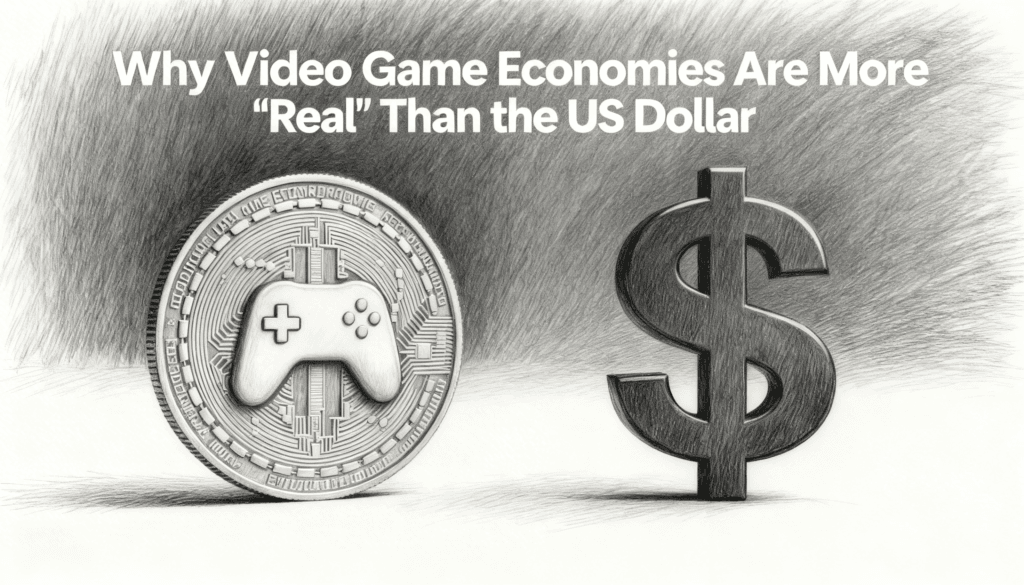
Fair enough. But consider what “real” means in this context. If “real” means widely accepted as a medium of exchange, then yes, the dollar wins. If “real” means grounded in production, transparent in its creation, honest in its signals, and resistant to manipulation by a small group of unelected officials, then World of Warcraft’s economy is more real than the US dollar by every meaningful measure.
Say would have added another layer. He would have pointed out that the acceptance of the dollar is not purely voluntary. You must pay taxes in dollars. You must settle legal debts in dollars. This is legal tender law, and it is the equivalent of a game forcing you to use its currency by banning all alternatives. The difference is that when a game does this, people call it a design choice. When a government does it, people call it monetary sovereignty.
What We Can Actually Learn
This is not an argument that we should replace the dollar with RuneScape gold. That would be insane, and also the exchange rate would be terrible. But the comparison reveals something that Say tried to tell us over two centuries ago: healthy economies are built on production, not on money creation. Money should represent value that already exists, not value that we hope will exist someday if the GDP growth projections are right and interest rates cooperate and nobody in Congress does anything catastrophically stupid.
Video game economies, for all their artificial constraints, get this relationship right. They have to. If Blizzard prints too much gold, players quit. If CCP lets fraud go unpunished, the trust economy collapses. If a game’s rewards do not align with effort, nobody plays. The feedback loop is immediate and unforgiving.
The US economy has feedback loops too. They are just longer. Sometimes decades longer. And in those decades, enormous distortions can build up, hidden by the complexity of the system and the willingness of participants to believe that this time it is different.
Say understood that production is the foundation of everything. Not money. Not credit. Not financial engineering. Production. Making things. Providing services. Solving problems. Everything else is infrastructure that either supports that foundation or slowly undermines it.
The irony is almost too clean. We built virtual worlds to escape reality, and in doing so, we accidentally built economies that are more honest than the one we live in. The game is fake. The economy is real. The dollar is real. The economy it represents is increasingly fictional.
Jean-Baptiste Say tried to explain this in 1803. It took us two centuries and a bunch of video games to finally see what he meant.