Table of Contents
You’re scrolling through your phone again. Another video, another post, another dopamine hit. You tell yourself you’ll stop in five minutes, but five minutes becomes fifty. When you finally put the device down, you feel somehow emptier than before.
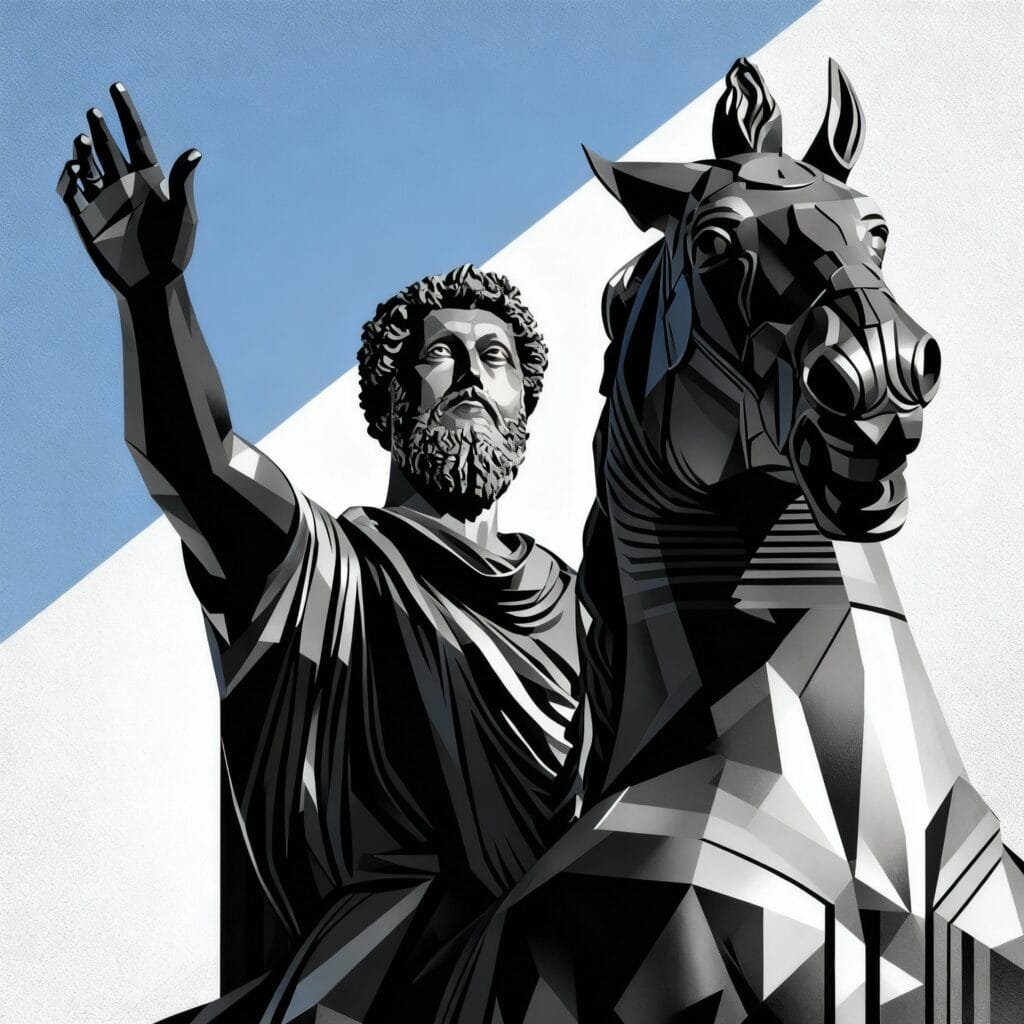
A Roman emperor figured out why this happens nearly two thousand years ago. He did it without Netflix, TikTok, or smartphones. He did it while running an empire, fighting wars, and dealing with a plague. His name was Marcus Aurelius, and his private journal entries read like he was sitting in your living room, watching you reach for your phone for the hundredth time today.
Here’s the strange part. Marcus Aurelius wasn’t writing a self-help book. He was writing reminders to himself because he struggled with the same thing you do. The man who had access to literally any entertainment the Roman Empire could provide spent his nights writing about why none of it satisfied him.
The Emperor’s Confession
Marcus Aurelius had everything. Gladiatorial games designed specifically for his amusement. The best musicians, actors, and performers in the known world. An entire empire dedicated to keeping him entertained. And yet, in his private writings, he sounds exhausted by it all.
“How much time he gains who does not look to see what his neighbor says or does or thinks, but only at what he does himself,” he wrote. This wasn’t philosophy for the masses. This was a man trying to convince himself to stop caring about the Roman equivalent of social media.
The interesting thing is what he noticed about entertainment. He saw that the games, the performances, and the spectacles all worked the same way. They pulled your attention outward. They made you focus on anything except your own thoughts. And the moment they ended, you needed more.
He described watching the same gladiatorial fights over and over and realizing they were basically identical. Different people, same structure. Different blood, same ending. The novelty wore off fast, but the craving didn’t. Sound familiar?
The Distraction Engine
Marcus Aurelius identified something that modern neuroscience has confirmed. Entertainment doesn’t make us happy. It makes us forget we’re unhappy. There’s a massive difference between those two states, but we pretend there isn’t because one is much easier to achieve than the other.
Think about the last time you binged a TV series. While you were watching, you weren’t worried about work, relationships, or that vague sense of anxiety that follows you around. The moment the credits rolled, all of it came flooding back. The show didn’t solve anything. It just hit pause on your awareness.
Marcus Aurelius called this “living in the external.” He saw citizens of Rome structuring their entire lives around the next games, the next festival, the next public spectacle. They were outsourcing their emotional regulation to events they had no control over. When the entertainment was good, they felt good. When it wasn’t, they blamed the quality of the show rather than examining why they needed the show in the first place.
The emperor realized something counterintuitive. The people who had the most access to entertainment were often the most miserable. Senators and wealthy Romans could attend every event, hire private performers, and throw elaborate parties. Yet they seemed more desperate for the next distraction than the common people who could only afford occasional visits to the Colosseum.
More access didn’t lead to more satisfaction. It led to faster adaptation and stronger cravings.
Why Silence Feels Like Punishment
Here’s what Marcus Aurelius understood that most of us don’t want to admit. We’re not seeking entertainment. We’re fleeing boredom. And we’re not actually fleeing boredom itself. We’re fleeing what boredom forces us to confront.
When you sit in silence with nothing to distract you, thoughts arise. Some are trivial. Many are uncomfortable. You remember that argument you had. You think about that deadline you’re avoiding. You feel the low hum of anxiety that you’ve learned to drown out with podcasts, music, videos, and endless scrolling.
Marcus Aurelius spent a lot of time in military camps where entertainment was limited. He noticed that soldiers who couldn’t handle silence were the same ones who made impulsive decisions in battle. The inability to sit with discomfort in peacetime translated to poor judgment when stakes were high.
“Nowhere can man find a quieter or more untroubled retreat than in his own soul,” he wrote. Then immediately added observations about how most people will do anything to avoid that retreat. They’ll seek out noise, crowds, and stimulation specifically because silence brings them face to face with themselves.
The craving for constant entertainment is really a craving for constant escape. From what? From the default state of human consciousness, which tends toward reflection, evaluation, and the recognition of mortality.
The Theater Trick
Marcus Aurelius made an observation about Roman theater that applies perfectly to modern streaming services. He noticed that audiences got upset when plays ended unhappily, even though they knew from the beginning that the characters weren’t real.
People invested emotional energy in fictional outcomes while ignoring real problems in their actual lives. They’d leave the theater arguing about plot points with more passion than they showed when discussing real political issues affecting their families.
This wasn’t stupidity. This was strategic deployment of attention. Fiction offered clear problems with resolution in two hours. Real life offered complex problems with no clear solutions. Obviously, the brain preferred one over the other.
The emperor saw wealthy Romans who could recite every detail of the latest theatrical performances but couldn’t tell you the names of their own slaves. They knew character arcs but not their children’s fears. They were experts in fictional drama and amateurs in their own lives.
Marcus Aurelius didn’t judge this harshly. He noted it as a feature of human psychology. We’re built to engage with stories because stories have structure. They have rising action, climax, and resolution. Real life mostly has maintenance, uncertainty, and gradual change. One makes you feel something immediately. The other requires patience and offers no guaranteed emotional payoff.
The Appetizer That Never Becomes a Meal
Here’s the part that Marcus Aurelius really nailed. Entertainment promises fulfillment but only delivers temporary relief from the desire for fulfillment. It’s like drinking saltwater when you’re thirsty. The act of drinking feels like you’re solving the problem, but you’re actually making it worse.
He watched people attend games, feel excited during, feel empty after, and then immediately start talking about the next games. The cycle was self-perpetuating. The entertainment didn’t satisfy the craving. It just reset it with a slightly higher threshold.
Modern psychology calls this hedonic adaptation, but Marcus Aurelius understood it through simple observation. He saw that no matter how spectacular the entertainment, people adjusted to it. What seemed amazing the first time became expected the second time and boring the third time. So the entertainment had to escalate. Bigger spectacles. More exotic animals. Greater violence.
The Roman games became increasingly elaborate not because audiences loved them more, but because they felt them less. You need stronger stimulation to achieve the same effect. This is addiction mechanics playing out at a cultural level.
Marcus Aurelius saw this pattern in his own life too. He had access to the finest foods, but he noted they brought him no more satisfaction than simple bread. The elaborate meals required more preparation, more expense, and more cleanup, but the actual eating experience wasn’t proportionally better. The return on investment diminished sharply.
What Actually Works
So what was Marcus’s solution? This is where it gets both simple and difficult.
He didn’t advocate for abandoning all entertainment. He advocated for examining why you’re seeking it. The difference is everything.
Watching a play because you genuinely enjoy theater is one thing. Watching a play because you can’t stand being alone with your thoughts is another. Same activity, completely different psychological function.
Marcus Aurelius practiced what he called “withholding assent.” When he felt the urge for distraction, he’d pause and ask himself what he was actually craving. Usually, it wasn’t the entertainment itself. It was relief from some uncomfortable feeling. Once he identified the feeling, he could address it directly instead of masking it.
This sounds like modern mindfulness because it basically is. Marcus Aurelius was doing cognitive behavioral therapy on himself seventeen centuries before CBT was formalized.
He also distinguished between active and passive engagement. Reading philosophy required active thought. Watching gladiators required passive observation. Both could be considered entertainment, but one left him feeling more capable afterward and one left him feeling drained.
The key wasn’t the activity itself but whether it demanded something from him or simply happened to him.
The Modern Colosseum
Everything Marcus Aurelius observed in ancient Rome has intensified in our current moment. We’ve built a global entertainment infrastructure that makes Roman spectacles look quaint. You can access infinite content from any device in any location at any time.
The Romans had to at least go to the Colosseum. You can bring the Colosseum into your bedroom at 3 AM.
The technology has changed completely. The psychology hasn’t changed at all.
We still use entertainment to avoid discomfort. We still adapt to any level of stimulation and need more. We still invest emotional energy in fictional narratives while neglecting real relationships. We still structure our time around consuming content rather than creating meaning.
Marcus Aurelius would recognize the pattern instantly. The delivery mechanism is different. The underlying drive is identical.
What would surprise him is how much more effective our tools are. Roman entertainment required infrastructure, planning, and physical presence. Ours requires only a phone and a weak moment. The barrier to entry has dropped to essentially zero, which means the psychological trap is much harder to avoid.
The Uncomfortable Truth
Here’s what makes Marcus Aurelius relevant right now. He understood that you can’t solve the entertainment problem with more entertainment. You can’t think your way out of it. You can’t optimize it or life hack it or find the perfect balance.
You have to sit with the discomfort that entertainment is covering up.
This is why all the productivity advice about limiting screen time misses the point. The screen isn’t the problem. The screen is the symptom. You’re treating a fever without addressing the infection.
Marcus knew that entertainment cravings emerge from existential discomfort. You’re going to die. Your life might not matter. Your choices might be meaningless. Most of your worries are outside your control. These thoughts are uncomfortable. Entertainment lets you not think about them.
The solution isn’t better entertainment or less entertainment. The solution is developing the capacity to face those thoughts without flinching.
This is harder than it sounds. Much harder. It’s easier to scroll.
What The Emperor Actually Practiced
Marcus didn’t just philosophize about this. He had specific practices he returned to constantly.
Morning reflection. Before doing anything else, he’d remind himself of his mortality and the temporary nature of all pleasure. This sounds morbid but it wasn’t. It was calibration. Starting the day by acknowledging that everything ends made him less desperate to fill every moment with distraction.
Evening review. At night, he’d examine his actions and thoughts from the day. Not to judge himself harshly but to notice patterns. Did he reach for entertainment when he was anxious? Bored? Lonely? Identifying the triggers made them less automatic.
Voluntary discomfort. He regularly practiced going without things he enjoyed. Not as punishment but as training. If he could be content with less, he’d be less controlled by cravings for more. He’d eat simple food, sleep on hard beds, and spend time in silence.
None of this was about achievement or optimization. It was about freedom. Freedom from the compulsive need to be entertained at all times.
The Real Question
Marcus Aurelius ended up asking himself the same question over and over in different forms. It’s the question underneath all his reflections on entertainment and distraction.
What do you actually want?
Not what do you want right now to make this uncomfortable feeling go away. What do you actually want from your life?
Most people never seriously ask this because the answer is frightening. It requires taking responsibility. It means admitting that you’re using entertainment to avoid building the life you claim to want.
The emperor noticed that people who were clear about what they wanted needed less entertainment. They were too busy doing meaningful work to need constant distraction. The people who were unclear about their purpose were the ones desperately filling time with spectacle.
This doesn’t mean purpose eliminates the desire for entertainment. Marcus Aurelius enjoyed theater and music. But he enjoyed them as conscious choices rather than compulsive escapes. There’s a world of difference between choosing to watch something because it genuinely interests you and watching something because you can’t bear to be alone with your thoughts.
Two thousand years separate you from Marcus Aurelius. The technology is unrecognizable. The society is transformed. But you’re still the same type of animal he was, running the same basic psychological software.
You still crave distraction from discomfort. You still prefer easy pleasure to difficult meaning. You still adapt to any level of stimulation and need more. You’re still mortal, still uncertain, still searching for something to make the existential weight feel lighter.
Entertainment still promises fulfillment and delivers temporary numbness.
The emperor figured this out while running an empire during a plague, fighting wars on multiple fronts, and dealing with personal tragedy. He didn’t have the luxury of zoning out. He couldn’t binge-watch his problems away. So he learned to face them directly.
You have even more distractions available than he did. Which means you need his insights even more than he did.
The question isn’t whether you’ll seek entertainment. You will. The question is whether you’ll notice what you’re actually seeking when you reach for it. Whether you’ll examine the craving instead of just satisfying it.
Marcus Aurelius spent his life trying to figure this out. He left his notes behind, not as rules to follow but as reminders of what he kept forgetting. That the substitute for meaning is not more distraction but the courage to ask why you need the distraction in the first place.
Your phone will buzz soon. Another notification, another pull toward the external. Before you reach for it, you might ask yourself what the emperor would ask. What are you actually seeking? What are you actually avoiding?
The entertainment will still be there after you answer. But maybe you’ll need it less.