Table of Contents
There is a peculiar ritual in democratic politics. Every few years, someone stands behind a podium and declares that the rich are not paying their fair share. The crowd roars. The policy passes. And then, quietly, the cost of everything you buy goes up, the jobs in your town get a little scarcer, and nobody connects the dots.
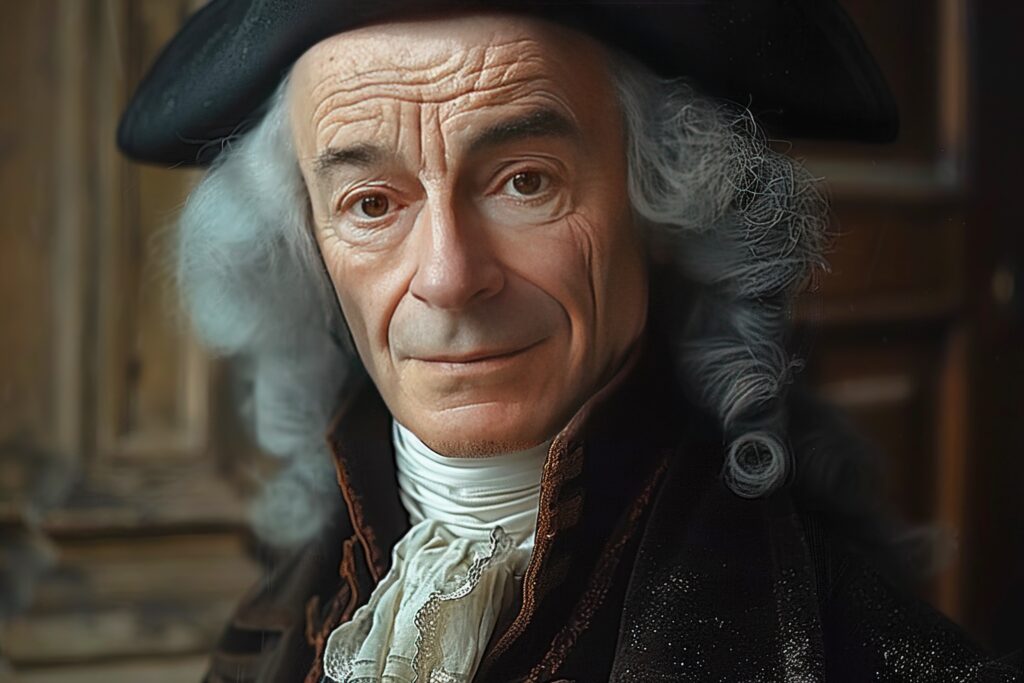
The dots were connected over two hundred years ago by a French economist named Jean-Baptiste Say. His ideas were not complicated. They were, in fact, embarrassingly simple. Which is probably why they keep getting ignored.
The Man Who Noticed What Everyone Missed
Say was born in 1767 in Lyon, France. He lived through the French Revolution, watched governments rise and collapse, and spent most of his intellectual life trying to answer one question: where does wealth actually come from?
His answer was unfashionable then and remains unfashionable now. Wealth, Say argued, comes from production. Not from money. Not from gold. Not from taxing the right people. From production. The act of turning raw materials, labor, and ideas into things other people want to buy.
This sounds obvious until you realize that almost every political debate about the economy ignores it completely. Politicians talk endlessly about how to distribute wealth. Say wanted to know how wealth gets created in the first place. He was less interested in who gets the pie and far more interested in what makes the pie exist at all.
His most famous insight, often called Say’s Law, is usually butchered into the phrase “supply creates its own demand.” That is a terrible summary. What Say actually meant was more nuanced and more powerful: when someone produces something valuable, that act of production gives them the means to buy things from others. Production is not just one side of the economy. It is the engine of the whole thing.
In other words, a society does not get richer by moving money around. It gets richer when people make more stuff that other people want.
The Invisible Math of “Taxing the Rich”
Now apply this to the idea of taxing the rich.
When politicians say they want to tax the wealthy, the implied math is simple: the rich have too much, the government takes some of it, the government gives it to everyone else, and society becomes fairer. It sounds like basic arithmetic. Take from column A, add to column B.
But Say would point out that this math leaves out the most important variable. What were the rich doing with that money before the government took it?
The answer, in most cases, is not swimming in a vault of gold coins like a cartoon duck. Wealthy individuals and the businesses they own tend to do a limited number of things with their capital. They invest it in new businesses. They expand existing ones. They fund research. They buy equipment. They hire people. They deposit it in banks, which lend it to other people who do all of the above.
This is not a moral defense of the rich. It is a mechanical description of what capital does in an economy. Capital that sits in a bank account does not actually sit there. The bank lends it out. Capital that funds a new factory creates jobs. Capital that backs a startup might produce the next technology that makes your life cheaper and better.
When the government takes that capital through taxation, it does not disappear. But it does change what it does. Instead of being allocated by people who have strong financial incentives to invest it productively, it is allocated by a political process that has entirely different incentives.
Say understood this distinction deeply. He wrote that the entrepreneur is the central figure in economic life because the entrepreneur is the one who sees where resources can be combined to create something more valuable than the sum of its parts. Tax away the entrepreneur’s capital, and you have not just taken money. You have removed the fuel from the engine of production.
The Part Nobody Wants to Hear
Here is where it gets uncomfortable.
When production slows down, it does not hurt the rich first. It hurts you first. The rich, by definition, have a cushion. They can move. They can wait. They can restructure. The person who loses their job when a company decides not to expand does not have those options.
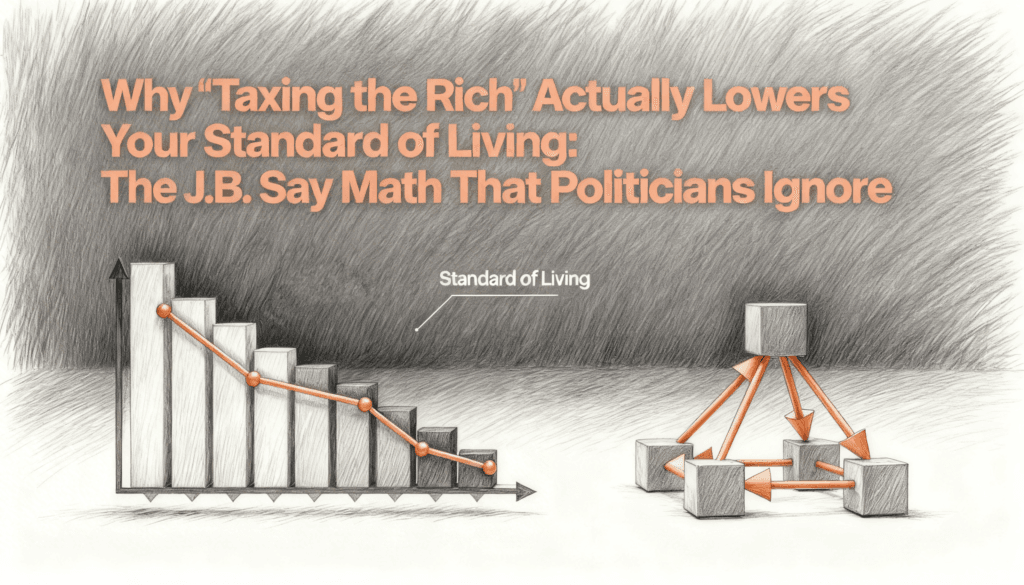
Say would have found the modern debate almost comically backwards. The stated goal is to help ordinary people by taxing the wealthy. But the mechanical result, when you trace the chain of cause and effect, is often the opposite. Less capital available for investment means fewer new businesses. Fewer new businesses means fewer jobs. Fewer jobs means less bargaining power for workers. Less bargaining power means lower wages. Lower wages means a lower standard of living.
This is not some abstract theory. It is the math of production that Say laid out in his Treatise on Political Economy in 1803. And it has played out repeatedly in real economies ever since.
Consider a concrete example. A government imposes a new tax on corporations, framed as making the wealthy pay more. The corporation, facing higher costs, has several options. It can absorb the cost, which means less money for expansion and hiring. It can raise prices, which means consumers pay more for the same products. It can move operations to a friendlier jurisdiction, which means local jobs vanish. Or it can do some combination of all three.
In none of these scenarios does the burden fall primarily on the wealthy. It falls on workers, consumers, and communities. The tax was aimed at the top of the mountain, but the avalanche rolls downhill.
Why Politicians Ignore This
If the math is so straightforward, why do politicians keep proposing these policies?
Because the math of elections is different from the math of economics.
In an election, you need votes. There are far more people who are not rich than people who are rich. Telling the majority that you will take money from the minority and give it to them is, electorally, a winning formula. It has been a winning formula since ancient Athens, where demagogues discovered that promising redistribution was the fastest route to power.
Say was aware of this dynamic. He warned explicitly that governments would always be tempted to consume capital rather than allow it to be invested, because consumption is visible and popular while investment is invisible and boring. A new government program has a ribbon cutting ceremony. The factory that was never built because the capital was taxed away does not have a press conference.
This is what the economist Frederic Bastiat, a direct intellectual descendant of Say, later called the problem of the seen and the unseen. The benefits of government spending are seen: new roads, new programs, new checks in the mail. The costs are unseen: the businesses never started, the innovations never funded, the jobs never created.
You cannot take a photograph of something that did not happen. And you cannot run a political campaign on it either.
The Grocery Store Test
Let us bring this down from the level of theory to the level of your Tuesday afternoon.
You are standing in a grocery store. The price of eggs has gone up. The price of bread has gone up. Your paycheck has not gone up by the same amount. Your standard of living has quietly, invisibly declined.
Now trace the chain backwards. Why are prices higher? Because the companies producing these goods face higher costs. Why do they face higher costs? Partly because of taxes and regulations that increased their cost of doing business. Those taxes were passed in the name of fairness. They were aimed at wealthy executives and corporate profits. But the executives still have their beach houses. You are the one staring at the egg prices.
Say would recognize this instantly. He wrote that a tax on production is ultimately a tax on consumption. You cannot separate the two. When you make it more expensive to produce something, you make it more expensive to buy that thing. The producer and the consumer are not on opposite sides. They are two ends of the same rope. Pull one end and the other moves.
This is perhaps the most counter intuitive aspect of the entire debate. The average person thinks of themselves as a consumer, separate from and even opposed to producers. But Say showed that these roles are inseparable. You are a producer when you go to work. You are a consumer when you go to the store. Anything that damages production damages your ability to consume. The war between workers and owners that politicians love to narrate is, in large part, a fiction. A useful fiction for winning elections, but a fiction nonetheless.
The Restaurant Analogy
Think of the economy like a restaurant. The rich, in this analogy, are not the diners eating all the food. They are more like the people who built the kitchen, bought the ovens, hired the cooks, and stocked the pantry.
Now imagine a policy that says: those kitchen builders have too many resources. Let us take some and distribute it to the diners as free appetizers. The diners cheer. Free appetizers are great.
But next month, the kitchen is a bit smaller. There are fewer ovens. The cooks, seeing less investment in the kitchen, go work somewhere else. The menu shrinks. The quality drops. The prices for what remains go up.
The diners got their free appetizers. But they lost access to the full menu, permanently. Say would call this the destruction of productive capital. A modern economist might call it a reduction in the economy’s productive capacity. Your grandmother would call it killing the goose that lays the golden eggs.
All three are saying the same thing.
What Say Would Say Today
If Jean-Baptiste Say could observe the modern economic debate, he would likely be baffled by how little has changed. The same arguments he dismantled in 1803 are still being made, often word for word, just with updated statistics.
He would point out that the wealthiest nations in the world did not become wealthy through redistribution. They became wealthy through production. The United States, Germany, Japan, South Korea: these are all economies that generated enormous wealth by creating conditions in which entrepreneurs could invest, innovate, and produce. The redistribution came after the wealth was created, not before.
He would also point out something that modern progressives and modern conservatives both tend to miss. The enemy of prosperity is not the rich and it is not the poor. It is any policy that destroys productive capital, regardless of its stated intention. A bad subsidy destroys capital just as effectively as a bad tax. Corporate welfare that props up unproductive companies is just as damaging as a confiscatory tax rate on productive ones. Say was not defending the rich. He was defending production itself.
This distinction matters enormously. Being pro-production is not the same as being pro-rich. Some wealthy individuals and corporations extract value through political connections, monopoly power, or outright corruption. Say would have no sympathy for that. He was explicitly critical of government granted monopolies and privileges. His argument was that the solution to crony capitalism is not to punish all capital. It is to remove the political privileges that allow some to profit without producing.
The Bottom Line for Your Bottom Line
Here is what all of this means for your life.
Every time a politician promises to tax the rich and use the money to improve your situation, ask one question: what was that capital doing before?
If the answer is that it was being invested in production, in businesses, in innovation, in the economic activity that creates jobs and goods and services, then taking it away and routing it through a political process will, on average, make you poorer. Not immediately. Not visibly. But steadily, through higher prices, fewer opportunities, and a shrinking economic pie.
Say did not frame this as a left versus right issue. He framed it as a math issue. Production creates wealth. Consumption uses it up. Anything that shifts resources from production to consumption makes a society poorer over time. It does not matter how noble the intention is. The math does not care about intentions.
The next time you hear the phrase “tax the rich,” remember that you are not watching Robin Hood. You are watching someone rearrange the deck chairs on a ship while quietly drilling holes in the hull. The water rises slowly.
By the time you notice, the people who drilled the holes are already in the lifeboats.