Table of Contents
There is a strange thing that happens the moment you say something out loud. The idea leaves your head, lands in the open air, and suddenly it is not just an idea anymore. It is yours. It has your name stitched into it. And from that second on, anyone who questions it is not questioning a thought. They are questioning you.
This is the trap. And almost everyone walks straight into it.
Karl Popper, an Austrian philosopher who spent most of his life thinking about how humans actually arrive at truth, noticed something uncomfortable. He noticed that most people, including scientists, do not really want to find out if they are wrong. They want to find out that they are right. They collect evidence the way a child collects shiny rocks. Anything that gleams in their favor goes in the bucket. Anything that does not is kicked aside or ignored.
Popper thought this was backwards. He thought the whole point of having a mind was to use it against yourself.
The Problem With Being Right
Most of us believe we are reasonable people. We believe we form our opinions carefully, weigh the evidence, and adjust when needed. This is almost entirely a flattering lie we tell ourselves.
What actually happens is closer to this. We pick up a belief, often without noticing, from a parent, a teacher, a charismatic friend, a podcast we listened to on a long drive. Then we spend the rest of our lives quietly assembling reasons to keep believing it. We do not test the belief. We decorate it.
Popper called this the verificationist trap. The trap of looking for proof that you are correct. The trap feels like thinking, but it is not thinking. It is something closer to interior decoration.
If you want to know how deep this goes, try a small experiment. Pick a strong opinion you hold. Something you would defend at a dinner party. Now ask yourself, with real honesty, what would have to be true for me to abandon this view. If nothing comes to mind, if you cannot picture any evidence that would change your mind, then congratulations. You do not actually have a belief. You have a costume.
The Beautiful Cruelty of Falsification
Popper proposed something that sounds simple but is psychologically brutal. He said a real idea is one that can be killed.
If your theory explains everything, predicts nothing specific, and survives any possible result, it is not powerful. It is empty. A claim that cannot fail is a claim that says nothing. Astrology can explain why you had a good week and why you had a bad one. That is not a strength. That is the problem.
The serious thinker, Popper argued, does not ask how can I prove my idea. He asks how could I destroy it. He goes looking for the experiment, the counterexample, the awkward fact, the bit of reality that would force him to throw the whole thing out.
This is the part most people skip. Because finding evidence that you are wrong feels terrible. It feels like losing. It feels like being publicly stripped of something you cared about. The ego treats every revised opinion as a small funeral.
But here is the trade. The person who tries to kill his own ideas ends up with ideas that have actually survived something. The person who only defends ends up with ideas that have never been tested, only protected.
One of these people is building. The other is just guarding.
Why Your Brain Hates This
There is a reason this approach feels unnatural. Your brain did not evolve to find truth. It evolved to keep you alive, fed, and accepted by your tribe. These are not the same thing.
In the world your ancestors lived in, being wrong in front of the group was a real social cost. Get embarrassed enough times and you started getting fewer invitations to the fire. So we developed a deep, almost physical aversion to being shown up. It is the reason you can feel your face get hot when someone points out a flaw in your reasoning, even if the flaw is small, even if the person is being nice about it.
This is also why so many arguments are not really arguments. They are status battles dressed up in vocabulary. Both people have decided what they think before they sit down, and the actual conversation is just a long performance of not flinching.
Popper was asking something genuinely hard. He was asking you to fight your own evolutionary wiring. To treat being wrong as a relief instead of a wound. To welcome the person who shows you a flaw in your thinking instead of secretly resenting them.
This is not natural. It has to be trained.
The Trick of Holding Ideas Loosely
When you identify with an idea, an attack on the idea feels like an attack on you. You stiffen. You get defensive. Your goal shifts from understanding the truth to protecting your sense of self. Everything you say from that point on is contaminated by the need to win.
When you merely hold an idea, you can put it down. You can rotate it, examine it, hand it to someone else and ask them to find the cracks. If they find cracks, you have not lost. You have gained information about a thing you happen to be carrying. The thing is not you.
This sounds like a small shift. It is not. It is the difference between a person who can think and a person who can only react.
Watch this in real conversations. The people who can casually say I had not considered that, or you might be right, or I need to update my view, are almost always the most respected people in the room over time because they are not afraid. They have nothing to defend except the truth, and the truth does not need them to defend it.
How to Actually Practice This
Theory is cheap. The interesting question is how to live this way without becoming insufferable or paralyzed.
A few moves help.
The first is to write down what you believe. Not the soft fuzzy version. The crisp version. If you think the economy is heading somewhere, say where, and by when. If you think a project at work will fail, write down why, and what would prove you wrong. Vague beliefs cannot be tested, which means they cannot be improved. They just float around forever, immune to reality.
The second is to actively seek out the smartest person you know who disagrees with you. Not the dumbest, the smartest. The dumbest opponent of your view is easy to dismiss, and dismissing him will make you feel clever and learn nothing. The smartest opponent will say things that genuinely bother you. Sit with the bother. That is where the work happens.
The third is to develop a private relationship with the phrase I was wrong. Say it to yourself first, in your own head, about small things. The restaurant you recommended that turned out to be mediocre. The prediction about a movie that flopped. The advice you gave that did not pan out. Get used to the small sting of it. Once you can take small doses, you can take larger ones. Most people never even get past the small ones, which is why they are stuck for decades on the larger ones.
The fourth is to notice when you feel certainty. Real certainty, the kind that feels like steel inside your chest, is almost always a warning sign. It does not usually appear because you have thought something through carefully.
The Strange Confidence of People Who Question Themselves
People who genuinely test their ideas, who have already tried to destroy them and watched them survive, act with a different kind of confidence than people who simply believe. Their conviction is earned. It has bones. It has been pressure tested in the dark, alone, against the best arguments they could find.
The loud certainty of the unexamined mind and the quiet steadiness of the examined one look similar from the outside, but they behave very differently under stress. The first one shatters when the world pushes back. The second one bends and keeps going.
If you want to be the kind of person who can be trusted with hard decisions, this is the route. Not louder opinions. Not more confident ones. Tested ones.
The Last Inconvenience
This approach will cost you some social comfort. People are not really looking for partners in honest inquiry. They are mostly looking for confirmation, validation, agreement, applause. If you start asking yourself hard questions in public, and worse, asking other people hard questions, you will be experienced by some of them as difficult. As cold. As too much.
That is the tax. There is no version of this where you become a clearer thinker and everyone in your life cheers you on. Some will find it threatening. Some will simply find it tiring.
But the trade is real. On the other side of that mild social cost is a life lived closer to reality. Decisions that hold up. Opinions you actually believe rather than ones you happened to inherit. A mind that gets sharper with time instead of more fragile.
Popper spent his life arguing that knowledge does not grow by accumulation. It grows by elimination. You do not get smarter by stacking up more beliefs. You get smarter by burning down the ones that cannot survive scrutiny, and keeping only what is left standing in the morning.
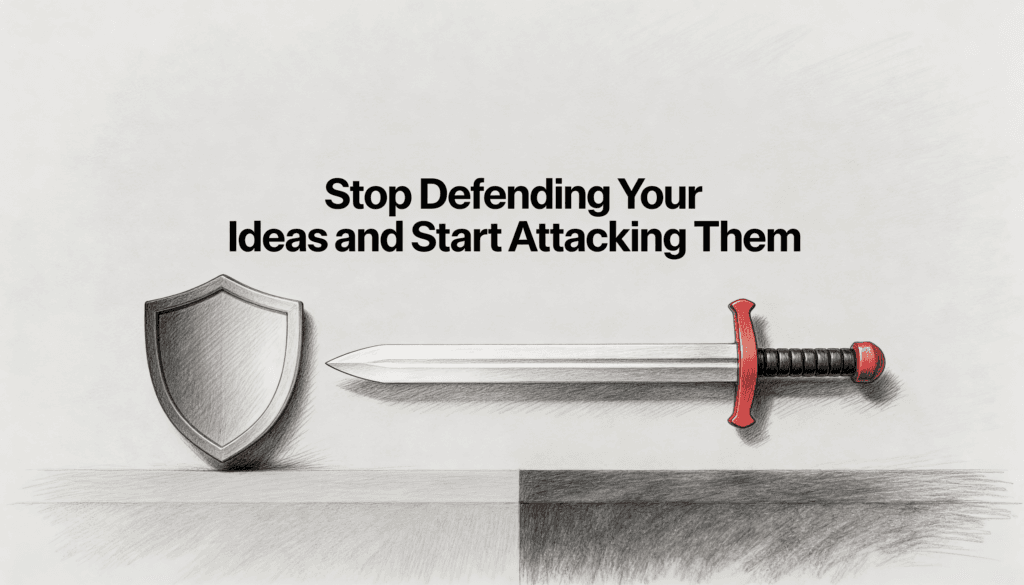
Stop defending your ideas. Start attacking them. Most of them will not survive, and you should be glad about that. The ones that do will be worth something.
That is the whole trick.