Table of Contents
You wake up tomorrow morning and you expect the sun to rise. You expect your coffee to taste like coffee. You expect the floor to hold you up when you swing your legs out of bed. You expect your face in the mirror to be the same one you saw yesterday.
Now here is a strange question. Why?
Not in a poetic sense. In a literal one. What proof do you actually have that any of these things will happen? You might say, “Well, they happened yesterday. And the day before. And every day before that.” And you would be right. But notice what you just did. You used the past to predict the future. You assumed that because something has happened a thousand times, it will happen the thousand and first.
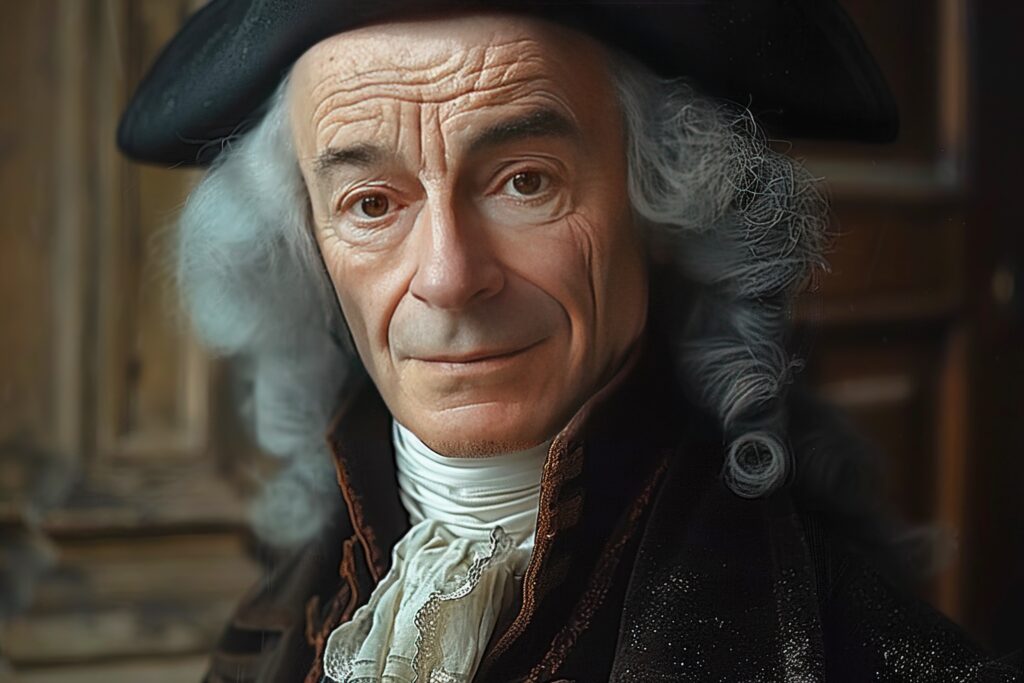
A Scottish philosopher named David Hume looked at this little mental move we all make and basically said, “Hold on. That is not reasoning. That is just a habit.”
And once you see what he meant, it is hard to unsee.
The Man Who Quietly Wrecked Certainty
David Hume was writing in the 1700s, in the middle of an era where everyone was very excited about reason. Newton had cracked the laws of physics. Philosophers were peacocking around claiming that the human mind, properly trained, could figure out almost anything. Hume showed up with a polite Scottish smile and started pulling threads.
His big move was almost embarrassingly simple. He said: look at how you actually come to know things. Not how you imagine you do. Look at the receipts.
When you believe the sun will rise, you are not deducing it from some grand cosmic principle. You are not running calculations. You are just remembering that it has risen every morning of your life and quietly assuming the streak continues. Hume pointed out that there is no logical bridge between “it has happened before” and “it will happen again.” None. The bridge is in your head. It is built out of repetition.
He called this the problem of induction, and philosophers have been chewing on it for almost three hundred years without quite digesting it.
The Billiard Ball Trick
Hume liked a particular example. Imagine two billiard balls on a table. One rolls toward the other, hits it, and the second ball moves. Easy. You saw cause and effect, right?
Hume says no. You did not see cause and effect. You saw one ball move. Then you saw a collision. Then you saw the other ball move. You never actually saw the causing. The “because” is invisible. You inferred it. And you inferred it because you have seen this kind of thing happen before, many times, in many forms.
Strip away your memory and your habits, and what you are left with is just a series of separate moments. Ball moves. Collision. Ball moves. Your mind staples them together into a story called causation, but that staple is not in the world. It is in you.
This is not a wild thought experiment. It is a description of what your brain is doing right now, at this very second, while you read this. It is connecting things. It is filling in the blanks. It does so quickly that the seams disappear, and you mistake the stitching for reality.
So What Is a Belief, Exactly?
Here is where it gets uncomfortable, in a fun way.
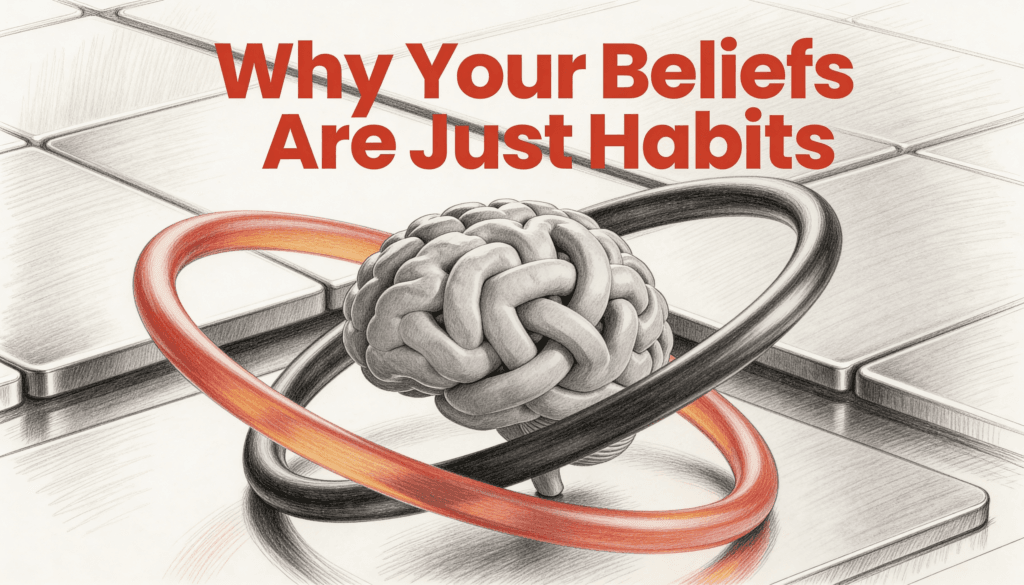
If our most basic beliefs about the world are not built on pure logic but on repeated experience, then a belief is not really a conclusion. It is a reflex. It is what happens when your brain has seen something enough times to stop checking.
You believe fire is hot. Why? Not because you have a proof. Because every encounter with fire has had the same result, and your nervous system has filed that under “settled.” You believe people you trust will probably keep behaving like they have been behaving. You believe water will be wet, traffic lights will follow their pattern, your front door key will fit your front door.
None of these are logical certainties. They are all bets. Very good bets, sure. But bets.
Hume was not saying these bets are bad. He was saying we should be honest about what they are. The mind, in his view, is less a courtroom and more a creature of habit, padding around in the rituals it has learned. We are not Sherlock Holmes calmly deducing the world. We are something closer to a dog who has figured out that the leash means a walk.
The Beliefs You Did Not Choose
Now zoom out from billiard balls and sunrises. Look at the beliefs you actually hold about big things. Politics. Money. Relationships. What makes a good life. What kind of person you are.
Where did those come from?
If you are honest, most of them came from exposure. From hearing certain things repeated by your parents, your friends, your culture, your favorite shows, the algorithm that decides what you see when you open your phone. Repetition is the workshop where beliefs get built. Most of us did not sit down at age nineteen, lock ourselves in a room, and rationally derive our worldview from first principles. We absorbed it. We marinated.
This is the part of Hume that still hits hard. If belief is a habit, then your worldview is, in a real sense, a side effect of your environment. Change the environment, and over time you change the worldview. People who move countries notice this. People who change careers notice this. People who leave a religion or join one notice this. Suddenly things they once found obvious start to feel weird, and things that once felt weird start to feel obvious. The “obvious” was never built into the universe. It was built into them.
But Wait, Is Not That a Bit Depressing?
You might be thinking: great, so nothing I believe is real, and I am basically a meat puppet of my upbringing. Thanks, Hume.
Not quite. And this is where Hume is more interesting than the cliff notes give him credit for.
He was not saying belief is worthless. He was saying it is human. He pointed out that even he, after spending hours arguing that we cannot rationally justify our most basic assumptions, would close his books, go play backgammon with his friends, eat dinner, and go on living like a normal person who fully expected the world to keep working. He could not help it. Nobody can.
This is actually his quiet punchline. Reason will not get you out of bed. Habit will. And there is nothing shameful about that. The mistake is not that we live by habit. The mistake is pretending we live by something grander.
So Hume was not trying to demolish belief. He was trying to take it down off the marble pedestal it had been propped up on, and put it back where it belongs, in the soft daily texture of being a creature with memory and expectations.
Why This Matters, Today, On A Thursday
You might wonder why a Scottish guy from the 1700s should rent space in your head. Here is the practical reason.
If your beliefs are mostly habits, then a few things follow.
First, you should be slower to be certain. Not paralyzed, just calibrated. The strength of a feeling that something is true is not great evidence that it is true. Your brain produces certainty the way your stomach produces hunger. It is a signal, not a verdict. The next time you feel absolutely sure about something, especially about another person or another group, it is worth asking: am I sure because I have examined this, or am I sure because I have heard it a lot?
Second, you can change your mind, but not the way you think. You do not change deep beliefs by reading one good argument. Arguments are little. Habits are big. You change deep beliefs by changing what you are repeatedly exposed to, what you repeatedly do, who you repeatedly talk to. New experiences over time wear new grooves. This is annoying because it is slow. It is also liberating, because it means you are not stuck.
Third, you can be more generous with people who disagree with you. They are not stupid. They have been marinating in a different environment. Their certainty feels just as obvious to them as yours does to you, and for the same reason: a lot of repetition. This does not mean every belief is equally good. Some beliefs match reality better than others. But it does mean that disagreement is rarely a moral failing. It is usually a difference in what got rehearsed.
The Ironic Twist
Here is the part that loops back on itself, and which I find delightful.
If Hume is right, then the very ability to read this article and nod along, or to push back, or to scoff, is itself a habit. Your sense of “yes that rings true” or “no that is rubbish” is not arriving from some neutral observation deck. It is filtered through every previous thing you have ever read or felt. Even your skepticism about Hume is Humean. The man cannot lose.
So no, you are probably not going to wake up tomorrow and refuse to assume the sun will rise. You should not. It would be exhausting and slightly insane. Hume himself would have laughed at you and gone back to his backgammon.
The point is not to live in radical doubt. The point is to know what kind of creature you are. You are not a perfectly rational mind sitting on top of a body. You are a deeply habitual animal who has learned to talk well enough to convince itself otherwise. Most of what you call thinking is pattern matching against your past. Most of what you call belief is a well worn path your mind has walked too many times to question.
Hume’s gift, three centuries later, is a small mental hygiene practice. Every so often, when you find yourself absolutely sure, ask gently: is this a conclusion, or is this a habit wearing the costume of a conclusion?
The answer will not always be comfortable. And in a world that has gotten very loud and very confident about almost everything, a little Humean doubt might be one of the most valuable habits you could pick up.
Even if, technically, that too is just a habit.