Table of Contents
Most economists treat their field like physics. They draw curves that intersect at neat little points, write equations that pretend humans are billiard balls, and speak of equilibrium as if markets were calm ponds waiting to settle. They want economics to behave. They want it to sit still long enough to be measured.
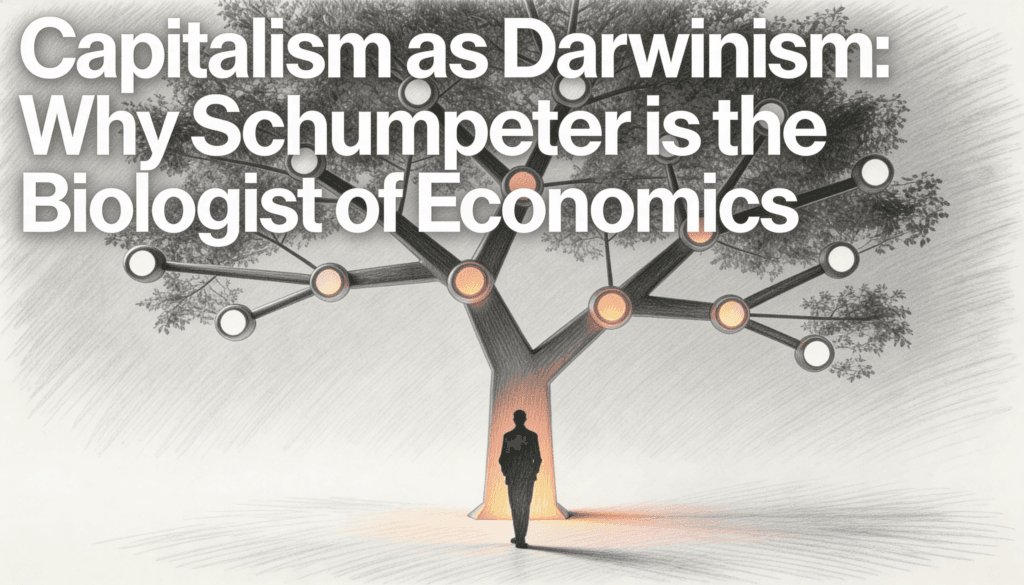
Joseph Schumpeter looked at all of this and quietly disagreed. He thought economists were studying the wrong science. The market, he believed, was not a machine seeking balance. It was a forest. And forests do not seek balance. They burn, they regrow, they kill off the weak, and they produce strange new species nobody asked for. Capitalism, in his view, was not a mechanical system. It was an ecosystem.
And the economist who wanted to understand it needed to think less like Newton and more like Darwin.
This is the lens that makes Schumpeter such a strange and useful figure. While his peers were busy building elegant models of how markets should rest, he was watching how markets actually move. And what he saw looked a lot like natural selection running at terrifying speed.
The Quiet Violence of Creative Destruction
Schumpeter gave us a phrase that has been used so often it has lost most of its meaning. Creative destruction. People throw it around in startup pitch decks and business school seminars as if it were a marketing slogan. It is not. It is closer to a description of how ecosystems work.
When a new species evolves an advantage, it does not politely ask the existing species for permission. It simply outcompetes them. Some go extinct. Some adapt. The forest looks different a few generations later. Nobody planned it. Nobody could have predicted exactly which species would win. But the process itself was inevitable.
This is what Schumpeter saw in capitalism. The automobile did not negotiate with the horse and buggy industry. Electric light did not file a polite request with gas lamp manufacturers. Streaming did not ask Blockbuster for an interview before showing up. New technologies, new business models, and new ideas arrive and they do not care about the comfort of what came before. They feed on it. They use the resources, the talent, and the capital that the old order built, and they redirect everything toward something new.
Most economic theory before Schumpeter, and frankly most of it after him too, assumed that the economy moved toward stable states. Supply met demand. Prices found their level. Things rested. Schumpeter looked at this and basically said the economy never rests. It is always being eaten from the inside by its own innovations. The stability is the illusion. The disruption is the truth.
Why Equilibrium is a Polite Fiction
To understand how radical this was, you have to understand what the rest of economics looked like at the time. The dominant school of thought treated markets the way astronomers treat planets. Forces push, forces pull, and eventually everything settles into a predictable orbit. The math was beautiful. The graphs were tidy. The only problem was that none of it described real economies very well.
Real economies do not orbit. They convulse. They produce industries that did not exist a decade ago and obliterate industries that seemed permanent. A graph of equilibrium prices tells you almost nothing about why the company you worked for in 2005 no longer exists.
Schumpeter understood that economists were drawing the wrong picture entirely. The right picture was not a pendulum returning to center. It was a population of organisms competing for resources, mutating, dying, and occasionally producing offspring that change the entire game. This is not a metaphor he reached for because he liked biology. It is the metaphor he reached for because it fit.
Think about it. In a market, businesses compete for scarce resources. Customers. Capital. Talent. Attention. Most of them fail. A few survive. Of those, a smaller number reproduce in the form of imitators, subsidiaries, and entire new industries built on their model. The traits that helped them survive get copied. The traits that did not get buried. This is selection pressure. This is natural selection wearing a business suit.
The Entrepreneur as Mutation
Here is where Schumpeter gets really interesting. In Darwinian evolution, change does not come from the existing population working harder. It comes from mutation. Some new variation appears, usually by accident, and either it fits the environment or it does not. The system cannot improve itself through more of the same. It needs novelty.
Schumpeter said the same thing about the economy. Growth does not come from existing businesses doing existing things slightly better. It comes from entrepreneurs. These are the mutations. They appear, often from nowhere, and try something the established players would never try. Most of them fail in ways nobody remembers. A few succeed in ways that rewrite entire industries.
This is why Schumpeter had such a strange view of the entrepreneur. He did not see them as heroic capitalists or as exploiters of labor. He saw them as biological agents performing a function. They introduce variation into the system. Without them, capitalism would stop evolving. It would stagnate, the way a population without genetic variation eventually does.
There is something almost cold about this view. The entrepreneur is not a moral figure. They are a structural one. The system needs them the way an ecosystem needs random mutation. Whether any particular entrepreneur is brilliant or lucky or insufferable is beside the point. What matters is that they exist and that the system gives them room to try. Imagine if Steve Jobs, Elon Musk, Walt Disney, Henry Ford or Thomas Edison never existed. Economies would be a very different than they are today without these mutations.
Why Big Companies Behave Like Old Forests
One of the more counterintuitive parts of Schumpeter’s thinking is that he did not have the standard fear of large corporations. Many economists then and now worry that big companies will dominate, suppress competition, and grow lazy and abusive. Schumpeter agreed they would grow lazy. He just thought it would not save them.
A mature forest looks dominant. The big trees take all the light. Nothing seems able to challenge them. Then a fire comes, or a disease, or a new species arrives, and within a few years the canopy is unrecognizable. The same is true, Schumpeter argued, of large firms. They look invincible right until the moment they are not.
History keeps proving him right in ways that almost feel like the universe is showing off. Kodak owned photography. Then digital cameras arrived. Nokia owned mobile phones. Then the iPhone arrived. Sears was once the largest retailer in America. Then Walmart, then Amazon. The pattern is so reliable that it should embarrass anyone who claims that any company is too big to fall. Size offers no immunity. If anything, size often produces the kind of slow, comfortable institutional habits that make a company easier to outmaneuver.
This is the Darwinian logic in plain view. Dominance in one era does not guarantee fitness in the next. The traits that built a giant in the 1980s may be exactly the traits that get it eaten in the 2020s. Adapt or die is not a motivational poster. It is a description of how the system actually operates.
The Awkward Truth About Progress
If you take Schumpeter seriously, you have to accept something uncomfortable. Economic progress is not a friendly process. It does not lift everyone gently. It picks winners and discards losers, and the discarded are real people with real lives. The factory town that loses its industry does not feel grateful that the world has progressed. The worker whose skills are now obsolete does not celebrate creative destruction.
Schumpeter did not pretend otherwise. He thought capitalism produced enormous wealth and enormous disruption at the same time, and that the disruption was not a flaw but a feature. You cannot get the gains without the pain. The system creates new value precisely because it destroys old value. You cannot freeze the destruction without also freezing the creation.
This is where his Darwinism becomes morally complicated. Evolution is not kind. It does not care about individuals. It optimizes for survival of types, not survival of members. A purely Schumpeterian view of the economy can sound disturbingly close to saying that human suffering is just the cost of doing business. Schumpeter himself was aware of this tension. In his later work he wondered whether capitalism would survive politically, not because it would fail economically, but because people would eventually refuse to tolerate its costs.
What He Got That Others Missed
The reason Schumpeter still matters, and arguably matters more now than when he was writing, is that the world has gotten more obviously Darwinian, not less. Software eats industries faster than any nineteenth century factory ever could. A startup with twenty employees can wipe out a hundred year old company. Entire job categories can vanish in a decade. If you wanted a laboratory designed to test Schumpeter’s ideas, you would build something that looks a lot like the present.
And yet, much of mainstream economics still behaves as if equilibrium is the natural state and disruption is the exception. It is the other way around. Disruption is the default. Equilibrium is the brief pause between waves. You may experience a few years of stability, but the system is always preparing the next round of mutations.
To think like Schumpeter is to stop asking how markets settle and start asking how markets evolve. It is to look at a company and see not a fortress but an organism with a life cycle. It is to look at an industry and see not a stable structure but a temporary configuration that will look different in twenty years whether anyone wants it to or not.
The Biologist in the Room
There is something almost lonely about Schumpeter’s position in the history of economics. He was surrounded by physicists and mathematicians, by people who wanted economics to look like a hard science with predictable laws. He insisted on being the biologist in the room. He talked about evolution when others talked about equations. He talked about populations of firms when others talked about representative agents. He talked about time, and history, and change, when others wanted timeless principles.
For a long time, this made him seem less rigorous than his peers. His ideas resisted the kind of mathematical formalization that economists love. You cannot easily build a clean model of creative destruction. You cannot put a precise number on the next mutation. This is, ironically, why his ideas have outlasted so many that were more precisely stated. The world he described was the world we actually live in.
If you want to understand why your favorite app was crushed by a competitor you never heard of, or why the company that seemed unstoppable five years ago is now firing half its staff, or why an entire profession can become obsolete in a decade, you will not find the answer in equilibrium models. You will find it in a small book by an Austrian economist who insisted on thinking like a biologist while everyone around him played at being physicists.
Capitalism, in the end, is not a machine. It is a living system. And Schumpeter is the rare economist who actually noticed.