Table of Contents
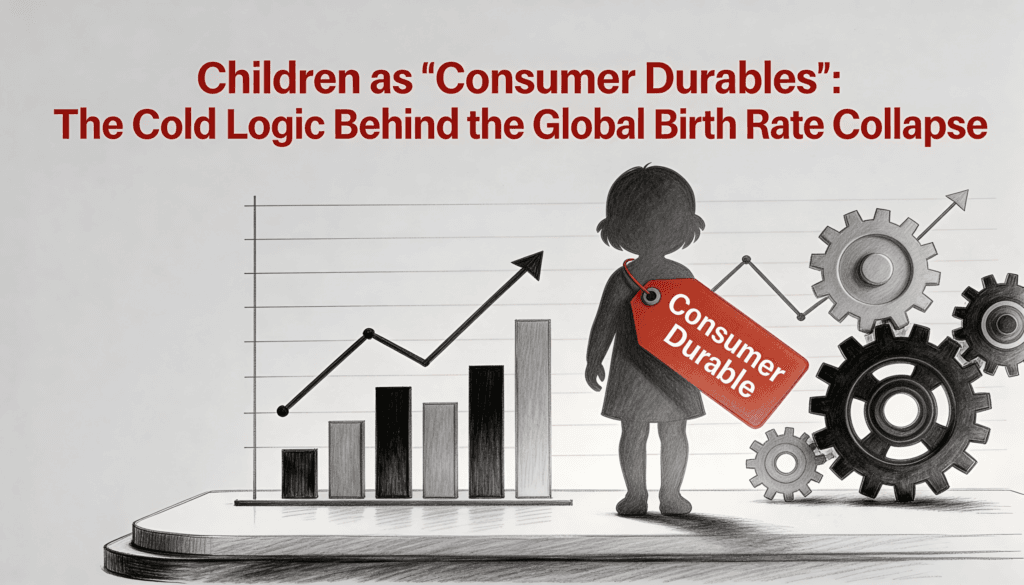
In 1960, an economist at Columbia University did something that horrified polite society. He sat down and applied the same mathematical framework used to analyze refrigerator purchases to the question of why people have babies. His name was Gary Becker, and his paper “An Economic Analysis of Fertility” treated children as what he politely called “consumer durables.” Think washing machines, cars, houses. Things you buy, maintain, and derive satisfaction from over many years.
The reaction was predictable. Critics called him cynical, reductive, even monstrous. How dare anyone compare a child to an appliance? Becker shrugged and kept working. Decades later, he won the Nobel Prize. And today, as country after country watches its birth rate slide toward demographic oblivion, his framework looks less like cold cynicism and more like prophecy.
South Korea now produces 0.72 children per woman. Italy sits at 1.2. Japan has been shrinking for years. China, despite abandoning its one child policy, cannot convince its citizens to have even one. The United States dipped below replacement level and shows no signs of climbing back. Something is happening across every developed economy on Earth, and the explanations offered by politicians tend to be sentimental, moralistic, or simply wrong. Becker, dead since 2014, would have understood it immediately. He spent his career explaining exactly this.
The Heretical Move
Before Becker, economists treated the family as a kind of black box. People got married, had kids, and that was the realm of sociologists, theologians, and poets. Economics dealt with widgets and wages, not love and lullabies. Becker found this division absurd. Families make decisions. Decisions involve trade offs. Trade offs are economics. Why exempt the most consequential decisions humans ever make from the same analysis we apply to buying a sofa?
His insight was that children produce a stream of satisfaction over time, much like any durable good. Parents derive joy, meaning, and eventually grandchildren from the investment. But children also impose costs. Direct costs like food, clothing, and education. And, crucially, opportunity costs. The time spent raising a child is time not spent earning, learning, traveling, or simply resting on the couch.
This last point was the bomb. Becker noticed that as wages rise, especially for women, the opportunity cost of having children skyrockets. A subsistence farmer who keeps a child home loses very little. A neurosurgeon who takes five years off to raise three kids loses millions in lifetime earnings, plus the career trajectory that compounds with every passing year. The richer a society becomes, the more expensive children become, not because diapers cost more but because the time required to raise them is worth so much more.
The Quality Quantity Switch
Here is where Becker became genuinely interesting. He did not just predict that wealthy families would have fewer kids. He predicted they would have fewer kids on purpose, and pour resources into each one with almost frightening intensity.
He called it the quality quantity trade off. Poor families historically had many children, each receiving relatively little investment. Six kids, one pair of shoes between them, a few years of schooling if you were lucky. Wealthy families, by contrast, would have fewer children and lavish each one with tutors, music lessons, orthodontics, summer camps, college funds, and therapy.
Look around. Does this describe modern parenting? The middle class American family of 2026 is not really raising children. It is running a small, intensive boutique investment fund with one or two assets. SAT prep starts in middle school. Travel sports cost thousands annually. Helicopter parenting is not a moral failing of millennials. It is the rational behavior of people who have decided to bet everything on a very small number of bets.
Notice the irony. The same parents who would rather die than describe their child as a “consumer durable” behave exactly as Becker predicted they would. They quantify, optimize, and invest with the dispassionate rigor of a hedge fund manager.
The denial is real. The behavior is Beckerian.
Why Birth Rates Are Falling Everywhere
If Becker is right, falling birth rates are not a moral panic. They are not caused by selfishness, smartphones, or feminism, although those are the usual suspects in newspaper op eds. They are the predictable result of children becoming more expensive at the same time that the alternatives to having children have become more attractive.
Consider what raising a child now requires. In a hunter gatherer band, a child could contribute economically by age six. In an agricultural society, by ten. In a modern knowledge economy, a child is a net financial drain until roughly age twenty two, sometimes twenty eight, sometimes never. The child you have today will not pay you back. They will not work the family farm. They will not support you in old age, because the state does that now, sort of. They are, in pure economic terms, the worst durable good ever invented. The maintenance costs are astronomical and the resale value is zero.
Meanwhile, the alternatives have become spectacular. A childless professional in Seoul or Berlin or Toronto can travel the world, build a career, accumulate wealth, watch every prestige television series ever made, and enjoy a quality of leisure that medieval kings would have killed for. The “competitor products” to children, as Becker would put it, have improved dramatically. Children have not gotten any easier.
This is not a moral failing. It is arithmetic. When the price of a good rises and the price of its substitutes falls, demand drops. Becker did not have to like this conclusion. He merely had to point at it.
The Women Question
The single most powerful predictor of low fertility, anywhere in the world, is female education. As women gain more years of schooling, fertility collapses. Always. Without exception. This is not a culturally specific phenomenon. It works in Iran. It works in Bangladesh. It works in Mississippi.
Becker explained why long before the data was overwhelming. Education raises wages. Higher wages raise the opportunity cost of staying home. A woman who could earn 80,000 dollars a year faces a different calculation than one who could earn 8,000. The first woman is “buying” a child at ten times the price of the second, even if the actual cost of diapers and daycare is identical.
This creates an awkward situation for policymakers. Every country that has tried to raise birth rates with cash payments has discovered that the payments do not work, or barely work. Hungary offers enormous family subsidies. Birth rates barely budged. South Korea has spent over two hundred billion dollars trying to bribe its citizens into reproduction. The fertility rate kept falling. The reason is that no government can write a check large enough to compensate a high earning woman for the career sacrifice involved in raising several children. The opportunity cost is simply too large.
The countries that have managed to keep fertility somewhat higher are those that have lowered the cost of having children for working women. Scandinavia, with its generous parental leave and subsidized childcare, manages to keep fertility around 1.5 or so. Not replacement, but not catastrophic either. Even there, the trend is downward. There is no policy escape from Becker.
The Counterintuitive Bit
Here is something most commentary on birth rates misses. People in poor countries are also choosing to have fewer children, often dramatically fewer. Iran went from seven children per woman in 1980 to about 1.7 today. India is now below replacement.
This is awkward for the people who blame falling fertility on Western decadence, capitalism, or the welfare state. The collapse is happening across every culture, every religion, every political system, the moment a country crosses certain thresholds of urbanization, female education, and child survival. When children stop dying in infancy, when daughters go to school, when families move from villages to cities, fertility falls. It does not matter if the country is Catholic, Muslim, Confucian, or secular. The pattern holds.
Becker would say this confirms his model. The forces driving fertility decline are not cultural at the deepest level. They are economic. Cultures merely provide the surface texture. Underneath, everyone is making roughly the same trade off, and arriving at roughly the same answer.
What Pronatalists Get Wrong
A small but vocal movement has emerged in recent years insisting that low fertility is a crisis that can be solved with sufficient political will. Build more housing. Pay families more. Restore traditional values. Ban abortion. Tax childless adults.
Most of these proposals would not move the needle, and some would make things worse. Becker would have predicted this. You cannot easily reverse the economic forces that made children expensive, because those forces are also the forces that made everyone richer, healthier, and more educated. The trade off works in one direction. Once you have built an economy that rewards human capital, both men and women will invest in their own human capital before they invest in producing more humans. This is not a flaw to be fixed. It is the system working exactly as designed.
The honest answer, if you take Becker seriously, is that low fertility is the price of modern prosperity. You can adjust the margins. You can make life easier for working parents. You can subsidize childcare. You can make housing cheaper. These are good policies. But none of them will return any developed country to a fertility rate of three or four children per woman. That world is gone, and the only way back to it is to undo the prosperity, the education, and the freedom that destroyed it.
The Uncomfortable Conclusion
Becker did not say children were really just consumer durables. He said the framework used to analyze consumer durables could illuminate decisions about children. The difference matters. Children remain, for most parents, the most important thing in their lives. The point was never to drain meaning from family life. The point was to understand why so many people are choosing to have so few children, despite saying repeatedly that they wish they could have more.
The answer, in the end, is that wanting and choosing are not the same thing. People want many things. They choose based on costs, options, and constraints. Becker built a machine for understanding that gap, and applied it to the most intimate decision humans make. He was not being cruel. He was being precise. And precision, even uncomfortable precision, tends to outlast the indignation it provokes.
The global birth rate is not collapsing because people stopped loving children. It is collapsing because people understood, perhaps without ever reading a word of economics, that children have become the most expensive luxury good in human history. They are choosing accordingly.
Becker saw it coming sixty years ago. The rest of the world is only now catching up.