Table of Contents
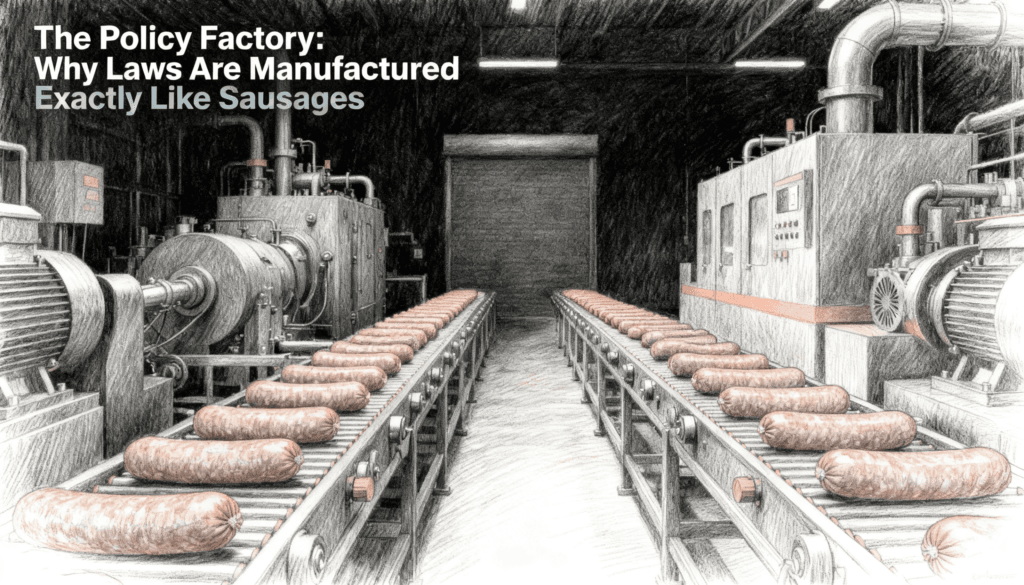
There is an old line, usually attributed to Bismarck but probably older than him, that laws are like sausages. You should never watch either one being made. Most people hear this and chuckle.
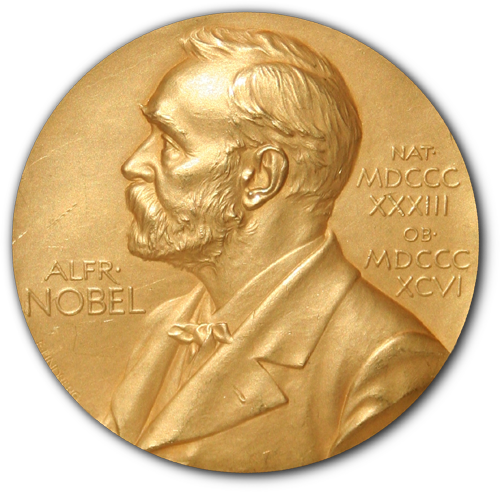
George Stigler, the Nobel laureate economist from the University of Chicago, heard it and thought: actually, let us watch. Let us watch very carefully. What he found was not pretty, but it was precise. Laws are not just like sausages. They are produced by the same industrial logic. They have inputs, outputs, suppliers, and customers. The only difference is that sausages come with nutrition labels.
Stigler published his landmark paper, “The Theory of Economic Regulation,” in 1971. It landed like a grenade in a library. Before Stigler, the dominant view of regulation was what we might call the fairy tale version.
Government spots a market failure. Government steps in to protect consumers. Government regulates wisely. Everyone benefits. Stigler looked at this story the way a mechanic looks at a car commercial. Nice footage, but that is not how the engine works.
His argument was deceptively simple. Regulation is a product. Like any product, it is supplied by those who have the power to create it (legislators, agencies) and demanded by those who stand to gain from it. And who stands to gain most from regulation? Not consumers. Not the general public. The industries being regulated. This was not cynicism dressed up as economics. It was economics revealing what cynicism had only guessed at.
The Assembly Line of Laws
To understand Stigler’s insight, think about what a law actually is in functional terms. A law is a rule backed by the coercive power of the state. That is an extraordinarily valuable commodity. If you can get the government to write a rule that limits your competitors, mandates the purchase of your product, or raises barriers to entry in your market, you have just acquired something money cannot buy on the open market. Or rather, it can. You just have to buy it from a different kind of store.
The “store” in this case is the political process. And like any market, it responds to supply and demand. The supply side is politicians and bureaucrats who control the machinery of regulation. They have something valuable to sell: the ability to write rules that carry the force of law. The demand side is interest groups who want those rules written in their favor.
Now here is where Stigler gets interesting. You might think the demand side would be dominated by consumers. After all, consumers vastly outnumber producers in any given industry. If airline regulation is being debated, there are millions of passengers and only a handful of airlines. Democracy should mean consumer interests win.
But they do not. And the reason they do not is a lesson in the mathematics of motivation.
The Logic of Collective Inaction
Stigler drew on a principle that Mancur Olson had articulated a few years earlier. Concentrated interests beat diffuse interests almost every time. Here is why.
Suppose a regulation will cost consumers ten dollars each across a population of thirty million people. That is three hundred million dollars extracted from the public. But each individual consumer only loses ten dollars. Is anyone going to fly to Washington, hire a lobbyist, and spend months fighting a regulation over ten dollars? Of course not. The cost of fighting exceeds the cost of losing.
Now flip the equation. That same three hundred million dollars flows to an industry with, say, five major firms. Each firm gains sixty million dollars. At those stakes, hiring lobbyists, funding campaigns, and wining and dining regulators is not just rational. It is practically a fiduciary duty to shareholders. The firms will mobilize. The consumers will not. The math is not even close.
This is the engine of Stigler’s policy factory. It does not run on ideology or public interest or democratic deliberation. It runs on concentrated benefits and dispersed costs. Every time you see a regulation that seems to make no sense for ordinary people, this equation is almost certainly humming away underneath.
The Product Line
What exactly does the policy factory manufacture? Stigler identified four main products that industries seek from government.
The first is direct subsidy. Straightforward cash transfers from the public treasury to a private industry. These are the most visible and therefore the hardest to sustain politically, but they exist everywhere from agriculture to energy.
The second is control over entry. If you can get the government to require a license, a certification, or a permit to enter your industry, you have just built a wall around your market at taxpayer expense. Every new competitor has to climb that wall. Many will not bother. This is regulation as competitive moat, and it is spectacularly common.
The third is power over substitutes and complements. If your product competes with something else, you can lobby for rules that handicap the alternative. If your product depends on some input, you can lobby for rules that make that input cheaper or more available to you.
The fourth is price fixing. Not the illegal kind that lands you in court, but the legal kind where the government sets minimum prices, maximum prices, or rate structures that happen to guarantee your profit margins. For decades, this was precisely how airlines, trucking companies, and telecommunications firms operated in the United States.
If this list sounds like a business strategy rather than a theory of government, that is exactly Stigler’s point. Regulation is not something that happens to industries. It is something industries shop for.
The Butcher’s Thumb on the Scale
There is a wonderful irony in all this. Many regulations are sold to the public under the banner of consumer protection. The marketing is first rate. The regulation arrives wrapped in the language of safety, fairness, and the common good. But if you peel back the packaging, you often find something quite different.
Consider occupational licensing. In the United States, roughly one in four workers now needs a government license to do their job. This includes doctors and lawyers, which most people find reasonable. But it also includes florists in Louisiana, interior designers in Florida, and hair braiders in numerous states. The stated rationale is always consumer protection. The actual effect is almost always to limit competition and raise prices for consumers while boosting incomes for those already inside the licensed profession.
A study by Morris Kleiner found that occupational licensing raises wages for licensed workers by about fifteen percent. That money comes directly from consumers who pay higher prices and from would be workers who are locked out of the profession. The policy factory produced a product. It just was not the product advertised on the box.
This pattern repeats with remarkable consistency. Taxi medallion systems were justified as ensuring quality and safety. They created millionaire medallion holders and kept fares artificially high for decades. Agricultural marketing orders were justified as stabilizing farm income. They often required farmers to destroy perfectly good produce to keep prices elevated. Banking regulations after the New Deal were justified as preventing another crisis. Many of them conveniently prevented new banks from competing with existing ones.
Stigler would not have been surprised by any of this. He would have predicted it.
When the Sausage Bites Back
Now, a reasonable objection arises. If Stigler was right, then all regulation is just industry capture in disguise, and we should deregulate everything. But that is not what Stigler argued, and the real world does not cooperate with such tidy conclusions.
Some regulations genuinely do serve the public interest. Clean air and water standards, food safety inspections, and rules against fraud have produced enormous benefits that dwarf their costs. The question is not whether regulation can work. It is whether the process by which regulation is produced tends to skew outcomes toward organized interests rather than the general public. Stigler’s answer was yes, and decades of evidence have supported him.
The more interesting question is what happens when the factory malfunctions. Sometimes, the very industries that captured their regulators find that the machinery turns against them. The airline industry spent decades lobbying for the regulations that kept fares high and routes limited. Then, in 1978, deregulation happened anyway. Fares dropped. Service expanded. Several established airlines went bankrupt. The factory they had built ended up manufacturing their own competition.
There is a parallel here to evolutionary biology that is hard to resist. Species that become too perfectly adapted to a specific environment are often the most vulnerable when that environment changes. Industries that invest heavily in regulatory capture become dependent on the regulatory structure. When the political winds shift, they find they have forgotten how to compete without protection. Their regulatory moat becomes a regulatory trap.
The Invisible Price Tag
One of the most counterintuitive aspects of Stigler’s framework is what it reveals about the cost of regulation. The direct cost of a regulation is usually measurable. Compliance costs, paperwork burdens, administrative expenses. These are the numbers that show up in policy debates.
But the real cost is almost always invisible. It is the business that was never started because the licensing requirements were too burdensome. The product that was never invented because the regulatory approval process was too slow. The price reduction that never happened because the regulation prevented the competition that would have driven it. These costs are enormous, but they are costs of things that do not exist. You cannot photograph an absence. You cannot put a missing innovation on the evening news.
Frederic Bastiat, the French economist, made this point in 1850 with his parable of the broken window. We see the glazier who profits from fixing the window. We do not see the shoemaker who lost a sale because the window owner spent his money on glass instead. Stigler’s policy factory produces a constant stream of broken windows, and we keep congratulating the glaziers.
The Factory Today
If Stigler were alive today, he would find his theory more relevant than ever, though the factory has upgraded its equipment.
The modern version of regulatory capture does not always look like a backroom deal between a senator and a CEO. It often looks like a revolving door between regulatory agencies and the industries they oversee. It looks like a thousand page bill that only the companies with large legal departments can actually interpret. It looks like a public comment process that is theoretically open to everyone but practically dominated by those with the resources to participate.
The technology sector provides a fascinating contemporary example. Large technology companies have, in recent years, begun openly calling for regulation of their own industry. This seems counterintuitive until you apply Stigler’s logic. If regulation is coming regardless, the rational strategy is to help write it yourself. And the regulations that large, established companies tend to favor are, by remarkable coincidence, exactly the kind that small startups cannot afford to comply with. The factory never closes. It just modernizes.
Reading the Label
The ultimate lesson of Stigler’s work is not that regulation is always bad or that government is inherently corrupt. It is that the political process responds to incentives just like any other human system. If we design institutions that make it cheap and easy for concentrated interests to influence regulation and expensive and difficult for diffuse interests to do the same, we will get regulations that serve concentrated interests. This is not a moral failure. It is a mechanical one. And mechanical failures require mechanical solutions.
Transparency helps. Sunset provisions that force regulations to be periodically renewed rather than living forever help. Reducing the sheer volume of things government regulates helps, because every regulation is another product the factory can customize for its best customers. None of these solutions are perfect. The factory is adaptive.
But the first step is always the same. It is the step Stigler took in 1971. Stop believing the label on the sausage. Walk around to the back of the factory. Watch what actually goes in.
The sausage may still be worth eating. But you should know what you are chewing on.