Table of Contents
There is something deeply strange about knowing what a stranger had for breakfast. Not a friend, not a neighbor, but a person you have never met and almost certainly never will. Yet millions of people wake up each morning and reach for their phones to find out exactly this. They scroll through the curated lives of celebrities with a devotion that would make medieval monks envious.
Arthur Schopenhauer, the German philosopher who spent most of the nineteenth century being irritated by humanity, would not have been surprised. He would have been disgusted, certainly. But not surprised. Because Schopenhauer built an entire philosophical system around one uncomfortable idea: that human beings are driven not by reason, not by virtue, but by a blind, restless, insatiable force he called the Will. And celebrity worship, had he lived to see it in its modern form, would have been his most satisfying case study.
The Will and the Endless Wanting
To understand why Schopenhauer matters here, you need to understand what he meant by the Will. This was not willpower in the motivational poster sense. It was not determination or grit. The Will, for Schopenhauer, was the fundamental driving force behind all existence. It is the thing that makes a plant turn toward sunlight, an animal hunt for food, and a human being refresh Instagram forty times before noon.
The Will has no purpose. It has no destination. It simply wants. And the tragedy of human life, according to Schopenhauer, is that we are conscious enough to feel this wanting but not wise enough to see it for what it is. We dress it up. We give it names. We call it ambition, or love, or passion. But underneath all the nice language, it is just a craving that can never be fully satisfied.
This is where celebrity culture slides perfectly into his framework. When someone becomes fixated on a famous person, they are not engaging in a rational activity. They are not learning anything useful. They are feeding the Will. The celebrity becomes a vessel for projected desire. We do not actually want to know what that actor thinks about politics or what that singer eats for lunch. We want to want. The celebrity gives us a target for a craving that would otherwise float around with nowhere to land.
The Representation Problem
Schopenhauer divided reality into two layers. There is the world as Will, which is the raw, chaotic force underneath everything. And there is the world as Representation, which is the world as we perceive and organize it. Our senses, our concepts, our categories of thought all act like a filter, turning the buzzing chaos of reality into something we can navigate.
Celebrity culture lives entirely in the world of Representation. A celebrity is not a person in any meaningful sense to the people who follow them. A celebrity is an image, a brand, a carefully constructed projection. The person behind the image might be boring, might be cruel, might be remarkably ordinary. It does not matter. The representation is what people consume.
Schopenhauer would have pointed out that this is a double illusion. First, there is the ordinary illusion that all humans live under: the belief that the world as we perceive it is the world as it actually is. Second, there is the specific illusion of celebrity, where we mistake a manufactured image for a real human being and then form emotional attachments to that image. We are, in effect, dreaming inside a dream.
And the entire machinery of modern media is designed to keep this dream going. Publicists, stylists, social media managers, photographers, and editors all work together to maintain representations that bear only a passing resemblance to reality. The consumer of celebrity content is engaging with a fiction that pretends to be fact. Schopenhauer, who had a low opinion of human gullibility even in an era without the internet, would have found the whole operation both impressive and appalling.
Fame as the Ultimate Vanity
Schopenhauer wrote extensively about vanity, and he was not gentle about it. He considered vanity one of the most common and most ridiculous human traits. Vanity, in his view, is the desire to be valued by others, and it is absurd because it places your sense of worth in the hands of people who are themselves driven by the same blind, purposeless Will.
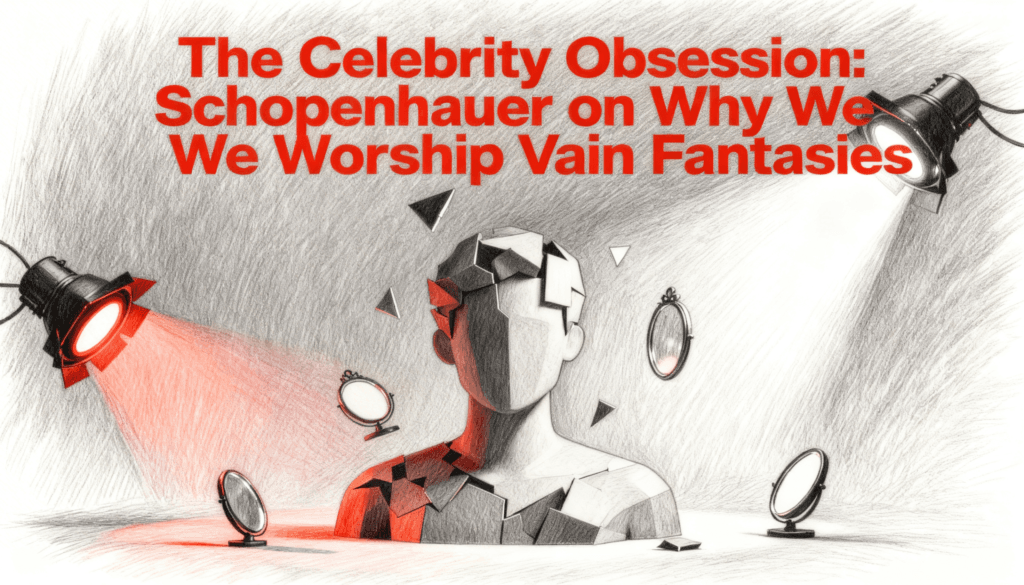
Celebrity worship is vanity observed from the outside. The celebrity is vain because they crave recognition. The fan is vain because they derive a sense of identity and belonging from their association with the celebrity. Neither party is engaging in anything that Schopenhauer would consider meaningful. Both are chasing shadows.
But here is where it gets interesting. Schopenhauer argued that vanity is not just foolish. It is actually a form of suffering. The vain person can never rest because their sense of self depends on something external and unstable. One bad review, one unflattering photograph, one shift in public opinion, and the whole structure collapses. This applies equally to the celebrity and to the devoted fan. The fan who builds their identity around admiration for a famous person has handed the keys to their emotional life to someone who does not know they exist.
There is a strange cruelty in this arrangement. The fan gives attention, money, and emotional energy. The celebrity gives back a representation. It is a transaction where one side pays in something real and the other side pays in something imaginary.
The Boredom Engine
One of Schopenhauer’s most famous observations is that human life swings like a pendulum between suffering and boredom. When we want something and cannot have it, we suffer. When we get what we want, we are briefly satisfied, then bored. Then we want something else, and the cycle starts again.
Celebrity culture is a boredom engine of remarkable efficiency. It generates an endless stream of new content, new scandals, new relationships, new feuds, new outfits, and new opinions. Each piece of content provides a tiny jolt of stimulation that briefly interrupts the boredom, only to be replaced by the need for the next jolt. The cycle is fast, relentless, and ultimately empty.
Consider the lifecycle of a celebrity scandal. Something happens. Everyone is fascinated. Think pieces are written. Opinions are formed. Sides are taken. And then, within days or weeks, it is forgotten, replaced by the next thing. The emotional energy that millions of people invested in caring about that scandal simply evaporates. It was never about the event itself. It was about the temporary relief from the pendulum.
Schopenhauer would see social media as the pendulum made visible. Every scroll is a tiny swing between wanting and having, between curiosity and boredom. The fact that we find this compulsive rather than satisfying is not a bug. It is exactly what his philosophy predicts.
The Paradox of Parasocial Relationships
Modern psychology has a term for the one sided emotional bonds that fans form with celebrities: parasocial relationships. These are relationships where one person invests emotion, attention, and a sense of connection, while the other person is completely unaware of their existence.
Schopenhauer did not use this term, but he described the underlying mechanism with precision. He argued that human beings are fundamentally isolated. The Will that drives each person is blind and self centered. True connection between people is rare and difficult because each person is ultimately trapped within their own subjective experience.
Parasocial relationships are what happen when people try to escape this isolation on the cheap. Instead of doing the hard, uncomfortable work of building real relationships with real people who can disappoint them, they form attachments to images. The image cannot reject you. The image cannot bore you, because it is constantly being refreshed and updated. The image cannot demand anything from you except attention. It is intimacy without risk, connection without vulnerability.
But it is also connection without substance. And Schopenhauer, despite his reputation as a pessimist, would have seen this as genuinely tragic. Not because he believed human connection was easy or even reliably good, but because he understood that substituting a real thing with a comfortable illusion only deepens the isolation it was meant to cure.
What Would Schopenhauer Actually Recommend?
Schopenhauer was not the kind of philosopher who offered cheerful solutions. He did not believe life could be made fundamentally happy. But he did believe it could be made more bearable, and his recommendations are surprisingly relevant to the problem of celebrity obsession.
First, he championed aesthetic contemplation. When you look at a great painting or listen to a great piece of music, Schopenhauer argued, you temporarily escape the tyranny of the Will. You stop wanting. You stop craving. You simply perceive. This is the opposite of scrolling through a celebrity feed, which is designed to stimulate desire and keep you wanting more. Art, for Schopenhauer, is the closest thing to freedom that most people will ever experience.
Second, he advocated for compassion. This might seem odd coming from a man who famously preferred the company of poodles to people. But Schopenhauer believed that recognizing the suffering of others is one of the few genuinely moral acts available to us. Celebrity culture does the opposite. It encourages us to envy, to judge, to compare. It turns other people into objects for our entertainment. Compassion requires seeing someone as a fellow sufferer. Celebrity culture requires seeing someone as a spectacle.
Third, and most radically, Schopenhauer pointed toward the denial of the Will itself. Drawing on Eastern philosophy, particularly Buddhism and Hinduism, he suggested that the ultimate escape from suffering is to stop wanting altogether. To let go of desire, ambition, attachment, and craving. This is, to put it mildly, not what the celebrity industrial complex is selling.
A Connection Worth Making
There is a striking parallel between Schopenhauer’s analysis and what behavioral economists now call the hedonic treadmill. The hedonic treadmill is the observation that people quickly adapt to positive changes in their circumstances and return to a baseline level of happiness. A raise, a new car, a bigger house all provide temporary pleasure that fades. You end up wanting more, not because you are greedy, but because your psychological machinery is built to keep you striving.
Celebrity culture is a hedonic treadmill for the imagination. You follow a new celebrity, you feel a burst of interest and excitement, and then it fades. So you follow another. Or you go deeper, consuming more content about the same person, chasing a feeling of connection or excitement that keeps receding. The modern attention economy is built on this treadmill. It profits not from your satisfaction but from your inability to be satisfied.
Schopenhauer identified this pattern almost two centuries before the term was coined. He simply described it in different language and with considerably less optimism about finding a solution.
The Uncomfortable Mirror
The real power of reading Schopenhauer on this topic is not that he gives you permission to feel superior to people who follow celebrities. That would itself be vanity, and he would have no patience for it. The real power is that he forces you to ask uncomfortable questions about your own desires.
Why do you care about what you care about? How much of your attention is freely given, and how much is compulsively taken? When you scroll, what are you actually looking for? And would you recognize it if you found it?
These are not questions with easy answers. Schopenhauer certainly did not pretend to have easy answers. What he had was an unflinching willingness to describe the problem in terms that are difficult to dismiss. Human beings are creatures of desire. Our desires do not serve our happiness. And the modern world has become extraordinarily good at exploiting this fact.
Celebrity culture is not a disease. It is a symptom. It is what happens when a species driven by boundless craving is given technology that can feed that craving at infinite speed and zero cost. Schopenhauer saw the craving clearly. We have simply built better machines for feeding it.
The next time you find yourself absorbed in the life of someone you have never met, it might be worth pausing. Not to feel guilty. Not to perform some act of intellectual superiority. But to notice the wanting itself. To feel the pull. To recognize it for what it is.
That moment of recognition is, according to Schopenhauer, the beginning of something that looks a lot like freedom. It will not last. The Will always comes back. But for a brief, quiet moment, you are no longer a puppet. You are the one watching the strings.