Table of Contents
There is a particular kind of advice that floats around modern culture like a bad perfume. It goes something like this: eliminate stress, avoid discomfort, optimize for happiness. Download this app. Try this breathing technique. Remove toxic people. Curate your environment until nothing scratches you.
Friedrich Nietzsche would have found this absolutely pathetic.
Not because he was a masochist or because he enjoyed watching people struggle. But because he believed, with a conviction that bordered on obsession, that suffering was not the enemy of a great life. It was the raw material.
This is not a comfortable idea. It was not comfortable when Nietzsche wrote it in the late 1800s, and it is not comfortable now. But discomfort, as he would remind us, is sort of the whole point.
The Hammer and the Marble
To understand Nietzsche on suffering, you first need to understand what he thought a human being could become. He was not interested in contentment. He was not interested in the absence of pain. He was interested in what he called the creation of the self, the idea that a person could sculpt something magnificent out of the chaos of existence.
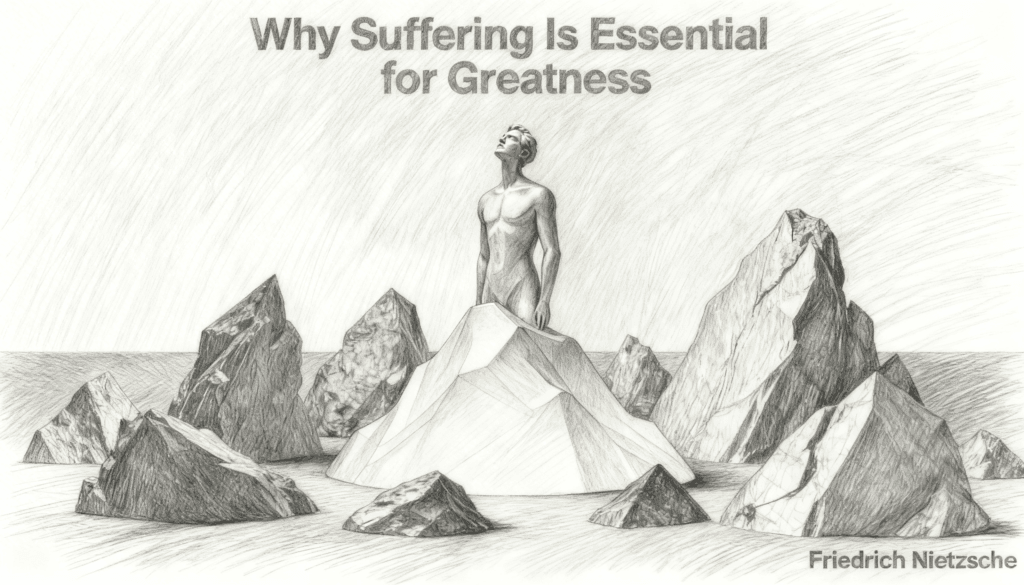
Think of Michelangelo standing before a block of marble. The marble does not become the David through gentle caressing. It becomes the David through relentless chipping, striking, and removal. The sculptor has to destroy most of the stone to find the figure inside it.
Nietzsche saw suffering as the chisel. Without it, you remain a block. Smooth, maybe. Comfortable, certainly. But formless.
In The Gay Science, he wrote that the discipline of suffering, of great suffering, has been the primary force behind every elevation of humanity so far. He was not being poetic for the sake of it. He meant this literally. Every person who had achieved something extraordinary, every thinker who had pushed past the obvious, every artist who had created something that endured across centuries, had done so not in spite of their suffering but because of it.
What Nietzsche Actually Meant by Suffering
Here is where most people get Nietzsche wrong. They assume he was glorifying pain for its own sake, like some philosophical frat boy telling you to toughen up. That is a misreading so deep it practically qualifies as fiction.
Nietzsche was not saying you should seek out suffering like a hobby. He was saying that when suffering arrives, and it will, your response to it determines what you become. The suffering itself is neutral. It is a furnace. What matters is whether you use it to forge something or whether it simply burns you down.
He drew a sharp distinction between two responses to hardship. One response is resentment. You suffer, and you decide the world is unfair, that someone must be blamed, that the system is broken. You become bitter. You shrink. Nietzsche had a word for this orientation, and he called it slave morality. It is the posture of someone who defines good as simply the absence of what hurts them.
The other response is transformation. You suffer, and you use the experience to deepen your understanding, sharpen your will, and expand your capacity. You do not pretend the pain was pleasant. You do not paste a motivational quote over it. You metabolize it. You let it change the architecture of who you are.
This second path is what Nietzsche associated with greatness. And it is far harder than it sounds.
The Uncomfortable Mathematics of Growth
There is a principle in exercise science that maps almost perfectly onto Nietzsche’s philosophy. Muscles do not grow during the workout. They grow during recovery from the workout. The exercise itself is damage. You are literally tearing muscle fibers apart. Growth only happens because the body, in repairing that damage, overcompensates. It builds back stronger than before.
Nietzsche understood this logic at the level of the soul, if you will forgive the term he himself would have complicated. Psychological and creative growth follow the same brutal arithmetic. You do not become wiser by reading fortune cookies in a comfortable room. You become wiser by having your assumptions destroyed and being forced to rebuild them from scratch.
Consider the people in history who fit this pattern. Beethoven composed some of his most powerful work while going deaf. Dostoevsky wrote The Brothers Karamazov after surviving a mock execution, years in a Siberian prison camp, epilepsy, gambling addiction, and the death of his child. These are not coincidences that Nietzsche would have waved away. He would have pointed at them and said: obviously. The depth of the work reflects the depth of the suffering that preceded it.
This is counterintuitive in a culture that treats comfort as a fundamental right. We assume that the best conditions for producing great work are stability, resources, and peace of mind. Nietzsche would argue that these conditions are more likely to produce mediocrity. Not because they are bad, but because they do not force anything out of you. They let you coast. And coasting, for Nietzsche, was a form of slow spiritual death.
Amor Fati: The Most Radical Idea He Ever Had
Of all Nietzsche’s concepts, the one that captures his view on suffering most completely is amor fati. Love of fate. Not tolerance of fate. Not acceptance. Love.
This means looking at everything that has happened to you, including every loss, failure, humiliation, and moment of despair, and saying: I would not have it any other way. Not because you enjoy pain, but because you recognize that every moment, especially the terrible ones, was necessary for you to become who you are.
This is an almost impossibly demanding idea. It is easy to love your fate on a good day. Try loving it when you have lost something that mattered deeply. Try loving it when your plans collapse and the future looks like a wall. That is where amor fati becomes something more than a slogan. It becomes a practice, a discipline, a way of relating to reality that refuses to edit out the hard parts.
Nietzsche was not theorizing from an armchair, either. His own life was a masterclass in suffering. He dealt with migraines so severe they left him bedridden for days. His eyesight deteriorated to the point where he could barely read. He was largely ignored by the intellectual world during his productive years. The woman he loved rejected him. His friendship with Richard Wagner, which had been one of the most important relationships in his life, collapsed in bitterness. And in 1889, he suffered a mental breakdown from which he never recovered, spending the last eleven years of his life in a fog of incapacity.
He wrote his greatest works in the middle of all this. Not after it. Not once things calmed down. In the middle.
The Overman Does Not Avoid the Storm
Nietzsche’s concept of the Übermensch, usually translated as the Overman or Superman, is often misunderstood as some kind of biological fantasy about a superior race. This interpretation, largely fueled by his sister’s posthumous manipulation of his work for Nazi propaganda, is a grotesque distortion.
The Overman, in Nietzsche’s actual writing, is a creative and spiritual ideal. It is the person who has moved beyond conventional morality, not to become cruel, but to become self-determining. The Overman creates values rather than inheriting them. The Overman gives meaning to existence rather than waiting for meaning to be handed down from some authority.
And here is the connection to suffering: you cannot become the Overman without it. The process of moving beyond inherited values requires destruction. You have to tear down before you build. You have to lose the comfortable certainties that once held your world together. This is a painful, disorienting experience. Nietzsche compared it to being unmoored on an open sea with no land in sight.
Most people, he believed, would rather cling to a sinking ship than swim toward an unknown shore. And he did not entirely blame them. The unknown is terrifying. But staying on the ship is not survival. It is just a slower way of going under.
Why Modern Culture Gets This Exactly Backwards
We live in an era of unprecedented comfort. There are apps to remove friction from every daily task. There are services that ensure you never have to encounter an inconvenience. The entire thrust of consumer technology is toward a life where nothing is difficult, nothing is uncertain, and nothing hurts.
Nietzsche would look at this and see a civilization in decline. Not because comfort is inherently wrong, but because a culture that treats the elimination of discomfort as its highest goal has lost the ability to produce anything meaningful. It has chosen the last man over the Overman.
The last man is Nietzsche’s image of the ultimate endpoint of comfort culture. The last man blinks and says, “We have invented happiness,” and then does nothing of significance ever again. He is fed, entertained, safe, and utterly empty. He has no great passions because great passions require great risks, and great risks involve suffering.
Look around. The resemblance is not subtle.
This is not a call to abandon modern medicine or air conditioning. Nietzsche was not an idiot. But it is a call to recognize that a life engineered entirely around the avoidance of suffering is a life that has traded its potential for its comfort. And that trade, once made, is very hard to reverse.
The Paradox Nietzsche Saw That Most People Miss
Here is the part that makes Nietzsche genuinely difficult to dismiss, even if you find his rhetoric excessive. He identified a paradox that sits at the center of human experience and that most philosophical traditions try to talk their way around.
The paradox is this: the moments that give life its deepest meaning are almost always intertwined with suffering. The love that transforms you is also the love that can devastate you. The creative work that defines your life will also be the source of your greatest frustration and doubt. The pursuit of truth will destroy comfortable illusions you did not even know you were holding.
You cannot have the meaningful parts without the painful parts. They are not separate experiences that happen to occur near each other. They are the same experience, viewed from different angles.
Buddhism addresses this by suggesting you release attachment. Stoicism addresses it by training you to be indifferent to externals. Nietzsche took a different and far more aggressive path. He said: do not release. Do not become indifferent. Embrace. Want more of it. Let the full catastrophe of being alive wash over you and use it as fuel.
This is why he spoke of the will to power, which is not, despite what you may have heard, about dominating others. It is about the drive to overcome, to grow, to become. And that drive requires resistance. It requires obstacles. It requires, in a word, suffering.
What This Means if You Are Not a 19th Century Philosopher
You do not need to agree with everything Nietzsche wrote to find something useful here. In fact, he would probably prefer that you did not agree with everything he wrote. He had very little patience for disciples.
But consider the core of the argument stripped of its 19th century drama. The hard things you go through are not just interruptions to your life. They are not detours from the real story. They are the story. They are the experiences that force you to develop capacities you did not know you had, that reveal what you actually care about, and that give your choices weight and consequence.
A life without suffering would not be paradise. It would be a simulation. Nothing would matter because nothing would cost anything. Your victories would be meaningless because you never risked defeat. Your relationships would be shallow because you never had to fight for them. Your work would be forgettable because it never demanded anything from you that hurt to give.
Nietzsche saw this with a clarity that was almost cruel. And he delivered the message with the subtlety of a sledgehammer, which is probably why people are still arguing about him more than a century after his death.
The question he leaves you with is not whether you will suffer. That is settled. You will. The question is whether you will do something with it, whether you will let it be the chisel that finds the figure in the marble or just another crack in a stone that nobody remembers.
He already knew which option most people would choose. He wrote for the ones who might choose differently.