Table of Contents
You probably believe you are a good person because you have thought carefully about right and wrong. You have weighed your options. You have reasoned through dilemmas. You have arrived at conclusions about justice, fairness, and decency through the disciplined application of your rational mind.
David Hume would like a word.
The Scottish philosopher, writing in the 18th century with a calm that bordered on mischief, made a claim that still irritates people today: reason is not what makes you moral. It never was. Your feelings got there first, and your logic showed up later to write a press release.
This is not a fringe idea dressed up in old language. It is one of the most consequential arguments in the history of ethics, and modern psychology has spent the last few decades proving Hume embarrassingly right. The implications reach into how we raise children, how we build institutions, how we argue on the internet, and why those arguments almost never change anyone’s mind.
Let us start where Hume started. With you, feeling something before you even know why.
The Dog That Wags the Tail
Hume’s most famous line on morality is blunt enough to be carved into stone: “Reason is, and ought only to be, the slave of the passions.” He did not mean that people are irrational animals stumbling through life. He meant something more precise and more unsettling. Reason is a tool. A very good tool. But tools do not decide where to go. They get picked up by something else.
When you see someone kick a dog on the street, you do not run a logical proof in your head before feeling outrage. The outrage arrives first. It is immediate, physical, almost electric. Only after the feeling lands do you start constructing reasons for why kicking dogs is wrong. You talk about suffering, about cruelty, about the moral status of animals. But those reasons are scaffolding built around a reaction that was already complete.
Hume noticed this pattern everywhere. Moral judgments feel like conclusions, but they behave like reflexes. We sense approval or disapproval the way we sense heat or cold. The thinking comes after, and its job is not to discover the truth but to justify what the body has already decided.
This is where it gets uncomfortable. If morality begins in feeling, then being good is less about having the right philosophy and more about having the right habits. The right instincts. The right training.
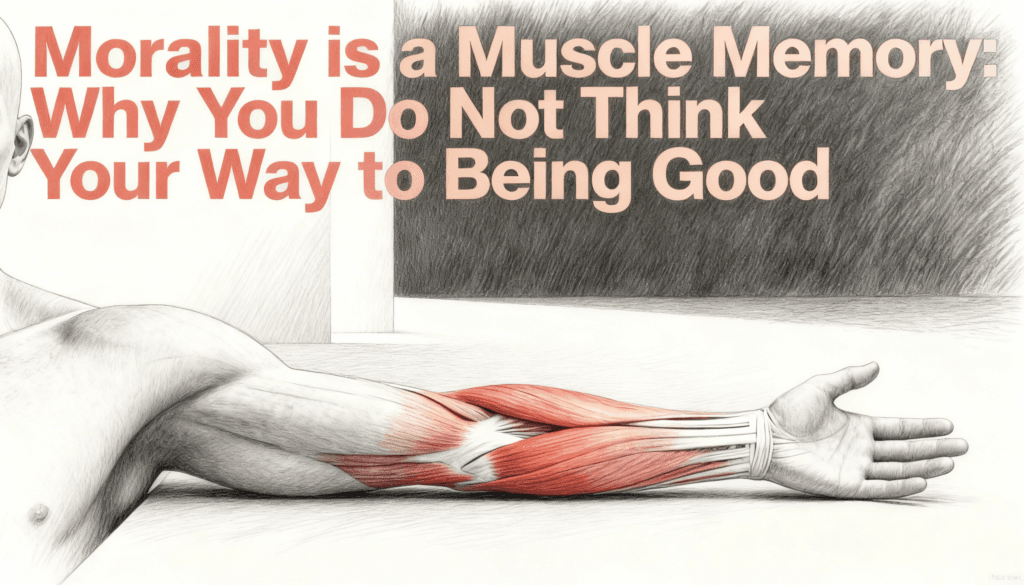
In other words, morality is not a theorem. It is a muscle memory.
The Gymnasium of Character
Think about how you learned to catch a ball. Nobody handed you a physics textbook and asked you to calculate trajectory, wind resistance, and the optimal angle of your hand. You just did it. Badly at first. Then less badly. Then without thinking at all. Repetition built something in your nervous system that operates faster and more reliably than conscious thought ever could.
Hume saw moral development the same way. You do not become honest by reading an essay on honesty. You become honest by being honest, over and over, in small moments that nobody notices, until it stops feeling like a choice and starts feeling like who you are. The generous person does not agonize over whether to help. They just help. The habit has become invisible to them.
This idea did not originate with Hume. Aristotle said something remarkably similar two thousand years earlier when he argued that virtue is a practice, not a piece of knowledge. But Hume pushed it further by attacking the assumption that reason could ever be the starting point. Aristotle still believed that the wise person reasons well about how to live. Hume said reasoning well is beside the point if you have not already been shaped by the right sentiments.
Here is where a comparison from an entirely different field makes the idea click. In cognitive science, researchers distinguish between declarative knowledge and procedural knowledge. Declarative knowledge is facts you can state: “The capital of France is Paris.” Procedural knowledge is skills you perform: riding a bicycle, playing piano, throwing a punch. You cannot learn procedural knowledge by reading about it. You have to do it until it lives in your body.
Morality, Hume suggests, is procedural. It lives in your reactions, your gut, your trained emotional responses. And just like you cannot talk someone into being able to ride a bicycle, you cannot argue someone into being a good person.
The Rationalist Objection (and Why It Keeps Losing)
Now, plenty of brilliant people have disagreed with Hume. The rationalist tradition, running from Plato through Kant and into contemporary philosophy, insists that morality must be grounded in reason. Kant in particular was almost personally offended by Hume’s suggestion. For Kant, a moral act only counts if it is done from duty, from rational principle, not from feeling. If you help someone because you feel like helping, that is nice, but it is not truly moral. Morality requires that you act from a rule you have rationally endorsed.
It is an elegant position. It is also, if Hume is right, a fantasy.
The problem with the rationalist account is not that it is wrong in theory. It is that it does not describe how actual human beings actually work. And here is where modern research has handed Hume a decisive victory.
Jonathan Haidt, the social psychologist, has built a career demonstrating what he calls the “emotional dog and the rational tail.” In study after study, Haidt and his colleagues have shown that people make moral judgments instantly and emotionally, then use reasoning to justify those judgments after the fact. When the reasoning fails, people do not change their minds. They just look for better reasons. Or they shrug and say, “I do not know why, I just know it is wrong.”
Haidt calls this “moral dumbfounding,” and it is exactly what Hume predicted. The feeling is the judgment. The reasoning is the lawyer hired to defend it.
One of Haidt’s most famous experiments involves a story about consensual incest between adult siblings who use protection, tell no one, and are not harmed by the experience. When people are asked whether it is wrong, nearly everyone says yes. When asked why, they struggle. They reach for arguments about genetic risk, but the story rules that out. They reach for arguments about psychological damage, but the story rules that out too. Eventually, most people land on some version of “It is just wrong.” They know it in their bones. Their reason cannot find the receipt.
This does not mean reasoning is useless. It means reasoning plays a different role than we thought. It is not the judge. It is the defense attorney.
The Inconvenient Implications
If morality is more like muscle memory than mathematics, several things follow that we would rather not admit.
First, moral education matters more than moral argument. How children are raised, what habits they form, what emotional responses are cultivated in them through years of practice and example, matters more than any ethics class they will ever take. This is not a popular idea in a culture that worships rational debate and believes the best argument should always win. But Hume would point out that the best argument usually just wins over people who already felt that way.
Second, moral disagreement is not primarily an intellectual failure. When two people disagree about abortion, capital punishment, or immigration, they are rarely disagreeing about facts or logic. They are disagreeing because their trained emotional responses point in different directions. Their moral muscle memories are different. This is why political debates so rarely change minds. You are not arguing against a position. You are arguing against a reflex.
Third, and this is the one that really stings, your own moral certainty deserves more suspicion than you give it. That feeling of righteous conviction, that absolute confidence that you are on the correct side of an issue, is not evidence that you have reasoned well. It is evidence that your emotional training is functioning smoothly. Which is fine, as long as you remember that someone with the opposite conviction feels exactly the same way.
This is not moral relativism. Hume was not saying all feelings are equally valid or that there is no difference between compassion and cruelty. He was saying that the foundation of morality is in our shared human sentiments, our capacity for sympathy, our instinctive responses to suffering, and that these sentiments can be cultivated or corrupted. A society that trains cruelty into its citizens will produce people who feel morally certain about terrible things. The feelings are real. The certainty is real. The goodness is not.
The Sympathy Engine
Hume placed enormous weight on one particular sentiment: sympathy. Not sympathy in the modern greeting card sense, but something closer to what we would now call empathy. The ability to feel what others feel. To catch emotions the way you catch a cold.
For Hume, sympathy is the engine of morality. When you see someone in pain, something in you mirrors that pain. When you see someone flourish, something in you shares the pleasure. This is not a choice. It is not an argument. It is a feature of your nervous system, and it is the raw material from which all moral life is built.
Mirror neurons, discovered in the 1990s, offered a neurological echo of this idea. These are brain cells that fire both when you perform an action and when you watch someone else perform it. They are part of the reason you wince when you see someone stub their toe. Your brain is running a simulation of their experience whether you like it or not.
The moral implications are significant. If sympathy is the foundation, then anything that strengthens sympathy strengthens morality. And anything that weakens it, isolation, dehumanization, abstraction, the reduction of people to categories or statistics, weakens morality too.
This may explain something that has puzzled observers of modern life. We live in an age of unprecedented moral reasoning. We have more ethical frameworks, more philosophical arguments, more sophisticated debates about justice than any civilization in history. And yet our ability to actually treat each other well does not seem to have improved proportionally. Hume would not be surprised. We have been sharpening the wrong tool. We have been training the lawyer when we should have been training the heart.
The Practice, Not the Theory
There is a strange liberation in Hume’s view if you let it in. It relieves you of the pressure to have a perfectly consistent moral philosophy. You do not need an airtight ethical system to be a good person. In fact, the people who have the most airtight ethical systems are sometimes the least pleasant to be around. They have perfected the theory and neglected the practice.
What you need, according to Hume, is cultivation. You need to practice compassion until it becomes automatic. You need to exercise generosity until it stops requiring willpower. You need to surround yourself with people whose moral instincts you admire, because sympathy is contagious, and you will absorb their habits whether you intend to or not.
This is why moral exemplars matter more than moral textbooks. A child who grows up watching genuine kindness learns kindness in a way that no lecture can replicate. The knowledge lives in a different place. It lives in the same place that knows how to catch a ball, or play a chord, or balance on a bicycle. In the body. In the habit. In the trained, effortless response.
Hume died in 1776, reportedly in good spirits and with a cheerfulness that annoyed his more religious friends, who expected him to panic on his deathbed. He did not. Perhaps this was the final evidence of his own argument. He had practiced composure so long that it was no longer a philosophical position. It was simply how he was.
And that, Hume would say, is the whole point. Morality is not something you figure out. It is something you become.
The muscle remembers. Even when the mind forgets why.