Table of Contents
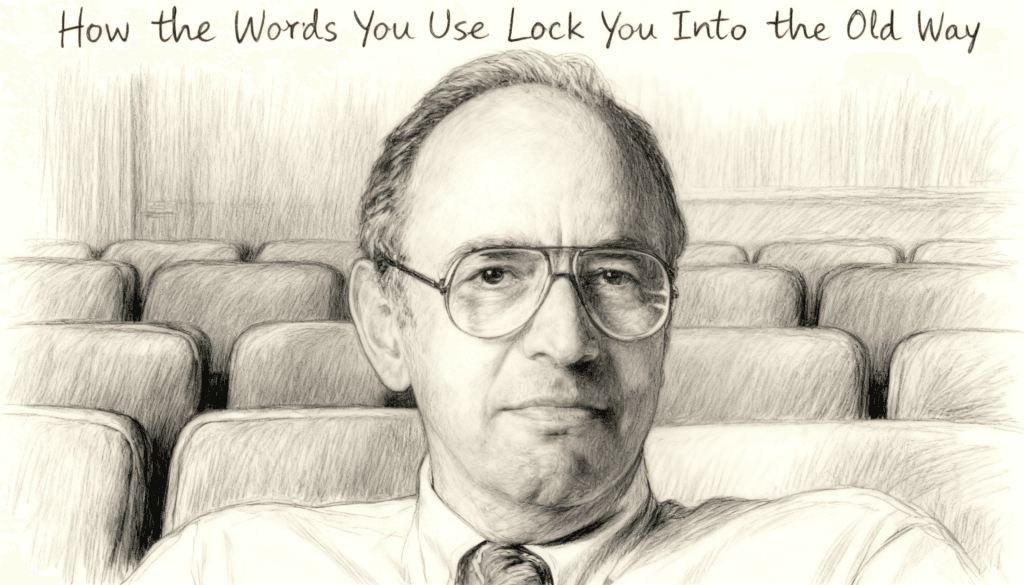
Thomas Kuhn ruined the word “paradigm” for everyone. That is not his fault, exactly. But it is ironic. The man who wrote the most important book about how language traps thinking had his own key term kidnapped, diluted, and turned into corporate wallpaper. Every startup pitch deck now has a “paradigm shift.” Every LinkedIn post promises one. The phrase means nothing anymore precisely because it once meant everything.
But here is the thing most people miss about Kuhn. His famous book, The Structure of Scientific Revolutions, is not really about science. Not at its core. It is about language. It is about how the words a community uses to describe the world quietly become the walls of a prison. And the prisoners do not know they are locked up because the walls look exactly like reality.
That idea should unsettle you. Because you are using words right now, in your work, in your thinking, in your daily decisions, that are doing the same thing to you.
The Furniture Nobody Notices
Kuhn published his book in 1962. The central argument is deceptively simple. Science does not progress in a straight line. It lurches. For long stretches, scientists work within a shared framework, what Kuhn called a paradigm. They solve puzzles. They refine measurements. They write papers that extend the existing model. This is what he called “normal science,” and it is not an insult. Normal science is productive. It builds bridges and cures diseases.
But here is where it gets interesting. During normal science, the paradigm is not just a theory. It is a vocabulary. It is a set of assumptions so deeply embedded in the language that they become invisible. Scientists do not debate them because they cannot see them. The words they use every day carry the old assumptions like hidden cargo.
Think of it this way. Before Copernicus, the word “planet” meant “wandering star.” That definition contained a geocentric universe inside it. The Earth was the fixed point. Everything else wandered around it. Every time an astronomer used the word “planet,” they were reinforcing a model of reality without realizing it. The word was not neutral. It was an argument disguised as a label.
This is the trap Kuhn identified. Language is not a transparent window onto reality. It is furniture. And after you have lived with the same furniture long enough, you stop seeing it. You just navigate around it.
Why Smart People Are the Last to Notice
Here is the counterintuitive part. The more expert you are, the more trapped you become. Kuhn observed that the scientists most invested in the old paradigm were almost never the ones who broke through to the new one. The revolution came from outsiders, from young researchers, from people working at the edges of a field who had not yet been fully trained in the vocabulary.
This makes sense if you think about what expertise actually is. An expert is someone who has spent years learning to see the world through a particular set of concepts. They have been rewarded for using those concepts well. Their careers, their reputations, their identities are built on them. Asking an expert to abandon their conceptual framework is not like asking them to change clothes. It is like asking them to change skeletons.
Max Planck, the physicist who helped launch quantum mechanics, put it bluntly. He said science advances one funeral at a time. He was not being morbid. He was being observational. The old guard does not convert. It retires. Or it dies. And then a new generation, unburdened by the old vocabulary, builds something different.
This is uncomfortable to sit with. It means that the thing we call expertise is also, simultaneously, a form of entrapment. The master craftsman and the prisoner are wearing the same suit.
The Dictionary as Invisible Architecture
Let us move this out of the laboratory and into your life. Because Kuhn was talking about physics, but the mechanism he described operates everywhere.
Consider the language of business. For decades, the dominant vocabulary was built around industrial metaphors. Companies have “pipelines.” They need “throughput.” They measure “output.” Employees are “resources.” These words are not accidents. They are artifacts from an era when the dominant model of a business was a factory. Every time a manager talks about “optimizing resources,” they are, without knowing it, treating human beings as interchangeable parts in a machine.
Now, some people will object here. They will say these are just metaphors. Everyone knows employees are not literally gears. But Kuhn’s point is precisely that the power of these words lies in their invisibility. Nobody thinks they are being influenced by a metaphor. That is what makes the influence so effective. You do not fight what you do not see.
The language of education offers another example. Students “absorb” knowledge. Teachers “deliver” content. Learning is “measured” through tests. The entire vocabulary assumes that education is a transfer process, like pouring water from one container into another. That metaphor shapes everything, from how classrooms are designed to how success is defined. And it is so deeply embedded in the language that questioning it feels almost nonsensical. What else would education be?
That question, the one that feels absurd, is always the most important one. Kuhn showed that the moment before a paradigm shift is the moment when the old vocabulary makes alternatives literally unthinkable. Not wrong. Unthinkable. The words do not exist yet to think the new thought.
The Anomalies You Cannot Name
Kuhn described a specific process by which paradigms collapse. It starts with anomalies. Small things that do not fit. Experimental results that should not happen. Data points that the existing model cannot explain.
In the early stages, these anomalies are dismissed. Not through conspiracy or malice. Through language. The existing vocabulary simply does not have a place for them. They are called “noise.” They are called “measurement errors.” They are called “edge cases.” Notice how each of those labels is a way of saying: this does not count. The words push the anomaly to the margins before anyone has to seriously examine it.
This happens in organizations every day. An employee notices something wrong. They try to raise it. But the company vocabulary does not have words for the problem they are seeing. So the concern gets translated into the existing language, and in the translation, it loses its meaning. “Systemic dysfunction” becomes “a few process improvements.” “Cultural rot” becomes “an engagement survey opportunity.” The words available determine what can be said. And what can be said determines what can be addressed.
George Orwell understood this mechanism perfectly. In 1984, the purpose of Newspeak was not to add words. It was to remove them. If you eliminate the word “freedom,” you do not need to argue against freedom. You just make it impossible to articulate as a concept. Kuhn was describing the same phenomenon, but without the totalitarian government. The censorship is built into the vocabulary itself, maintained not by a ministry but by professional consensus and habit.
When the Map Eats the Territory
There is a concept in general semantics, originally from Alfred Korzybski, that says the map is not the territory. Everyone nods along when they hear this. Yes, obviously, the description of a thing is not the thing itself. But Kuhn showed something more disturbing. In practice, for the people inside a paradigm, the map does become the territory. They do not use the map to navigate reality. They use it to define reality. Anything not on the map does not exist.
This is why paradigm shifts feel so disorienting. It is not just that the answers change. The questions change. The categories change. Things that were central become peripheral. Things that were invisible become obvious. It is not like updating a map with new roads. It is like discovering you have been navigating a completely different continent.
Consider how this played out in medicine. For centuries, the dominant vocabulary described disease in terms of bodily “humors.” Physicians talked about blood, phlegm, yellow bile, black bile. They had an elaborate and internally consistent language for diagnosis and treatment. The vocabulary worked. It made sense. It produced explanations. It just happened to be completely wrong. But the wrongness was invisible because the language was so comprehensive. It could explain anything. And a framework that can explain anything actually explains nothing. It just redescribes the world in its own terms and calls that an explanation.
The Expensive Silence
Here is where this gets practical and a little painful. If Kuhn is right, and decades of evidence suggest he is, then the biggest risks you face are not the problems you can articulate. They are the problems you cannot name.
Every field, every organization, every individual operates within a vocabulary that highlights some things and hides others. That vocabulary is not neutral. It was inherited from a particular moment in history, built to solve particular problems, shaped by particular assumptions. Those assumptions may no longer hold. But the words remain, and they keep shaping how you think, long after the conditions that created them have changed.
This is why genuinely new ideas are so often met with confusion rather than disagreement. Disagreement requires a shared vocabulary. When someone proposes something truly new, the first reaction is not “you are wrong.” It is “what are you even talking about?” That confusion is not a sign of stupidity. It is a sign that the new idea exists outside the current vocabulary. It has no address in the existing map.
Resistance to new ideas is often framed as a psychological problem. People are stubborn. People fear change. People cling to the familiar. Kuhn offered a more structural explanation. People are not resisting the new idea. They literally cannot see it. Their vocabulary makes it invisible. And telling someone to “think outside the box” while handing them a box-shaped dictionary is a recipe for frustration on both sides.
Finding the Words Before They Find You
So what do you do with this? You cannot simply abandon your vocabulary. You need language to think. The solution is not to stop using words. It is to start noticing them.
Kuhn suggested that paradigm shifts often begin with a period of crisis, when anomalies pile up so high that they can no longer be dismissed. But there is something you can do before the crisis arrives. You can audit your vocabulary. You can ask yourself which words in your field are treated as descriptions of reality when they are actually inherited assumptions. You can look for the “of course” moments, the points where everyone nods in agreement because the conclusion seems obvious. Those are usually the most dangerous spots. Obvious conclusions are often just deeply embedded premises wearing a disguise.
You can also pay attention to discomfort. When someone says something that sounds nonsensical, before dismissing it, ask whether the nonsense is in the idea or in the gap between the idea and your vocabulary. Sometimes what sounds like gibberish is just a thought that has not yet been assigned words in the current language. The early papers on quantum mechanics sounded like nonsense to physicists trained in classical vocabulary. The ideas were not nonsensical. They were undomesticated.
And you can study history. Not for the answers, but for the pattern. Every era believed its vocabulary described reality as it actually was. Every era was wrong in ways it could not see. There is no reason to think ours is different. The only question is which words are currently doing the hiding, and whether you can catch them in the act before they cost you something you cannot afford to lose.
Kuhn died in 1996, leaving behind a word, “paradigm,” that had been stretched so thin it barely meant anything. But the idea underneath remains as sharp as ever. The words you use are not windows. They are walls. And the most important intellectual skill you can develop is not learning new words. It is learning to see the ones you already use.
That might be the real paradigm shift. Not a new vocabulary. Just eyes open enough to read the one you already have.