Table of Contents
There is something deeply satisfying about owning less. Ask anyone who has cleared out a closet and felt that rush of liberation, that sense of moral superiority over the clutter. The minimalist movement has turned this feeling into a philosophy, a lifestyle brand, and ironically, a very profitable publishing niche. Declutter your home. Simplify your life. Buy nothing. Want nothing. Be free.
It sounds beautiful. It also sounds like a recipe for economic collapse.
John Maynard Keynes, the British economist who reshaped how governments think about money, would have watched the minimalist movement with a mixture of amusement and horror. Not because he loved excess. Not because he was some champion of mindless consumption. But because he understood something that the decluttering gurus tend to gloss over: your spending is someone else’s income. When you stop buying things, someone loses their job. That is not a metaphor.
So here we are, caught between two moral frameworks that cannot both be right. One says virtue lives in restraint. The other says restraint, taken far enough, is a form of collective self harm. Let us work through this properly.
The Paradox of Thrift, or How Your Savings Account Hurts People
Keynes introduced a concept in the 1930s that still makes people uncomfortable. He called it the paradox of thrift. The idea is deceptively simple. If one person saves more money, that person becomes wealthier. If everyone saves more money at the same time, everyone becomes poorer.
This is not intuitive. We are raised to believe that saving is responsible. And for an individual, it is. But economics has this annoying habit of punishing collective virtue. When millions of people simultaneously decide to spend less, demand drops. When demand drops, businesses earn less revenue. When businesses earn less revenue, they lay off workers. When workers lose their jobs, they spend even less. The cycle feeds on itself like a snake eating its own tail.
Keynes watched this happen in real time during the Great Depression. People were terrified, so they hoarded cash. The more they hoarded, the worse things got. The economy did not need more discipline. It needed someone to walk into a shop and buy something.
This is where the minimalist philosophy runs into a wall it does not like to acknowledge. Marie Kondo can ask whether an object sparks joy, but Keynes would ask a different question: does your refusal to buy that object spark unemployment?
The Minimalist Blind Spot
To be fair to the minimalists, their movement did not emerge from nowhere. It was a reaction to something genuinely toxic. The consumer culture of the late twentieth and early twenty first century was, by any reasonable standard, absurd. People were buying houses they could not afford, filling them with things they did not need, and financing it all with debt they could not repay. The 2008 financial crisis was, in many ways, the logical conclusion of consumption without thought.
So when Joshua Fields Millburn and Ryan Nicodemus started telling people that less is more, they were responding to a real problem. Overconsumption is wasteful. It damages the environment. It creates anxiety. The research on this is fairly robust. Beyond a certain income threshold, more stuff does not make people happier. The hedonic treadmill is real. You buy the car, you feel good for a month, then you need a bigger car.
But here is where the minimalists make their philosophical error. They diagnose the disease correctly and then prescribe a cure that, if universally adopted, would kill the patient. Their framework treats consumption as a personal moral question. Should I buy this? Do I really need it? These are fine questions for an individual sitting in a comfortable apartment with a full refrigerator. They are terrible questions for an economy that depends on demand to function.
The minimalists think in terms of the individual soul. Keynes thought in terms of systems. And systems do not care about your soul. They care about flows. Money flowing from your wallet to a business to an employee to another business. Stop the flow and the system seizes up.
Your Latte is an Act of Civic Participation
There is a popular piece of financial advice that has been circulating for years: stop buying your daily coffee and invest the money instead. Over thirty years, at compound interest, your latte money could become a meaningful sum. This advice is mathematically correct and economically illiterate.
That daily coffee supports a barista, a coffee roaster, a dairy farmer, a cup manufacturer, a delivery driver, and the landlord of the building where the café operates. Each of those people spends their earnings somewhere else, supporting yet another chain of workers and businesses. Economists call this the multiplier effect. Every dollar spent does not just move once. It moves several times through the economy, creating value at each stop.
When you skip your latte to pad your savings account, that money sits in a bank. The bank might lend it out, or it might not. Even if it does, the velocity of that money slows dramatically. A dollar spent at a café today becomes five or six dollars of economic activity within weeks. A dollar saved might become a loan in six months, if at all.
This does not mean you should never save. Keynes was not an idiot. He understood that investment is crucial for long term growth. But he also understood timing. In a healthy, booming economy, saving is fine. In a sluggish or contracting economy, saving is poison. And for most of the past fifteen years, major economies have struggled with insufficient demand, not insufficient savings.
The minimalists never talk about timing. Their philosophy is absolute. Less is always more. Spending is always suspect. Simplicity is always the answer. But economies are not simple. They are complex adaptive systems, and what works for one person in isolation can be catastrophic when scaled.
The Moral Weight of a Purchase
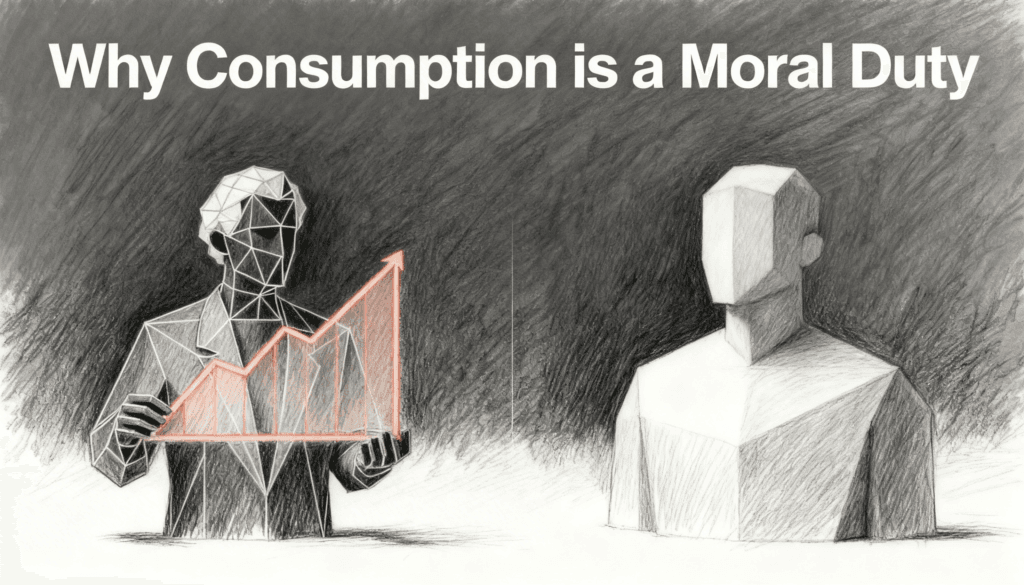
Here is where things get philosophically interesting. If your spending supports other people’s livelihoods, then consumption is not merely an economic act. It is a moral one. Choosing to buy something is choosing to participate in a network of mutual support. Choosing not to buy, especially when you can afford to, is choosing to withdraw from that network.
This framing will irritate a lot of people, and it should. We are not accustomed to thinking of shopping as a moral duty. It sounds crass. It sounds like something a desperate retail executive would say during a slow quarter. But strip away the discomfort and the logic holds.
Consider a small town with one restaurant. The restaurant employs a cook, a server, and a dishwasher. If the townspeople decide, collectively, that they should be more frugal and stop eating out, the restaurant closes. Three people lose their income. The cook cannot pay rent. The server cannot buy groceries. The dishwasher cannot afford the medication they need.
Now, the frugal townspeople might feel virtuous. They are saving money. They are being responsible. But responsible to whom? Not to the cook, the server, or the dishwasher. The townspeople’s thrift has become, without anyone intending it, a form of communal cruelty.
This is the moral dimension that Keynes grasped and that minimalism ignores. In an interconnected economy, your financial choices are never just about you. They ripple outward in ways you do not see and cannot fully predict. The decision to own thirty three items of clothing instead of a hundred is a personal aesthetic choice. But if enough people make that choice simultaneously, it becomes a structural force that destroys textile jobs from Bangladesh to North Carolina.
The Unlikely Connection to Game Theory
There is a fascinating parallel here with a concept called the tragedy of the commons. The idea, popularized by ecologist Garrett Hardin, describes situations where individuals acting in their own rational self interest collectively destroy a shared resource. Each herder adds one more cow to the common pasture because it benefits them personally. But when every herder does this, the pasture is overgrazed and collapses.
The minimalist version of this tragedy runs in reverse. Each person reduces consumption because it benefits them personally. But when enough people do this, the shared resource they destroy is not a pasture. It is the economy itself. The jobs, the businesses, the tax base that funds schools and hospitals. You could call it the tragedy of the uncommons: everyone takes less, and the system that sustains everyone degrades.
This is not a perfect analogy. Overconsumption does real environmental damage, and there are legitimate reasons to consume less of certain things. But the structural point stands. Individual virtue, aggregated across millions of people, can produce collective vice. Keynes saw this clearly. The minimalists, focused on the individual, do not.
What Keynes Actually Wanted
It is worth noting what Keynes was not. He was not a champion of waste. He was not advocating for people to buy things they do not want or cannot afford. He was not the intellectual godfather of Black Friday.
What Keynes wanted was balance. He believed that consumption and saving needed to exist in a dynamic equilibrium, with the balance shifting based on economic conditions. When the economy is overheating, save more. When it is cooling, spend more. The government, in his view, should step in as the spender of last resort when private citizens could not or would not spend enough to keep the economy moving.
His most famous insight was that demand drives supply, not the other way around. Businesses do not create jobs out of generosity. They create jobs because customers are buying things. Remove the customers and you remove the jobs. It does not matter how innovative or efficient the business is. Without demand, production is pointless.
This is why Keynes would have viewed the minimalist movement not as enlightened but as dangerous. Not because wanting less is wrong. But because wanting less, at scale, without any compensating mechanism, is a recipe for stagnation. And stagnation hurts the people who can least afford it. The wealthy minimalist who declutters their home will be fine. The factory worker who loses their job because demand for consumer goods dropped will not.
The Uncomfortable Synthesis
So where does this leave us? Is consumption good? Is minimalism bad? Like most interesting questions, the answer is frustrating: it depends.
The minimalists are right that mindless consumption is destructive. Buying things you do not need, with money you do not have, to impress people you do not like, is a losing game. The environmental costs of overconsumption are real and mounting. The psychological evidence that material goods provide diminishing returns on happiness is solid.
But Keynes is also right that consumption is the engine of economic life. Without it, the system that provides jobs, incomes, and opportunities does not work. Thrift is a private virtue that becomes a public vice when practiced universally.
The synthesis, if there is one, lies in mindful consumption rather than minimal consumption. Spend money, but spend it well. Buy from businesses that treat their workers fairly. Invest in quality goods that last rather than cheap products designed to break. Support local economies. Choose experiences that enrich your life rather than objects that clutter it.
This is harder than either pure consumption or pure minimalism. It requires thought, research, and a willingness to see your spending as something more than a personal budget exercise. It requires understanding that when you hand over money for a product or service, you are not just acquiring something. You are participating in a vast, interconnected system that sustains millions of livelihoods.
Keynes would not ask you to spark joy. He would ask you to spark demand. And in a world where economic stagnation threatens the wellbeing of billions, that might be the more moral choice.
The next time you feel guilty about buying something you enjoy, consider the possibility that guilt is misplaced. Consider that the barista, the craftsman, the farmer, and the truck driver on the other end of that transaction are counting on you. Not to be reckless. Not to be wasteful. But to participate.
In the end, the minimalists want you to need less. Keynes wanted you to understand that being needed is the whole point. Your consumption is not a vice to be minimized. It is a thread in the fabric that holds the economy together. Pull out enough threads and the whole thing unravels.
So buy the coffee. Tip the barista. And do not let anyone tell you that wanting nothing is the highest form of virtue. Sometimes, wanting something and acting on it is exactly what the world needs you to do.