Table of Contents
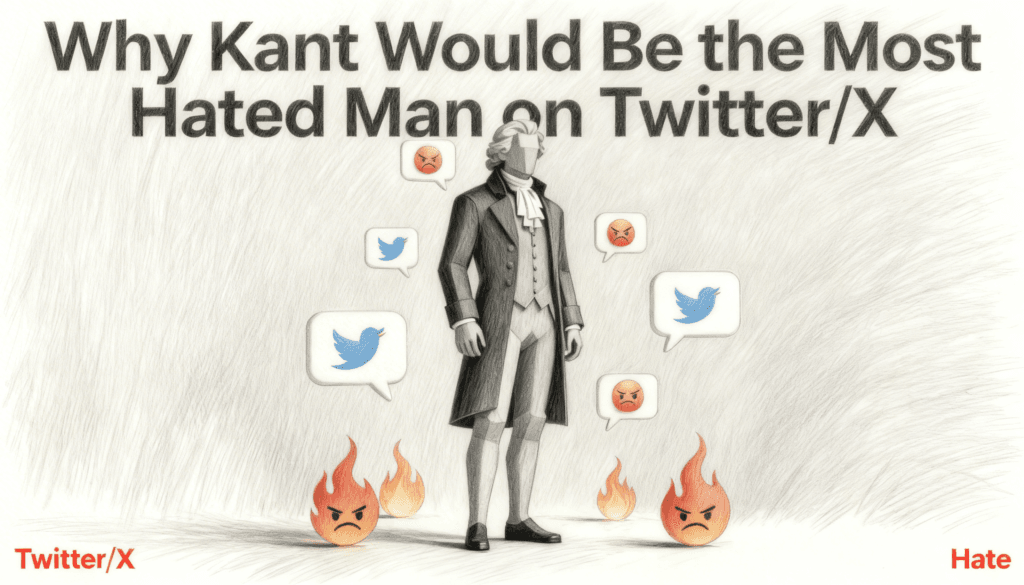
Imagine a man who takes forty five minutes to explain why you should not lie to a murderer standing at your door asking where your friend is hiding. Now imagine that man on Twitter. Welcome to the nightmare of Immanuel Kant in the age of hot takes.
Kant was born in 1724 in Königsberg, a city he famously never left. His neighbors could set their clocks by his daily walks. He was so predictable that the only time he missed his afternoon stroll was when he got his hands on a copy of Rousseau’s Emile and could not put it down. This is the kind of man we are dealing with. Someone so committed to routine and principle that a single French book counted as a personal crisis.
Now drop him into the most chaotic, reactive, emotion driven information environment in human history. Twitter is a place where nuance goes to die and outrage is the only currency that never inflates. Kant would not last a week. But not for the reasons you might think.
The Man Who Refused to Play the Game
The first thing that would get Kant into trouble is his absolute refusal to care about consequences when making moral judgments. This is the core of his ethical philosophy. He believed that the morality of an action has nothing to do with its outcome and everything to do with the principle behind it. He called this the categorical imperative, which in plain language means: act only according to rules you could want everyone to follow, always.
Twitter does not work this way. Twitter runs on consequentialist thinking. Did the tweet get engagement? Did the statement produce the desired effect? Did the post move the needle for my side? The entire platform is built around outcomes. Likes, retweets, ratio counts. Every word is measured by what it produces, not by what it means.
Kant would reject all of this. He would argue that tweeting something because it gets attention is morally empty. The value of a statement comes from whether it follows a principle you could universalize, not from whether it went viral. Try explaining that to someone who just got fifty thousand likes for a take they do not even believe.
This alone would make him insufferable to every faction on the platform. The left would hate him for refusing to bend his principles for social utility. The right would hate him for insisting that their favorite pragmatic arguments are morally hollow. The centrists would hate him for being too rigid. And the influencers would hate him most of all, because he would essentially be saying that their entire business model is an ethical failure.
The Lying Problem
Nothing would generate more fury than Kant’s position on lying. He argued, with complete seriousness, that you must not lie even if a murderer comes to your door and asks where your friend is hiding. This was not a thought experiment he casually tossed off. He wrote an entire essay defending this position.
His reasoning was straightforward. If you accept lying as permissible when the consequences seem favorable, you destroy the universal principle of truthfulness. And once that principle collapses, you lose the foundation for trust, communication, and rational society itself. The short term benefit of one lie is not worth the structural damage to the moral framework that makes human cooperation possible.
Now imagine someone screenshots this take and quote tweets it with “This dude thinks you should snitch on Anne Frank.”
That is exactly what would happen. And here is the painful part. Kant would not back down. He would not clarify. He would not say “I was taken out of context.” He would double down, because in his framework, the moment you start making exceptions based on outcomes, you have abandoned morality altogether. You are just doing cost benefit analysis and calling it ethics.
The internet would lose its collective mind. There would be think pieces. There would be memes. Someone would make a TikTok reenactment. And Kant would sit in his study in Königsberg, unbothered, because popular opinion was never part of his equation.
The Problem With Good Intentions
Here is where things get genuinely interesting and counter intuitive. Kant did not actually care whether you were a good person in the way most people understand that phrase. He cared whether you acted from duty.
Suppose you help an elderly person cross the street because it makes you feel warm inside. For most people, that is a good deed. For Kant, it is morally neutral. You did not act from duty. You acted from inclination. You did it because it felt nice. The only morally worthy action, in his view, is one performed purely because it is the right thing to do, regardless of how it makes you feel.
This is devastating to modern internet culture, which is built almost entirely on the performance of virtue. Every charity post, every solidarity hashtag, every public declaration of support for a cause is, by Kantian standards, morally suspect the moment it makes you feel good or earns you social approval. He would look at the entire ecosystem of performative kindness online and declare it ethically worthless.
People who spend their days crafting the perfect compassionate tweet would suddenly find a dead German philosopher telling them that their compassion does not count because they enjoyed expressing it. The rage would be boundless.
Kant Versus the Algorithm
There is a deeper structural conflict here that goes beyond individual arguments. Kant’s entire philosophy is built on the idea that rational beings should treat each other as ends in themselves, never merely as means to an end. This is his second formulation of the categorical imperative and it might be the most radical idea he ever produced.
Twitter, and the broader attention economy it sits within, treats every human being as a means to an end. You are not a person on that platform. You are a data point, an engagement metric, a pair of eyeballs to be monetized. The algorithm does not care about your dignity as a rational being. It cares about keeping you scrolling.
Kant would see this and recognize it immediately as a profound moral violation. Not just a flaw in the system, but an active assault on human dignity. Every notification engineered to trigger a dopamine response, every outrage bait headline designed to override your rational judgment, every dark pattern nudging you toward compulsive behavior. All of it would be, in Kantian terms, treating you as a mere means.
This connects to something happening right now in the debate around artificial intelligence and technology ethics. The people arguing that AI systems should respect human autonomy and not manipulate users are, whether they know it or not, making a fundamentally Kantian argument. They are saying that systems which treat people as means to an end, whether for profit or engagement or data collection, violate something essential about human dignity. Kant wrote about this two hundred and forty years ago. The tech industry is only now catching up.
But here is the catch. If Kant were on Twitter making this argument, he would be dismissed as a luddite, a scold, or worse, someone who does not understand how the real world works. The very platform he was critiquing would be the one drowning out his critique.
The Loneliness of Principled Thinking
One of the most underappreciated aspects of Kant’s philosophy is how lonely it is. He did not offer comfort. He did not promise happiness. He did not say that following moral duty would make your life better or that the universe would reward you for doing the right thing. He simply said: this is what reason demands. Do it or do not, but do not pretend the alternative is morally equivalent.
Twitter is, at its core, a machine for avoiding this kind of loneliness. It offers constant validation, constant feedback, constant evidence that your views are shared by others. The dopamine hit of a like is a tiny reassurance that you are not alone in your beliefs. Kant would see this as a crutch, a way of outsourcing your moral reasoning to the crowd.
He would argue that the need for external validation is itself a sign that you are not truly acting from reason. A genuinely moral agent does not need applause. They do not need a community of agreement. They need only the internal consistency of their principles.
This is, admittedly, an almost inhuman standard. And that is part of why Kant would be hated. He demands something that almost nobody can deliver. But the fact that the standard is difficult does not make it wrong. It just makes it unpopular. And on Twitter, unpopular is the same as wrong.
The Sarcasm Would Not Help
It is worth noting that Kant was not actually a humorless man. He was known for witty dinner conversation and enjoyed socializing with friends. But his wit was dry and precise, the kind that lands in a room of six people who have all read the same books. It was not the kind that plays well in a medium where subtlety is indistinguishable from sincerity.
If he attempted sarcasm on Twitter, it would be screenshotted, stripped of context, and used as evidence of whatever crime the mob decided he had committed that day. His careful, layered arguments would be reduced to single sentences pulled from threads twenty posts long. His insistence on defining every term before using it would be mocked as pretension. His refusal to simplify would be read as elitism.
In short, he would experience exactly what happens to every serious thinker who wanders onto the platform expecting good faith engagement. He would find none.
Why This Actually Matters
It is tempting to treat this as a purely comic thought experiment. The stuffy old philosopher meets the screaming void of social media. Laughs are had. But there is something genuinely important underneath the joke.
Kant was trying to build a moral framework that did not depend on feelings, popularity, cultural trends, or power dynamics. He wanted ethics grounded in reason alone, accessible to any rational being regardless of their circumstances. He wanted moral truth to be as stable and universal as mathematical truth.
Twitter represents the exact opposite vision. It is a world where moral positions shift hourly based on who is speaking, who is listening, and what the prevailing mood happens to be. It is a world where the same action can be praised or condemned depending on the identity of the actor. It is a world where consistency is treated as stubbornness and principle is treated as naivety.
The fact that Kant would be hated on Twitter is not a criticism of Kant. It is an indictment of the epistemic environment we have built for ourselves. We have created a public square where the most rigorous moral thinker in modern history would be ratioed into oblivion within his first afternoon.
There is a parallel here with how markets work, particularly financial markets during periods of mania. In those moments, the person saying “this does not make sense, the fundamentals do not support this” is always the most hated voice in the room. They are called boring, out of touch, unable to read the moment. And they are usually right. Kant would be that voice. The one saying that the moral fundamentals do not support what we are doing, while everyone else insists that the engagement numbers prove otherwise.
The Final Irony
Here is the deepest irony of all. If Kant were on Twitter and he were hated, he would consider that irrelevant. His entire system is designed to be immune to popular rejection. The categorical imperative does not care about your follower count. Moral law does not bend to public opinion. Reason does not negotiate with trending topics.
He would post his position. He would be attacked from every direction. He would not delete the tweet. He would not post a notes app apology. He would not go on a podcast to provide context. He would simply continue, because the rightness of the principle has nothing to do with how many people agree with it.
And that, more than anything, is why he would be hated. Not because he was wrong. But because he could not be moved. In a world that runs on reaction, a man who cannot be provoked is the most provocative thing imaginable.
Kant would be terrible at Twitter. And Twitter would deserve him.