Table of Contents
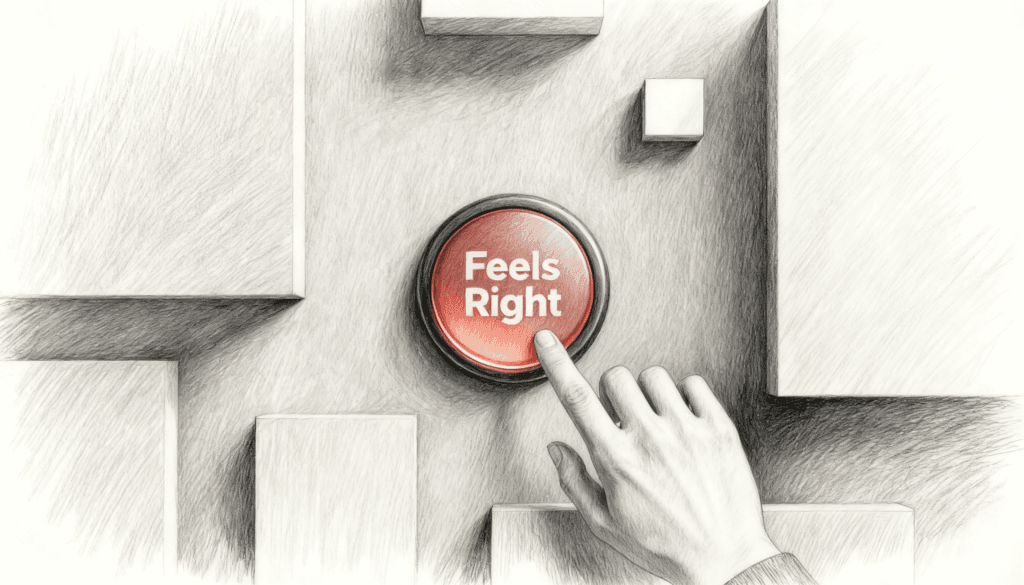
You have probably heard this advice at least a hundred times. Follow your heart. Trust your gut. If it feels right, it probably is. It sounds warm. It sounds human. It sounds like the kind of thing a wise grandmother would say while handing you a cookie.
Immanuel Kant would not have taken that cookie.
The 18th century German philosopher spent most of his life in the small city of Königsberg, reportedly never traveling more than ten miles from his home. His neighbors could set their clocks by his daily walks. This was not a man governed by spontaneous feelings. And his philosophy reflects exactly that. Kant believed that doing something because it “feels right” is not only unreliable. It is, in a precise moral sense, worthless.
That sounds extreme. It is meant to.
The Problem With Feelings as a Moral Compass
Let us start with something obvious that most people overlook. Feelings change. You wake up on a Tuesday morning feeling generous and leave a massive tip at the coffee shop. By Thursday you are irritated by the weather, and you walk past a homeless person without a second glance. Your moral character did not change between Tuesday and Thursday. Your mood did.
Kant saw this problem clearly. If your ethics depend on how you feel at any given moment, then your ethics are essentially weather. Sometimes sunny, sometimes stormy, and entirely outside your control. You would not trust a pilot who only flies well when he is in a good mood. Why would you trust your own moral judgment under the same conditions?
This is the core of Kant’s argument against what he called “inclination.” Inclination is just a philosophical word for desire, impulse, or emotional pull. When you do something kind because you feel like being kind, Kant argued you deserve no moral credit. You were simply following an internal itch. You scratched it. A dog does the same thing when it licks your face because it is happy. It is pleasant, sure. But it is not ethics.
True moral worth, according to Kant, only arises when you act from duty. Not from desire, not from emotion, and certainly not from that warm fuzzy sensation in your chest that modern culture has decided to worship.
Duty Does Not Mean What You Think It Means
When most people hear the word “duty,” they imagine something grey and joyless. Standing in line at the DMV. Filing your taxes. Eating vegetables you do not enjoy. Kant’s version of duty is more interesting than that, though it does share the quality of being profoundly unsexy.
For Kant, acting from duty means acting according to a principle you have rationally chosen, regardless of how it makes you feel. It means you tell the truth not because honesty gives you a dopamine hit, but because you have recognized, through reason, that lying undermines the very structure of human communication. You help someone not because their sad face triggers your empathy, but because you have concluded that helping others is what a rational moral agent ought to do.
The distinction matters more than it appears to at first glance. Consider two people who donate to charity. Person A donates because seeing suffering makes them uncomfortable, and giving money relieves that discomfort. Person B donates because they believe they have a rational obligation to help others, even on days when they feel nothing at all. From the outside, the action looks identical. But Kant would say only Person B has performed a truly moral act. Person A was just managing their own emotional state. They were, in a sense, being selfish while looking generous.
This is one of those ideas that is initially annoying and then gradually starts to make an uncomfortable amount of sense.
The Categorical Imperative, Without the Headache
Kant did not just criticize feeling based morality. He proposed an alternative. He called it the categorical imperative, which sounds like a military operation but is actually a surprisingly elegant idea.
The most famous version goes like this: act only according to that rule which you could will to become a universal law. In other words, before you do something, ask yourself what would happen if everyone did it. If the answer is chaos, do not do it. If the answer is a functioning society, proceed.
Want to lie to get out of a contract? Imagine a world where everyone lies to get out of contracts. Contracts become meaningless. The entire concept of an agreement collapses. Therefore, lying is wrong. Not because it feels wrong. Not because a voice inside you whispers that you should not. It is wrong because reason demonstrates that it cannot be universalized without self destruction.
This is beautifully mechanical. And that is precisely the point. Kant wanted morality to work like mathematics. Two plus two equals four whether you are happy, sad, angry, or deeply in love. Moral truths, he believed, should have the same immunity to emotional interference.
There is something almost refreshing about this in an age where “listen to your heart” has become the default answer to every ethical dilemma. Your heart, Kant would remind you, is an organ that pumps blood. It has no opinions.
When Feeling Good About Doing Good Is Actually the Problem
Here is where Kant gets genuinely counterintuitive. Most of us would agree that it is better to enjoy being kind than to hate it. If you help an elderly person cross the street and it makes you feel warm inside, that seems like a win for everyone. Kant would not necessarily disagree that it is pleasant. But he would insist that the pleasant feeling is morally irrelevant.
Why? Because if you only help people when it feels good, you will stop helping people the moment it stops feeling good. Your morality becomes conditional on your emotional reward system. And emotional reward systems are notoriously unreliable. They are shaped by childhood, culture, brain chemistry, what you had for breakfast, and whether you got enough sleep. Building your entire ethical framework on that foundation is like building a skyscraper on a trampoline.
Kant’s ideal moral agent is someone who does the right thing even when it feels terrible. Especially when it feels terrible. The person who visits a sick friend despite being exhausted, who tells an uncomfortable truth despite dreading the consequences, who fulfills a promise even though every fiber of their being wants to break it. That person, according to Kant, is the only one demonstrating genuine moral character. Everyone else is just riding the wave of their own neurochemistry.
The Uncomfortable Mirror
If Kant is right, then a lot of what we call morality is actually just emotional self service. Think about how often people frame their ethical decisions in terms of feelings. “I could not live with myself if I did not help.” “It just felt like the right thing to do.” “My conscience would not let me.”
Kant would look at each of these statements and point out the same thing. They are all about you. Your comfort. Your conscience. Your inability to tolerate guilt. The suffering person is almost incidental. They are the occasion for your emotional management, not the true object of your concern.
This is not a comfortable realization. It is also not entirely fair. Kant’s critics have argued, with some justification, that he draws the line too sharply. Surely emotions and reason can work together. Surely feeling compassion and acting on principle are not mutually exclusive. The philosopher Schiller once joked about Kant’s ethics: “I gladly help my friends, but unfortunately I do it with pleasure. Hence I am constantly troubled that I am not virtuous.“
The joke lands because it exposes a real tension in Kant’s system. If a person helps others from both duty and inclination, are they less moral than someone who helps only from duty while secretly wishing they did not have to? Kant’s answer seems to suggest yes, which strikes most people as absurd. And yet, the underlying logic is harder to dismiss than the joke implies.
What This Means in a World That Worships Authenticity
We live in an era that prizes authenticity above almost everything. Be true to yourself. Follow your passion. Do what feels right. These are not just casual suggestions. They are cultural commandments. Social media has amplified this to an almost religious degree. The highest compliment you can pay someone is that they are “authentic.” The worst insult is that they are “fake.”
Kant would find this entire framework suspicious. Not because authenticity is bad, but because it assumes your feelings are a reliable guide to truth. And that assumption, Kant would argue, is the biggest self deception of all. Your feelings are not you. They are events that happen inside you, shaped by forces you did not choose and often do not understand. Treating them as the voice of your true self is like treating the static on a radio as a message from the cosmos.
So Should You Ignore Your Feelings Entirely?
No. And Kant did not actually say that, though people often assume he did. Kant’s argument is not that feelings are evil or worthless in every context. It is that they are morally unreliable as the foundation for ethical decisions. You can feel things. You should feel things. Being human without emotion would be strange and probably impossible. But when it comes to deciding what is right and wrong, your feelings should be passengers, not drivers.
This is a subtlety that gets lost in most popular summaries of Kant. He was not arguing for robotic behavior. He was arguing for something much harder: the discipline to do what reason demands, even when your emotions are screaming in the opposite direction. That takes more strength, not less. It takes more humanity, not less.
There is a paradox here worth sitting with. The person who acts morally only when they feel like it is, in a sense, a slave to their emotions. They have no freedom because their behavior is determined by forces beyond their rational control. The person who acts from duty, even against their inclinations, is the truly free one. They have chosen their principles with their mind and refuse to let the chaos of feeling derail them.
Kant believed this was the highest expression of human dignity. Not the warm glow of doing something nice. Not the satisfied sigh of following your heart. But the quiet, unglamorous resolve to do what is right because it is right, and for no other reason.
The Takeaway You Were Not Expecting
The next time someone tells you to just do what feels right, consider the possibility that they are giving you the philosophical equivalent of junk food. It tastes good. It is easy. It requires zero effort. And it is almost certainly not nourishing you in the way that matters.
Kant’s ethics are not easy. They are not fun. They will never trend on social media or appear on an inspirational poster with a sunset background. But they offer something that feeling based morality never can: consistency. A framework that works on your best days and your worst. A moral compass that does not spin every time the wind changes.
You do not have to agree with everything Kant said. Plenty of brilliant philosophers have not. But you should at least take seriously the possibility that “it feels right” is the weakest reason you could ever give for doing anything. Your feelings are a magnificent part of being human. They are just a terrible basis for deciding how to live.
And if that conclusion makes you uncomfortable, Kant would probably say that is exactly the point.