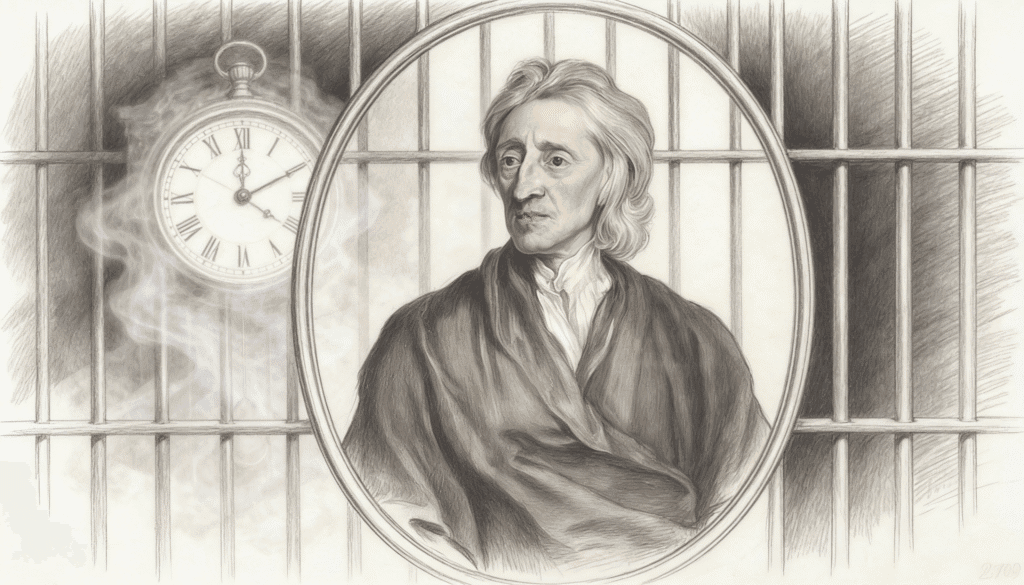
John Locke never said this explicitly, but buried in his ideas about government lies an uncomfortable truth: the very systems we create to protect our freedom will inevitably eat away at it. This isn’t a bug in the Lockean system. It’s a feature. And we’re watching it play out in real time.
Most people remember Locke for the inspiring bits. The philosopher who told us we’re born free and equal. The thinker who said government exists only by our consent. The intellectual godfather of the American Revolution. But Locke understood something darker about political societies. Something we’d rather not think about.
The state begins as our protector and ends as our master. The tool becomes the tyrant.
The Original Bargain
Locke’s story starts in the state of nature. Not an actual historical period but a thought experiment. Imagine people living without government. You own yourself, your labor, and whatever you mix your labor with. You can gather apples, clear land, and build a house. Nobody needs to give you permission.
Sounds perfect. Except for one problem: what happens when someone tries to take your apples?
In the state of nature, you are simultaneously judge, jury, and executioner in all disputes involving yourself. You decide what justice requires. You enforce it. This creates obvious difficulties. When you and your neighbor disagree about where your property line is, both of you are absolutely convinced you’re right. Both of you are personally invested. Neither of you can be objective. And whoever is stronger will probably win.
So people make a deal. They agree to create a third party, a referee who can settle disputes fairly. This referee is government. Everyone consents to give up their absolute freedom to do whatever they want in exchange for security and impartial justice.
Notice what just happened. Freedom was already traded away, and we haven’t even gotten started yet.
The Mechanism of Erosion
Here’s where Locke’s insight gets interesting. Once you create a government, you set in motion forces that will expand its power. Not because politicians are evil. Not because of conspiracy. But because of the basic logic of political societies.
First, every rule creates a constituency. When government passes a law protecting property rights, property owners suddenly have an interest in government power. They want enforcement. They want courts. They want mechanisms to ensure compliance. Each protection requires infrastructure. Each piece of infrastructure requires funding. Each funding mechanism requires more rules.
Second, every problem invites a governmental solution. Someone’s property gets stolen? We need better enforcement. Someone’s contract gets violated? We need clearer rules. Someone uses their property in a way that harms others? We need regulations. Each solution expands the scope of what government does.
Third, what counts as “protection” constantly expands. Initially, government might just prevent murder and theft. But then we realize that fraud is a kind of theft. That pollution is a kind of harm. That unsafe products damage people. That economic crashes destroy livelihoods. The boundary of legitimate government action keeps moving outward.
Locke saw this coming. He insisted that legitimate government could only act within strict bounds. Only with consent. Only to protect natural rights. Only through established laws.
But he also understood that these limitations are fragile. They depend on constant vigilance. They require people to resist short term benefits for long term freedom. They demand that we sometimes accept harm rather than government intervention.
How often does that happen?
The Math Doesn’t Add Up
Here’s the mathematical problem with Lockean government: every incremental surrender of freedom seems rational in isolation.
You give up the freedom to steal in exchange for having your property protected. Good trade. You give up the freedom to drive drunk in exchange for safer roads. Reasonable. You give up the freedom to sell spoiled meat in exchange for food safety. Makes sense. You give up the freedom to dump chemicals in rivers in exchange for clean water. Fair enough.
Each individual trade looks like a winner. But the cumulative effect is that you wake up one day needing a license to cut hair, permission to add a room to your house, and approval to sell lemonade in your front yard.
The philosopher Robert Nozick called this “the tale of the slave.” He asked readers to imagine a series of small, individually justifiable changes that transform a free person into a slave. Change one at a time. Each change seems minor. But add them up and you’ve gone from liberty to servitude.
Locke would recognize this pattern. He knew that the same government created to protect property could be used to seize it. The same legislature established to create fair laws could pass oppressive ones. The same executive meant to enforce justice could become a tyrant.
His solution? Revolution. If government breaks the social contract, if it stops protecting rights and starts violating them, the people can overthrow it and start again.
But here’s the problem: revolution is expensive. It’s dangerous. Most people won’t revolt over small erosions of freedom. They’ll endure. They’ll adjust. They’ll convince themselves it’s not that bad.
And so the ratchet clicks forward. Government expands. Freedom contracts. Everyone notices, but nobody acts until things get truly intolerable.
The Property Paradox
Nowhere is this paradox clearer than in Locke’s theory of property. You own what you mix your labor with. You have a right to your possessions. Government exists primarily to protect these rights.
Except government also gets to define property rights. And regulate them. And tax them. And take them under certain circumstances.
Locke tried to square this circle by arguing that when you enter society, your property becomes subject to the government. You still own it, but now with qualifications. Government can tax you, but only with your consent. Or really, with the consent of your representatives. Or actually, with the consent of the majority of your representatives.
Notice how far we’ve traveled from “this is mine because I made it.” We’ve arrived at “this is mine unless the government needs it, in which case a majority of representatives I may not have voted for can take a portion.”
This isn’t a betrayal of Locke. This is Locke working through the implications of his own system. Property rights in political society must be different from property rights in the state of nature. Otherwise, you haven’t really created a government at all. You’ve just created an expensive arbitrator with no real power.
The Modern Manifestation
We’re living through the latest chapter of this story. Consider the alphabet soup of modern governance: the EPA, FDA, SEC, FCC, OSHA, and hundreds of others. Each was created to solve a real problem. Environmental damage. Unsafe drugs. Financial fraud. Broadcast interference. Workplace injuries.
Each solved the problem it was created to solve, at least partially. And then each continued existing. And expanding. And finding new problems to solve. And creating new constituencies that depend on its continued existence.
The Environmental Protection Agency doesn’t just prevent companies from dumping toxic waste. It regulates puddles in backyards. The Food and Drug Administration doesn’t just prevent poisonous food. It determines which substances you can put in your own body. The Securities and Exchange Commission doesn’t just prevent fraud. It decides who can invest in which companies.
Is this illegitimate? By Lockean standards, maybe. These agencies often act without clear legislative authority. They make rules that look like laws. They enforce these rules. They adjudicate violations. They combine legislative, executive, and judicial powers in ways Locke explicitly warned against.
But is this unexpected? No. This is exactly what Locke predicted would happen. Once you create government, it will seek to expand. Once you give it power, it will find new uses for that power. Once you establish it as the solution to problems, people will keep bringing it problems to solve.
Why We Can’t Just Go Back to John Locke’s Original idea
Some libertarians read Locke and think the answer is to dramatically shrink government. Return to something closer to the state of nature. Let people be free.
But Locke understood why this won’t work. We can’t unscramble the egg. We live in a complex society with interdependent systems. Property rights themselves are now incredibly complicated. Does owning land mean you own the air above it? The minerals below it? The water flowing through it? The electromagnetic spectrum passing through it?
In the state of nature, these questions don’t arise because the technology doesn’t exist. But in modern society, these questions are everywhere. And they require answers. And those answers require some kind of collective decision making. Which requires government.
Plus, we’ve adapted to government protection. Most people can’t imagine being their own judge, jury, and executioner. We’ve outsourced these functions so thoroughly that we’ve lost the capability to perform them ourselves. When someone steals from you, you call the police. You don’t form a posse comitatus. When someone breaches a contract, you file a lawsuit. You don’t challenge them to a duel.
We’ve made a one way trade. We gave up the freedom and burden of self protection. We gained security and specialization. Going backward would require unlearning centuries of social evolution.
The Technology Multiplier
Technology makes this paradox worse. Locke lived in a world where government power was limited by practical constraints. To oppress people, you needed soldiers who could physically travel to their location. To collect taxes, you needed collectors who could count coins. To monitor behavior, you needed spies who could follow individuals.
These physical limits constrained how much government could do. A 17th century government couldn’t track every transaction, monitor every communication, or enforce every petty rule. Not because they didn’t want to. Because they couldn’t.
Modern technology removes these constraints. Digital surveillance is cheap and comprehensive. Automated enforcement is efficient and tireless. Database systems can track millions of people simultaneously. The same tools that make our lives convenient make government power effectively unlimited.
Consider taxation. In Locke’s time, collecting taxes required physical representatives going door to door or setting up customs houses. Citizens could avoid taxes through simple geographic evasion. Today, every electronic transaction leaves a trail. Every bank account is visible to tax authorities. Every paycheck gets automatically withheld. The government takes its cut before you even see your money.
Or consider regulation. Historically, enforcing building codes required inspectors physically visiting properties. Limited resources meant limited enforcement. Today, satellite imagery can detect unpermitted construction. Automated systems can flag violations. Databases can track compliance across entire jurisdictions.
This isn’t inherently evil. Many of these capabilities solve real problems. But they fundamentally alter the balance of power between government and citizen. They make Locke’s vision of limited government much harder to maintain because the limits that mattered most were practical ones, and we’ve eliminated them.
The Democratic Trap
Democracy was supposed to solve this problem. If government power comes from the people, and the people elect representatives, then government remains accountable. When it overreaches, voters will punish it.
Locke believed something like this. He thought government required ongoing consent. That people had the right to alter or abolish governments that violated their trust. That majority rule would prevent tyranny.
But democracy creates its own paradox. Voters are rationally ignorant. Each person has little incentive to deeply understand complex policy issues because their individual vote matters so little. So most people rely on simple heuristics. Does this policy benefit me? Does it sound good? Do I like the person proposing it?
This creates what economists call concentrated benefits and diffuse costs. A regulation that gives ten million dollars to a specific industry and costs every citizen one dollar is likely to pass. The industry will lobby intensely for it because they stand to gain a lot. Citizens won’t fight it because one dollar isn’t worth their time and attention.
Multiply this dynamic across thousands of policies and you get exactly what Locke predicted: steady expansion of government power through countless small decisions, each seemingly justifiable, none worth fighting over individually.
Democracy doesn’t prevent this. Democracy enables it. Because in a democracy, expanding government power is often the popular choice. People vote for politicians who promise to solve their problems. And politicians solve problems by expanding government authority.
Locke would be horrified but not surprised. He understood that majority rule wasn’t a solution to tyranny. It was just a different mechanism for it. Better than monarchy in many ways. But not proof against the tendency of government to grow.
The Consolation Prize
So are we doomed? Is the Lockean project hopeless? Not quite. Locke himself provided the tools to resist unlimited government expansion.
First, remember that government exists only by consent. This isn’t just a theoretical point. It means government must maintain legitimacy. When governments clearly violate the social contract, when they obviously stop protecting rights and start threatening them, people withdraw consent. Sometimes gradually through non compliance. Sometimes suddenly through revolution.
Second, competition between governments matters. Locke noted that people can leave oppressive societies. This isn’t as practical as it sounds, but it creates pressure. If your government is too burdensome, productive people emigrate. If another jurisdiction has better rules, businesses move there. This competitive dynamic limits how far any single government can go.
Third, institutional design creates friction. Separation of powers. Federalism. Constitutional limits. These don’t prevent government expansion but they slow it down. They force different parts of government to check each other. They create veto points where expansion can be blocked.
These mechanisms aren’t perfect. But they’re something. They shift the paradox from inevitable disaster to manageable tension.
Living With the Paradox
The deepest insight in Locke’s work isn’t that we’re born free. It’s that political freedom is unstable. It requires constant effort to maintain. It’s always in danger of erosion. And the very structures we create to preserve it become the instruments of its destruction.
This isn’t cause for despair. It’s cause for vigilance. Every expansion of government power should be viewed with suspicion, even when it solves a real problem. Every new law should be questioned, even when it has good intentions. Every regulation should be justified, even when it seems obvious.
Because the alternative is what Locke saw: a slow, steady ratchet toward less freedom. Not through conquest. Not through revolution. But through the accumulated weight of thousands of individually reasonable decisions.
We create government to be free from the state of nature. But then we must be free from government. That’s the paradox. That’s the eternal tension. That’s the price of civilization.
Locke didn’t have a solution to this paradox. He just described it honestly. He showed us that political societies face a permanent tradeoff between security and liberty. That there’s no stable equilibrium. That every generation must choose how much freedom to trade for how much safety.
The question isn’t whether government will expand. Locke understood that it will. The question is whether we’ll notice. Whether we’ll care. And whether we’ll push back before we’ve traded away so much freedom that we can’t get it back.
That choice is ours. The paradox is eternal, but our response to it isn’t. We can accept the erosion of freedom as inevitable. Or we can treat it as a challenge that requires constant resistance.
Locke would tell us to choose the second option. Because the price of freedom isn’t just its initial creation. It’s its perpetual defense. Against enemies foreign and domestic. Against tyrants obvious and subtle. And yes, against the very institutions we created to protect it.
The paradox of progress is that moving forward in civilization means constantly fighting to stand still in freedom. That’s not a bug. That’s not a design flaw. That’s just the human condition in political society.
Welcome to the machine we built to set ourselves free.