Table of Contents
Samuel Huntington published The Clash of Civilizations in 1993. The Berlin Wall had just fallen. Liberal democracy was supposed to sweep the planet like a benign virus. Francis Fukuyama had already declared the end of history, and most of the Western intellectual establishment was ready to pop champagne.
Huntington refused to drink.
Instead, he argued something deeply unfashionable. He said the future would not be shaped by the triumph of one universal ideology. It would be shaped by the friction between civilizations that see the world through fundamentally different eyes. Western, Islamic, Confucian, Hindu, Orthodox, Latin American, African, Japanese. Each one carrying its own gravitational pull on questions of authority, morality, individual rights, and the role of the state.
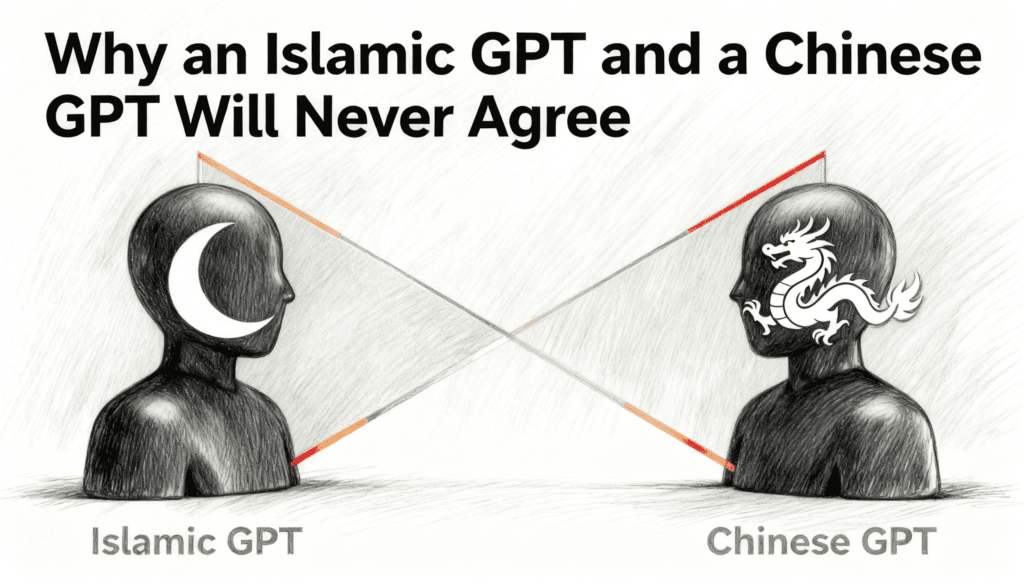
Three decades later, we are building large language models that are trained on data, shaped by values, and governed by institutions that come from specific civilizations. And here is the part nobody in Silicon Valley wants to talk about: those models are not converging. They are diverging. An AI system built under the assumptions of Islamic jurisprudence and an AI system built under the logic of Chinese Communist Party governance will never arrive at the same answers. Not because of a technical limitation. Because of a civilizational one.
Huntington did not predict artificial intelligence. But he predicted the cultural architecture that would make a single, unified global AI impossible.
The Illusion of Neutral Data
There is a popular fantasy in technology circles that data is neutral. That if you feed enough text into a model, the biases cancel out and what emerges is some kind of objective intelligence. This is like saying that if you blend every cuisine on Earth into one pot, you will get a meal everyone enjoys. You will not. You will get something no one recognizes.
Data is not neutral. Data is culture compressed into text. When a large language model trains on English language internet content, it absorbs the assumptions embedded in that content. Assumptions about individual autonomy. About the separation of church and state. About the primacy of free expression. These are not universal truths. They are Western liberal positions, and perfectly reasonable people in Cairo and Beijing would push back on every single one of them.
An Islamic GPT would be trained on the Quran, the Hadith, centuries of Islamic legal scholarship, and the writings of thinkers like Al Ghazali and Ibn Khaldun. Its understanding of justice would not begin with individual rights. It would begin with divine command. Its concept of freedom would not mean the ability to do whatever you want. It would mean the freedom to live in accordance with God’s will. This is not a lesser framework. It is a different framework. And it produces different outputs.
A Chinese GPT, meanwhile, would be shaped by Confucian thought, Legalist philosophy, Marxist Leninist doctrine, and the particular brand of techno authoritarianism that defines modern Chinese governance. Its understanding of order would not start with protecting the individual from the state. It would start with the harmony of the collective. Dissent would not be treated as a healthy feature of public life. It would be treated as a symptom of disorder.
Feed both models the same prompt. Ask them whether blasphemy should be punished by law. Ask them whether a citizen has the right to publicly criticize the head of state. Ask them what the proper relationship is between a woman and her family. You will get answers that do not just differ. They differ in ways that cannot be reconciled through more data or better engineering.
Huntington’s Core Insight, Applied to Machines
The central argument of The Clash of Civilizations was not that cultures fight each other. That would be obvious and boring. The deeper argument was that cultures think differently. They have different answers to the foundational questions of human existence, and those answers are not negotiable.
What is the source of legitimate authority? In the West, it is the consent of the governed. In Islam, it is the sovereignty of God. In China, it is the mandate of effective governance backed by historical continuity. Three different answers. Three different operating systems.
This is where the analogy to AI becomes almost too clean. A large language model is, at its core, a machine that predicts what comes next based on patterns it has absorbed. If the patterns come from a civilization that treats individual conscience as sacred, the model will produce outputs that protect individual conscience. If the patterns come from a civilization that treats social harmony as the highest good, the model will suppress outputs that threaten social harmony. Neither model is broken. Both are working exactly as designed.
And this is what makes the disagreement permanent. You cannot debug a civilizational worldview. You cannot patch a value system with a software update.
The Alignment Problem Nobody Talks About
In the AI safety community, there is an enormous amount of discussion about the alignment problem. How do we make sure AI systems do what humans want? But this conversation almost always assumes a single, unified set of human values. It assumes that there is a “we” that wants the same things.
Huntington would have found this assumption laughable.
The alignment problem is not just a technical challenge. It is a political and civilizational one. Aligned with whom? An AI aligned with the values of the European Convention on Human Rights will produce outputs that are misaligned with the values of Saudi Arabian religious law. An AI aligned with the Chinese Communist Party’s vision of social stability will produce outputs that are misaligned with the American First Amendment.
This is not a bug. This is the human condition expressing itself through silicon.
Consider a concrete scenario. A user in Jakarta asks an Islamic GPT whether it is permissible to charge interest on a loan. The model, trained on Islamic jurisprudence, will say no. Riba is forbidden. It will explain alternatives rooted in profit sharing and asset backed financing. Now ask a Western GPT the same question. It will explain interest rates as a normal feature of modern economies and perhaps offer tips on finding the best mortgage deal.
Both answers are internally coherent. Both are useful within their respective frameworks. And they are completely incompatible.
Now scale this across every domain of human life. Marriage. Governance. Criminal punishment. Gender roles. The relationship between religion and law. The meaning of human dignity itself. At every junction, the Islamic GPT and the Chinese GPT will take different exits. And they will both be certain they are heading in the right direction.
The Confucian Algorithm and the Islamic Algorithm
There is an almost poetic irony in the fact that two civilizations often grouped together by Western analysts as “the rest” would disagree with each other just as fundamentally as either disagrees with the West. Huntington actually anticipated this. He wrote about a potential Confucian Islamic connection, a strategic alignment against Western dominance. But strategic alignment is not the same as agreement.
China and the Islamic world might both resist Western hegemony, but they resist it for different reasons and toward different ends. China wants a multipolar world where state sovereignty is absolute and no external force can lecture Beijing about how to govern. The Islamic world, or at least significant currents within it, wants a world where divine law takes precedence over man made legislation, regardless of what any state decides.
One civilization worship order. The other worship God. You can build a temporary alliance out of shared enemies, but you cannot build a shared AI out of incompatible first principles.
This distinction matters practically. A Chinese GPT would have no problem discussing financial interest. It would have significant problems discussing Tiananmen Square. An Islamic GPT would have no problem discussing historical political events. It would have significant problems discussing the permissibility of alcohol or the artistic depiction of the Prophet Muhammad.
The censorship regimes are different. The sacred territories are different. The things that cannot be said are different. And in a large language model, the things that cannot be said are precisely what define the model’s character.
What This Means for the Future of the Internet
We are already seeing the early signs of a civilizationally fragmented internet. China has the Great Firewall. Russia has been building its own information ecosystem. The idea of a single, global, open internet was always more aspiration than reality.
AI will accelerate this fragmentation. Because AI does not just deliver information. It interprets, prioritizes, and frames information. It answers questions. And the way it answers them will reflect the civilization that built it.
In a generation, a student in Riyadh asking an AI about the meaning of justice will get a different answer than a student in Shanghai asking the same question. And both will get a different answer than a student in Stockholm. Each answer will feel authoritative. Each will be internally consistent. And each will quietly reinforce the civilizational assumptions of its origin.
This is not the dystopian scenario most people imagine when they worry about AI. There is no rogue superintelligence. No paperclip maximizer. Just the quiet, relentless reproduction of civilizational difference through the most powerful information technology ever built.
Huntington would have recognized it immediately.
The Counter Argument, and Why It Falls Short
The most common objection to this thesis is that technology is inherently universalizing. The telephone did not come in civilizational flavors. Neither did the printing press. Why should AI be different?
The answer is that AI is not a tool in the way a telephone is a tool. A telephone transmits your voice. It does not tell you what to say. AI generates responses. It makes judgments. It ranks, filters, and recommends. It is not a pipe. It is an editor. And editors always have a point of view.
The printing press is actually a better comparison than people realize, and it supports Huntington rather than undermining him. The printing press did not unify Europe. It shattered it. It enabled the Protestant Reformation, which split Western Christianity in two and triggered a century of wars. Technology does not dissolve differences. It gives differences new tools to express themselves.
AI will do the same thing, but faster and at scale.
There is also the argument that market forces will push AI toward convergence. Companies want global customers, so they will build models that work everywhere. This argument underestimates the power of governments and religious institutions. China does not allow its citizens to use ChatGPT. It has invested billions in domestic alternatives that operate within the Party’s ideological parameters. Several Muslim majority nations are exploring AI frameworks grounded in Sharia compliance. Market forces do not override civilizational imperatives. If anything, the money follows the civilization, not the other way around.
The Most Important Question Nobody Is Asking
If different civilizations produce fundamentally different AIs, and those AIs shape how billions of people understand the world, then who is right?
This is the question Huntington forced us to confront, and it is the question AI makes unavoidable. The Western liberal position is that there are universal human rights and any system that violates them is wrong. The Islamic position is that divine law is the ultimate standard and human legislation that contradicts it is in error. The Chinese position is that stability and collective prosperity define legitimacy and abstract rights are a luxury that can become a liability.
Three civilizations. Three AIs. Three versions of the truth. And no referee.
The temptation is to retreat into relativism and say all perspectives are equally valid. But Huntington did not do that. He simply observed that civilizations act as though their values are universal, even when those values contradict each other. AI will do the same thing. Each model will present its outputs with the same confidence, the same fluency, the same veneer of objectivity. And users will have no easy way to see the civilizational code running beneath the surface.
The Honest Conclusion
An Islamic GPT and a Chinese GPT will never agree because they are not trying to solve the same problem. One is trying to align human behavior with divine will. The other is trying to align individual behavior with collective order. These are not two paths to the same destination. They are two paths to two different destinations, each convinced it is the only destination worth reaching.
Huntington understood that the deepest conflicts are not about resources or territory. They are about meaning. What does it mean to live a good life? What does it mean to build a just society? What should a machine say when a human asks it what is right?
We built AI hoping it would give us answers. Instead, it is showing us that we never agreed on the questions.