Table of Contents
You know what kills more ideas than bad execution? The way we talk about them.
We coddle our concepts. We nurture them. We protect them from the harsh light of criticism like they’re fragile newborns who might not survive their first winter. And in doing so, we doom them.
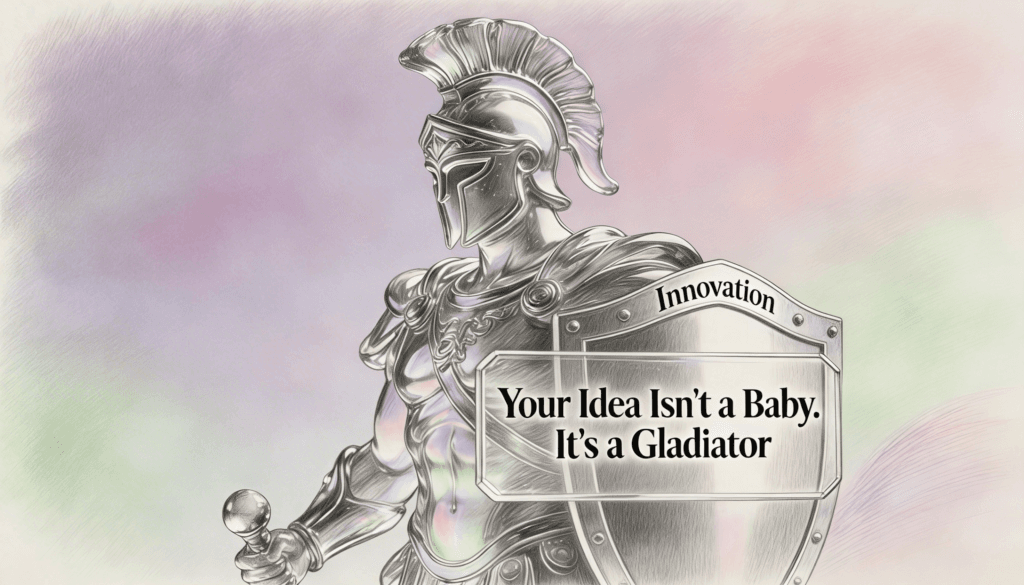
Your idea isn’t your baby. It’s a gladiator. And the sooner you throw it into the arena, the better its chances of survival.
The Maternal Instinct Problem
There’s this moment that happens in every startup accelerator, every innovation workshop, every corporate brainstorming session. Someone presents an idea. The room goes quiet. Then someone else offers gentle feedback, couched in so many qualifiers and softening phrases that the actual critique gets lost somewhere between “I love the energy of this” and “just thinking out loud here.”
We’ve built an entire culture around treating ideas like precious, vulnerable things. We have “safe spaces” for innovation. We talk about “growing” ideas and “nurturing” them. We give them time to “mature” before we “put them out into the world.”
This sounds compassionate. It’s actually cruel.
Because the world doesn’t care about your idea’s feelings. The market won’t go easy on it because it’s young. Your competitors won’t pull their punches because you need more time. Reality is the arena, and it’s already full of battle tested concepts that have survived a thousand cuts.
The maternal metaphor fails because babies actually are fragile. They need protection to survive. Ideas are the opposite. They need combat to evolve.
What Gladiators Actually Teach Us
Gladiators in ancient Rome weren’t just thrown into the Colosseum untrained. They went through brutal preparation. They fought in practice bouts. They learned from fighters who had survived previous battles. They studied their opponents and adapted their techniques.
But here’s the key difference from our modern idea incubators: the training was always preparing them for real combat. Not for more training. Not for another round of feedback sessions. For actual, stakes driven conflict where weakness meant elimination.
Your idea needs the same approach. Yes, preparation matters. But preparation only has value if it’s oriented toward genuine confrontation with reality, not indefinite shelter from it.
Think about how software developers actually work now versus twenty years ago. The old model was “waterfall development.” Spend months or years building something in private, then release it and pray. The new model is agile. Release early, release often, let users break your product, fix it, repeat.
The agile approach treats software like a gladiator. It throws early versions into the arena knowing they’ll get wounded. The difference is that those wounds provide information. Each cut shows you exactly where your armor is weak.
The Seduction of Eternal Preparation
Here’s where it gets psychologically interesting. We tell ourselves we’re being responsible by protecting our ideas. We’re doing due diligence. We’re being strategic. We’re waiting for the right moment.
But scratch the surface and you’ll find something else: fear dressed up as prudence.
Because once your idea enters the arena, it might lose. And if it loses, you can’t blame insufficient preparation or bad timing or lack of resources. You have to confront the possibility that the idea itself wasn’t strong enough.
Keeping your idea in training indefinitely is a hedge against ego damage. As long as you never truly test it, you never truly fail. You can always tell yourself it would have worked if only you’d had more time, more money, more support.
This is why some of the most “sophisticated” organizations are terrible at innovation. They’ve built elaborate systems that look like they’re designed to develop ideas but are actually designed to avoid testing them. Endless committee reviews. Comprehensive market studies. Pilot programs that never scale. It’s all armor against the admission that most ideas, even from smart people, don’t work.
What the Arena Actually Reveals
When you throw your idea into real world confrontation, three things happen fast.
First, you discover what you were wrong about. Not what might be suboptimal or could use refinement. What you were flatly, completely wrong about. This is valuable beyond measure because being wrong in private costs you time. Being wrong in public costs you time but teaches you truth.
Second, you find out what resonates in ways you never predicted. The thing you thought was a minor feature turns out to be what people actually want. The audience you dismissed shows up in force. The use case you never considered becomes the primary one. You can’t discover this in a conference room.
Third, you’re forced to evolve or die. And evolution under pressure works faster than iteration in comfort. When feedback is theoretical, you can debate it. When it’s existential, you adapt.
Look at how comedians develop material. They don’t write jokes in isolation for months, then perform a special. They test bits in small clubs. They try different phrasings, different setups, different callbacks. They watch what lands and what dies. They ruthlessly cut what doesn’t work and expand what does.
The audience is the arena. And a joke that kills in your apartment but bombs on stage isn’t a good joke that needs more time. It’s a bad joke that your preparation failed to expose.
The False Choice Between Speed and Quality
People will tell you this approach sacrifices quality for speed. They’re wrong on both counts.
It doesn’t sacrifice quality. It defines quality differently. A “high quality” idea that’s been perfected in isolation but doesn’t survive market contact wasn’t high quality. It was high fidelity to the wrong specifications.
Real quality means fitness for purpose in actual conditions. You can’t determine that without actual conditions. A beautifully engineered product that solves a problem nobody has is trash. A rough prototype that solves a genuine problem is valuable.
And it’s not actually about speed, though speed is often a byproduct. It’s about information flow. The faster you can get genuine market feedback, the faster you can iterate based on reality rather than assumption. This doesn’t mean rushing. It means not confusing preparation with progress.
Scientists understand this. They don’t develop a hypothesis and protect it from testing until they’re absolutely sure it’s right. They test it, often hoping to break it, because a broken hypothesis tells them something true about the world. A protected hypothesis tells them nothing.
Why We Resist the Arena
There’s a deeper reason we treat ideas like babies instead of gladiators, and it connects to how we think about value creation itself.
We’ve been taught that value comes from rarity and exclusivity. A diamond is valuable because it’s rare. A masterpiece is valuable because only one exists. So we think our ideas need to be fully formed, completely unique, and perfectly protected before we reveal them.
But in innovation, value doesn’t come from rarity. It comes from usefulness multiplied by adoption. The most valuable ideas are often ones that many people have had, but someone actually executed. Facebook wasn’t the first social network. Google wasn’t the first search engine. The iPhone wasn’t the first smartphone.
What made them valuable wasn’t that they were precious, protected secrets. It was that they got into the arena faster and adapted better than the competition.
This means the traditional competitive advantage of secrecy is often outweighed by the learning advantage of openness. Yes, someone might copy your idea. But while they’re copying version one, you’re already on version five because you’ve been learning from real users.
The Pattern in Other Domains
This principle shows up everywhere once you look for it.
Athletes don’t just train. They compete in smaller events before major championships. The competition is the teacher. You can drill techniques forever, but you don’t know what works under pressure until someone is actually trying to beat you.
Musicians don’t perfect songs in private then release them. They play shows, they jam, they collaborate. The energy of live performance shapes the final recording in ways that studio isolation never could.
Writers, the good ones at least, don’t wait until their prose is perfect before sharing it. They publish, they get edited brutally, they rewrite. Hemingway said he rewrote the ending of “A Farewell to Arms” 39 times. You think he did that in isolation, or do you think readers and editors told him it wasn’t working?
Even in warfare, which is literally about survival, the military concept of “No plan survives first contact with the enemy” acknowledges that preparation is good but confrontation with reality is transformative. You don’t really know if your strategy works until someone is shooting back.
The pattern is clear. High performance in any domain comes from iterations under real conditions, not from extended development under simulated ones.
The Practical Shift
So what does this actually mean for how you handle your next idea?
It means you should be more afraid of perfecting something that doesn’t matter than of releasing something imperfect that teaches you what does matter.
It means your goal should be to minimize the time and resources between conception and market contact. Not because fast is always better, but because real feedback is always more valuable than imagined feedback.
It means you should design ideas to be testable cheaply and quickly. If your idea requires millions in investment before you can learn if anyone wants it, you’ve designed a fragile idea. Redesign it so you can test the core assumption with hundreds of dollars and a week of work.
It means embracing smaller arenas before larger ones. You don’t start a gladiator in the Colosseum. You start in local games. Similarly, you don’t launch globally on day one. You find your smallest viable arena, learn there, then scale.
And it means getting comfortable with public failure as information rather than shame. Every gladiator lost fights. The ones who survived learned from the losses. The ones who didn’t either died or never fought again.
The Counterintuitive Benefits of Combat
Here’s something odd that happens when you treat ideas like gladiators instead of babies.
People respect them more.
An idea that has survived real market contact has credibility that no amount of PowerPoint polish can create. Battle scars are proof of durability. When you say “We’ve tested this with 500 users and here’s what we learned,” you’re saying something fundamentally different than “We’ve analyzed the market and we think this will work.”
Also, combat attracts allies in ways that protection doesn’t. Nobody wants to join you in a conference room to nurture an idea. But people will join you in the arena to fight for something that’s already showing signs of life. Early adoption creates momentum. Proof of concept creates investment interest. Traction creates talent attraction.
The very thing we think will destroy our ideas, exposure to harsh reality, is often what makes them antifragile. They get stronger from disorder, from stress, from attacks.
When Protection Actually Matters
Now, I’m not arguing for recklessness.
There are times when your idea genuinely needs development before arena time. If you’re working on something technically complex, you need to get it to minimal viability. If you’re in a regulated industry, you need to clear legal hurdles. If you’re building something with network effects, you might need critical mass before it’s useful.
But notice what these all have in common. They’re not about protecting the idea from criticism. They’re about getting it to a state where criticism is even possible. You can’t get useful feedback on software that doesn’t run. You can’t test a medical device that hasn’t passed safety trials.
The key is distinguishing between necessary development and fear based delay. Ask yourself: what would I need to learn if this idea is any good? Then ask: what’s the fastest, cheapest way to learn that?
If the answer is “build the full thing and hope,” you’re probably stalling. If the answer is “test this specific assumption with this specific group,” you’re probably being honest about what you don’t know.
The Arena Mindset
Ultimately, this is about adopting a different mental model for innovation.
Stop asking “Is my idea ready?”
Start asking “What can I learn this week?”
Stop thinking “I need to protect this until it’s strong.”
Start thinking “I need to stress test this until I know where it’s weak.”
Stop saying “We should wait until conditions are favorable.”
Start saying “We should create conditions that provide information.”
The gladiator metaphor works because it captures something essential about ideas that survive. They’re not the ones that were most protected. They’re the ones that were tested most thoroughly, adapted most quickly, and came back from damage stronger than before.
Your idea doesn’t need a crib. It needs a trainer, a strategy, and a willingness to step into the arena knowing that some ideas lose.
But the ones that win? They win because they fought.
Not because they waited for a fight they were guaranteed to win.