Table of Contents
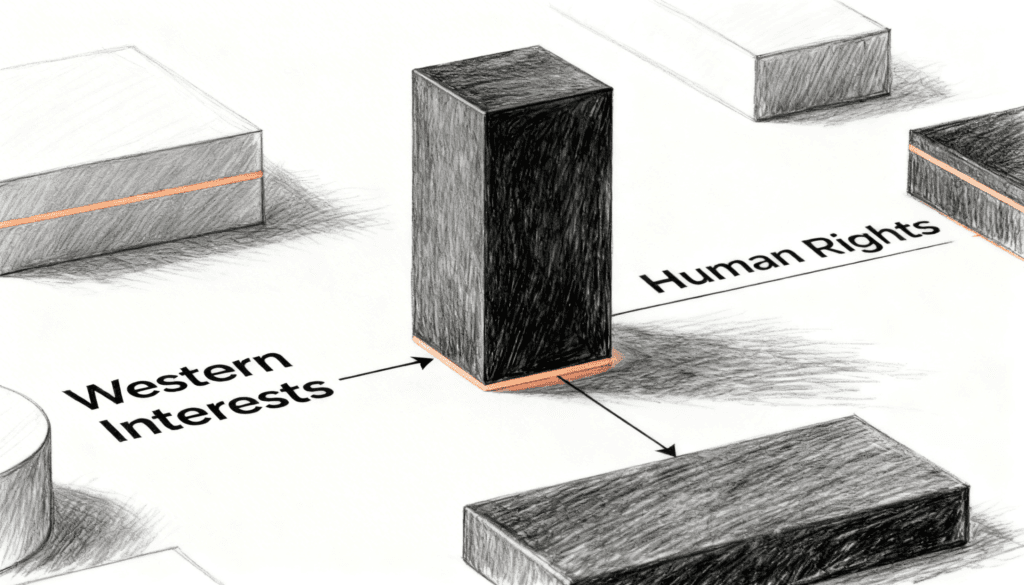
There is a certain kind of idea that makes people uncomfortable not because it is wrong, but because it might be right. Samuel Huntington’s claim that human rights discourse often functions as a vehicle for Western geopolitical interests is one of those ideas. It sits in the intellectual living room like an uninvited guest who keeps making valid points.
Huntington, best known for his “Clash of Civilizations” thesis, did not argue that human rights are inherently bad. He argued something more subtle and, frankly, more dangerous to the established order of thinking. He suggested that when Western nations talk about universal human rights, they are frequently projecting their own cultural values onto the rest of the world and calling it morality. The label changes. The product does not.
This is not a comfortable essay. But comfortable essays rarely say anything worth reading.
The Universality Problem
The modern human rights framework was born in 1948 with the Universal Declaration of Human Rights. It was drafted primarily by Western intellectuals, adopted by a United Nations that was dominated by Western powers, and framed in language that reflected Enlightenment philosophy. None of this is controversial. It is simply historical fact.
What Huntington found interesting was the next move. After constructing a moral framework rooted in a very specific intellectual tradition, Western nations declared it universal. Not Western. Not culturally particular. Universal. Applicable to every human being in every society regardless of history, tradition, or context.
This is a remarkable claim if you stop to think about it. Imagine a group of chefs from one region of the world getting together, writing a cookbook, and then declaring that all other cuisines are inferior and must conform to their recipes. You would rightly ask who gave them that authority. Huntington essentially asked the same question about human rights.
The standard response is that human rights are not cultural products but natural truths. They belong to people simply because they are human. This sounds beautiful. It also happens to be a philosophical position that emerged from a particular time and place in European intellectual history. John Locke, Jean Jacques Rousseau, Immanuel Kant. These are not Confucian thinkers. They are not Islamic scholars. They are not drawing from Ubuntu philosophy or Buddhist ethics. The “universal” tradition has a very specific zip code.
When Rights Become Leverage
Huntington’s sharpest observation was not philosophical. It was political. He noticed a pattern that, once seen, is difficult to unsee.
Western governments tend to invoke human rights selectively. The volume gets turned up when the target is a geopolitical rival and turned down when the offender is an ally. Saudi Arabia’s human rights record has been catastrophic for decades, yet for most of that time Western criticism was muted because oil flows and arms deals mattered more. China’s treatment of Uyghur Muslims generates enormous Western outrage, and it should, but the intensity correlates suspiciously well with the broader strategic competition between Washington and Beijing.
This selectivity is the smoking gun in Huntington’s argument. If human rights were truly the driving concern, enforcement would be consistent. It is not. It never has been. The pattern suggests that human rights function less as a genuine moral commitment and more as a diplomatic tool, deployed when useful and shelved when inconvenient.
Consider the Iraq War. The justification shifted from weapons of mass destruction to democracy promotion and human rights almost seamlessly. When one rationale collapsed, another was waiting. Human rights became the backup generator for a policy that had already been decided on other grounds. The people of Iraq did not ask to be liberated in this particular fashion. But their suffering became useful rhetoric.
This does not mean that human rights abuses in these places are fictional. They are real and they are serious. The point is that the Western response to them is driven less by moral consistency than by strategic calculation. Huntington saw this clearly and said it plainly, which is probably why so many people found him irritating.
The Cultural Imperialism Angle
There is a deeper layer to this argument that goes beyond geopolitics and into the structure of culture itself.
Different civilizations have developed different ways of organizing society. Some prioritize the individual. Others prioritize the community. Some place the highest value on personal freedom. Others place it on social harmony, family obligation, or spiritual duty. The Western human rights framework assumes that individual liberty is the supreme value. This is not self evident. It is a choice. A culturally specific choice dressed up in the language of inevitability.
When Western nations pressure others to adopt this framework, they are not simply asking them to stop torturing people. They are asking them to reorganize their entire value system around a Western conception of the good life. Stop prioritizing the collective. Start prioritizing the individual. Stop deferring to tradition. Start deferring to personal autonomy. This is not a minor request. It is a civilizational demand.
Lee Kuan Yew, the founding father of Singapore, pushed back on this for years. He argued that Asian societies valued order, discipline, and community in ways that did not map neatly onto Western individualism, and that this was not a deficiency. It was a difference. Singapore became one of the most prosperous and stable nations on earth while cheerfully ignoring Western lectures about liberal democracy. This was not supposed to be possible according to the theory that Western values were prerequisites for success.
Huntington saw this not as an anomaly but as evidence. The Western model was one model among many. Its claim to universality was not a statement of fact but an assertion of power.
The Counter Argument Deserves Its Space
Fairness requires acknowledging that Huntington’s critics have strong points of their own.
The most powerful counter argument is simple. When a government tortures a dissident, the dissident does not care whether the prohibition against torture originated in European philosophy or Martian philosophy. Pain is pain. Oppression is oppression. The cultural origins of the idea that torture is wrong do not diminish the reality of suffering.
This is a genuinely compelling point. There is something deeply uncomfortable about telling a political prisoner that the concept of their rights is culturally constructed. They do not need a philosophical framework. They need the beating to stop.
Critics also argue that Huntington’s thesis can be weaponized by authoritarian governments. And they are right. Every dictator on earth has at some point waved the flag of “cultural sovereignty” to justify repression. We do things differently here. This is not your concern. Mind your own business. These phrases are the authoritarian’s best friend, and Huntington’s argument, however intellectually honest, provides them with sophisticated cover.
The fact that authoritarians misuse the argument does not make it wrong. Bad people can exploit true observations. The existence of corrupt doctors does not invalidate medicine. The fact that dictators hide behind cultural relativism does not mean that cultural differences are irrelevant to how we think about rights.
Follow the Institutions
One of Huntington’s less discussed but equally important observations was about institutional power. The organizations that define, monitor, and enforce human rights are overwhelmingly Western in origin, funding, and leadership. The International Criminal Court, Human Rights Watch, Amnesty International, the various UN human rights bodies. These institutions were created by Western nations, staffed largely by Western educated professionals, and funded by Western governments and foundations.
This matters because institutions shape narratives. They decide which abuses get attention and which get ignored. They determine which countries face scrutiny and which get a pass. They set the terms of debate. When the entire infrastructure of human rights enforcement is controlled by one civilization, it is naive to pretend that the enforcement will be culturally neutral.
The ICC is a case study. It has been criticized extensively for focusing disproportionately on African leaders while Western leaders who arguably committed similar or worse violations remained untouched. This pattern is not accidental. It reflects the power dynamics embedded in the institution’s structure. The nations with the most power built the court in a way that insulated themselves from its jurisdiction. Then they used it to judge others.
This is like a group of students writing the exam, grading the exam, and then exempting themselves from taking it. The arrangement works beautifully for the people who designed it.
The Soft Power Connection
There is a fascinating intersection here with Joseph Nye’s concept of soft power that Huntington himself would have appreciated. Human rights promotion is one of the most effective soft power tools ever developed. It allows Western nations to project influence without deploying military force. It frames Western values as aspirational rather than imposed. It recruits local allies who internalize the framework and become advocates for it within their own societies.
This is brilliantly effective. And it is not necessarily malicious. Soft power can genuinely improve lives. But it is still power. It still serves interests. The fact that it operates through attraction rather than coercion does not make it politically innocent. A velvet glove is still a glove. And there is still a hand inside it.
Huntington understood that the most effective forms of dominance are the ones that do not look like dominance. When a country can get others to want what it wants, it does not need to force them. Human rights discourse achieves this by making Western values appear not as Western values but as human values. The branding is impeccable. The product placement is seamless. You do not even notice you are being sold something.
What Huntington Got Wrong
No thinker gets everything right, and Huntington was no exception.
His framework sometimes treated civilizations as monolithic blocks with fixed, unchanging value systems. But civilizations are messy, contradictory, and constantly evolving. There are fierce human rights advocates in China, Saudi Arabia, and Iran who ground their arguments not in Western philosophy but in their own traditions. Islamic scholars have developed robust human rights frameworks from within Islamic jurisprudence. Confucian thinkers have articulated conceptions of human dignity that do not depend on Western individualism.
Huntington sometimes wrote as if civilizations were billiard balls bouncing off each other. In reality, they are more like rivers, constantly mixing, merging, and influencing each other. The idea that human rights is purely Western ignores the many non Western thinkers who have arrived at similar conclusions through entirely different intellectual paths.
He also underestimated the degree to which people genuinely care about human rights regardless of strategic interests. Not every human rights activist is a tool of Western foreign policy. Many are sincere, courageous individuals who risk their lives for principles they believe in. Reducing their work to geopolitics is unfair and inaccurate.
So Where Does This Leave Us
Huntington’s argument is not a reason to abandon human rights. It is a reason to be honest about the politics that surround them. It is a reason to notice when moral language is being used to advance strategic interests. It is a reason to ask who benefits every time a powerful nation wraps its foreign policy in the language of universal values.
The most productive path forward is probably one that Huntington himself did not fully articulate. Instead of insisting on a single universal framework defined by one civilization, we might work toward genuine cross civilizational dialogue about what human dignity means. This would require Western nations to do something they have historically found very difficult. Listen. Not lecture. Not export. Not assume that their particular intellectual tradition has a monopoly on moral truth.
It would also require non Western societies to resist the temptation to use cultural sovereignty as a shield for genuine oppression. The fact that human rights discourse can be weaponized does not give anyone a license to abuse their own people.
The truth, as usual, is inconvenient for everyone. Human rights are not purely universal truths floating above culture and politics. But they are not purely Western inventions either. They exist in that uncomfortable space where genuine moral insight meets political interest, where real suffering meets strategic calculation, where good ideas get used by people who do not always have good intentions.
Huntington forced us to look at that uncomfortable space. We do not have to agree with everything he said. But we should probably stop pretending the space does not exist.
That would be a start.