Table of Contents
There is a philosopher most people have never heard of who might explain the modern economy better than any economist alive. His name is Willard Van Orman Quine, and he never wrote a single word about oil prices, inflation, or supply chains. He wrote about language, logic, and the strange architecture of human belief. Yet his most famous idea, published in 1951, turns out to be one of the most powerful lenses we have for understanding why a barrel of crude getting more expensive does not just make gasoline cost more. It changes the meaning of everything.
Let me explain.
The Idea That Changed Philosophy
Quine’s big move was to attack a distinction that philosophers had cherished for centuries. Since at least the time of Immanuel Kant, thinkers had divided human knowledge into two neat categories. There were analytic truths, which are true by definition. “All bachelors are unmarried” is the classic example. You do not need to go out and survey bachelors to confirm it. The meaning is baked into the words. Then there were synthetic truths, which depend on how the world actually is. “It is raining outside” requires you to look out the window.
This division felt clean. It felt obvious. Quine said it was an illusion.
In his paper “Two Dogmas of Empiricism,” Quine argued that you cannot cleanly separate what a word means from what you believe about the world. Meaning and fact are tangled together. Every statement you hold true sits inside a vast web of other statements, and that web faces the world as a whole, not piece by piece. When experience forces you to revise one belief, the revision ripples outward. It can reach any part of the web. Even the parts you thought were untouchable definitions can, in principle, be revised.
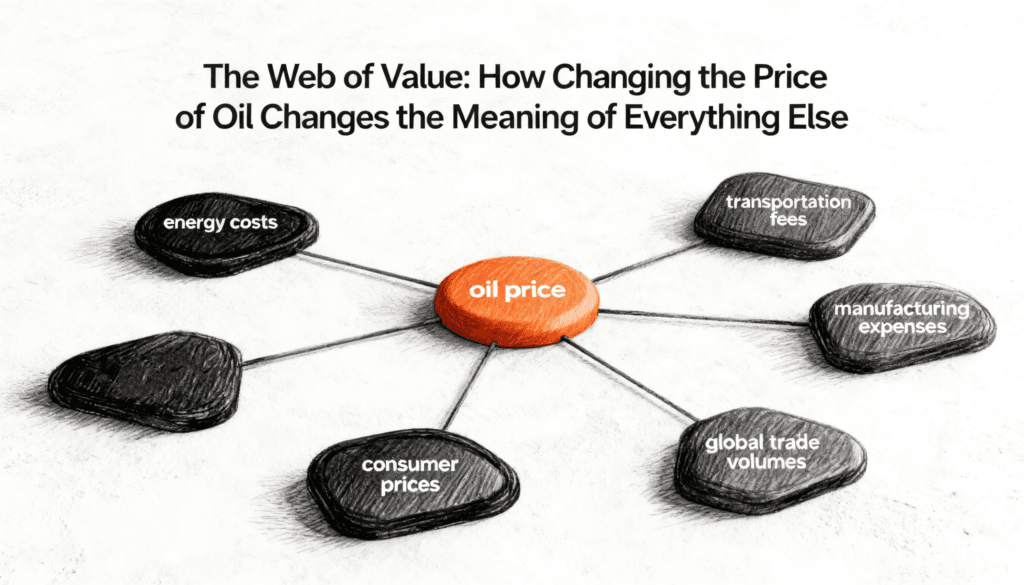
This is the famous “web of belief.” And it is not just a clever abstraction for philosophy seminars. It is a startlingly accurate description of how prices work.
Oil Is Not Just Oil
Consider what happens when the price of oil rises significantly. The obvious first order effect is that fuel costs more. Gasoline goes up. Diesel goes up. Jet fuel goes up. So far, so boring. This is the part everyone understands.
But oil is not just fuel. It is a raw material woven into an almost incomprehensible number of products and processes. Plastics, fertilizers, pharmaceuticals, synthetic fabrics, asphalt, paint, detergent. The list runs into the thousands. Oil is also the energy source that powers the trucks, ships, and planes that move every other product on earth from where it is made to where it is sold. When the price of oil changes, the cost of moving anything changes.
Now watch the ripples.
A farmer pays more for diesel and fertilizer. The cost of growing wheat rises. The price of flour rises. The price of bread rises. A bakery raises its prices. A sandwich shop raises its prices. An office worker who eats lunch at that sandwich shop now has less money left over at the end of the month. She cancels a streaming subscription. The streaming company loses revenue. It cancels a show. An actor does not get hired. A real estate agent in Los Angeles notices a slight dip in demand for apartments in a certain neighborhood.
This is not a hypothetical chain. Every link in it has played out in the real world, many times over, across decades. The point is not that oil prices cause everything. The point is that nothing is insulated. There is no sealed compartment in the economy where a major price change enters and stays put. The system is a web, and the web vibrates as a whole.
Quine would have recognized this immediately.
Meaning Is Not Fixed Either
Here is where it gets genuinely interesting. Quine did not just say that beliefs are connected. He said something more radical. He said that the meaning of any individual statement depends on its position in the web. Change the web enough, and the meaning itself shifts.
Apply this to economics. When oil was ten dollars a barrel in the late 1990s, owning a large SUV meant something. It meant freedom, comfort, a certain casual affluence. It was a lifestyle choice with minimal financial consequence. When oil shot past one hundred dollars a barrel in 2008, the same vehicle did not just cost more to operate. It meant something different. It became a symbol of wastefulness, of being behind the times, of ignoring reality. The object had not changed. The web around it had, and the web determines meaning.
This is not limited to consumer goods. When oil prices are low, certain political alliances make sense and others do not. Entire foreign policy doctrines are underwritten by assumptions about energy costs. When those costs shift, the doctrines do not just become more expensive. They become incoherent. The logic that justified them depended on a web of conditions that no longer holds.
Think about how the fracking revolution in the United States changed the meaning of “energy independence.” For decades, the phrase was aspirational. It sat in political speeches as a goal, roughly equivalent to “world peace” in its practical achievability. Then hydraulic fracturing made the US a net exporter of petroleum, and the phrase stopped being a dream. It became a fact. But it also became a different kind of political tool, one that could justify withdrawal from foreign entanglements or could justify new kinds of engagement. Same two words. Completely different meaning. The web had shifted.
The Periphery and the Core
Quine made another distinction that maps beautifully onto economic systems. He said that beliefs at the periphery of the web are the ones most directly exposed to experience. These are the first to be revised when reality pushes back. Beliefs at the core are more insulated. They are protected by layers of peripheral beliefs, and we are reluctant to revise them because doing so requires revising everything else connected to them.
In the economy, peripheral beliefs are things like “this brand of coffee is worth four dollars.” That can change tomorrow. A new competitor opens. A supply disruption hits. A social media trend makes a different brand fashionable. The revision is easy and local.
Core beliefs are different. “Economic growth is always good.” “Home prices generally go up over time.” “A college degree is worth the investment.” These sit deep in the web. People build entire life plans around them. Institutions are constructed on their foundations. Revising them is not just intellectually difficult. It is existentially threatening.
Oil price shocks have a way of rattling the core. The 1973 oil embargo did not just raise prices. It challenged the core belief held by the entire Western world that cheap energy was a permanent feature of modern life. That revision forced a cascade of changes in everything from automotive design to urban planning to geopolitical strategy. The meaning of “progress” itself had to be renegotiated.
This is what Quine would call a recalcitrant experience. Reality pushes hard enough that you cannot handle the pressure by adjusting the periphery alone. You have to go deeper.
The Underdetermination Problem
There is another Quinean concept that applies here with almost uncomfortable precision. Quine argued for the underdetermination of theory by evidence. In plain language, the same set of facts can be explained by multiple, mutually incompatible theories. The evidence alone does not force you to pick one.
Watch this play out every time oil prices spike. The same price increase will be simultaneously explained as the result of OPEC manipulation, Wall Street speculation, genuine supply constraints, geopolitical instability, or insufficient investment in exploration. Often, all of these explanations are partially true and none of them is sufficient on its own. The data underdetermines the theory.
This matters because the explanation you choose shapes the policy response, and the policy response reshapes the web. If you blame speculators, you regulate financial markets. If you blame supply constraints, you open new drilling. If you blame foreign producers, you pursue energy independence. Each choice sends different ripples through the system. Each one changes different meanings.
The economy, like Quine’s web of belief, does not come with labels telling you which adjustments to make when experience contradicts your expectations. You have to choose, and your choice is never fully determined by the facts.
A Connection Most People Miss
There is a parallel here to something from a completely different field that is worth noticing. In ecology, there is a concept called a keystone species. Remove a single species from an ecosystem, one that might represent a tiny fraction of the total biomass, and the entire system can collapse or transform beyond recognition. Sea otters in Pacific kelp forests are the textbook example. Remove the otters, and sea urchin populations explode, and the urchins devour the kelp, and the fish that depended on the kelp disappear, and the eagles that ate the fish shift their diet to seabirds, and on and on.
Oil is the keystone species of the global economy. Not because it is the largest sector by revenue. It is not. But because it is connected to everything else in a way that nothing else is. Its removal or significant price change does not just create a gap. It restructures the relationships between everything that remains.
Quine would appreciate this analogy. In his web, there is no single belief that is the “most important.” But some beliefs are so densely connected that revising them forces revisions almost everywhere else. Oil prices work the same way. Their importance is not about magnitude. It is about connectivity.
The Counter Intuitive Part
Here is something that might seem wrong but is not. Sometimes a drop in oil prices causes more disruption than an increase. When prices collapsed in 2014 and again in 2020, the immediate reaction in many quarters was relief. Cheaper energy. Lower costs. More money in consumers’ pockets. What could go wrong?
Quite a lot, as it turned out. Entire regional economies built around oil production went into crisis. Russia’s government budget, heavily dependent on oil revenue, came under severe strain, contributing to a series of geopolitical decisions that would reshape European security. Venezuela, already fragile, tipped into genuine humanitarian disaster.
The web does not care about the direction of the change. It only cares about the magnitude. A significant shift in either direction forces revisions, and revisions cause disruption. Stability of the web depends not on prices being low or high, but on prices being predictable. Quine understood this about beliefs in general. Coherence matters more than any individual belief being “correct.”
What This Means for You
If you have read this far, you might be wondering why any of this matters outside a philosophy department or an economics think tank. Here is why.
Most people think about prices the way pre-Quinean philosophers thought about meaning. They treat each price as an isolated fact. Gas costs this much. Rent costs that much. A salary is worth this amount. Each number sits in its own box, and boxes do not contaminate each other.
Quine showed that this way of thinking is wrong about language and logic. The economy shows that it is wrong about value. Every price you encounter is embedded in a web of other prices, and that web is embedded in a larger web of social meanings, political structures, and cultural assumptions. When a major node in the web shifts, everything shifts. Not always visibly. Not always immediately. But inevitably.
The practical implication is that paying attention to oil prices is not just for traders and policy wonks. It is a way of reading the future shape of everything else. Not because oil determines the future. But because oil is so densely woven into the web that its movements telegraph the coming revisions before they arrive.
Quine died in 2000, just before the era of extreme oil price volatility that would define the first quarter of the twenty first century. He never got to see his philosophical framework vindicated by commodity markets. But then again, he probably would not have been surprised. He always insisted that philosophy and science are continuous with each other, that there is no clean line between thinking about logic and thinking about the world.
He was right about that too.
The web is one web. Pull on any thread, and the whole thing moves. The only question is whether you are paying attention when it does.