Table of Contents
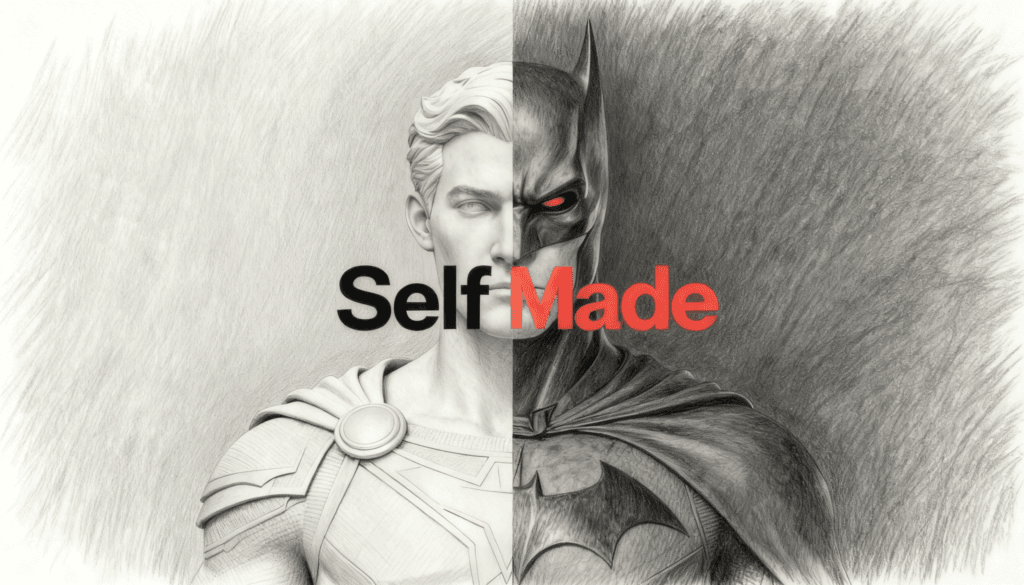
There was a time when the self made individual was the protagonist of Western civilization. The person who started with nothing, built something, and refused to apologize for it. That person was celebrated in novels, held up in political speeches, and Christ-like in the American imagination. Somewhere along the way, the script flipped. The self made individual went from hero to villain, from aspirational figure to cultural punching bag. And no one captured that tension, or accelerated it, quite like Ayn Rand.
To understand how we got here, you have to understand what Rand was actually arguing, not the cartoon version that circulates on social media, but the philosophical architecture underneath it. And then you have to understand why that architecture became so threatening that an entire cultural apparatus mobilized against it.
The Original Promise
The idea of the self made person is not an American invention, but America certainly franchised it. From Benjamin Franklin’s autobiography to Andrew Carnegie’s gospel of wealth, the message was consistent: you are not your birth. You are what you build. This was genuinely radical for most of human history. For thousands of years, your identity was inherited. You were your father’s son, your tribe’s member, your king’s subject. The notion that an individual could define themselves through action rather than ancestry was a philosophical earthquake.
Rand took this idea and removed the apology from it. Where earlier thinkers softened the self made ethos with obligations to charity, community, or God, Rand said something far more uncomfortable. She said the act of creation itself was the moral act. That the builder owed nothing to those who did not build. That the highest purpose of a human life was not service to others but the full expression of one’s own productive ability.
This was not, as critics often claim, a defense of greed. It was a defense of sovereignty. The right of a person to exist for their own sake. Read that sentence again, because most of the cultural war against Rand depends on you not reading it carefully.
Why Rand Became the Lightning Rod
Rand published The Fountainhead in 1943 and Atlas Shrugged in 1957. Both novels sold millions of copies. Both were savaged by critics. The literary establishment treated her like an infection. And yet people kept reading her. They still do. Atlas Shrugged consistently ranks among the most influential books in America.
This created a problem. If Rand was so obviously wrong, so intellectually bankrupt, so morally repugnant, why did her ideas keep resonating? The cultural establishment had two options: engage with the ideas seriously or discredit the person. They overwhelmingly chose the second option.
The attacks followed a pattern that is now familiar in other cultural battles. First, reduce the philosophy to a slogan. Rand becomes “selfishness is good.” Second, associate the philosophy with its worst possible adherents. Every ruthless CEO becomes a Rand disciple. Third, make the philosophy socially expensive to hold. If you admire Rand, you must be a sociopath, or at least someone who has never suffered.
This pattern works. It works because most people do not read primary sources. They read summaries of summaries. They absorb cultural signals about what is acceptable to believe. And the signal on Rand has been clear for decades: she is not to be taken seriously by serious people.
The Collectivist Undercurrent
To understand why the self made individual became a villain, you need to look at the intellectual current running beneath the surface of Western culture for the last century. That current is collectivism, not necessarily in its Soviet form, but in a softer, more palatable version that says individual achievement is always, ultimately, a product of collective inputs.
You did not build that. You had teachers, roads, a society, a language, parents who fed you, a government that protected you. Therefore your achievement is not really yours. It belongs, at least in part, to everyone.
This argument is not entirely wrong. That is what makes it so effective. Of course no one succeeds in a vacuum. Of course there are inputs from the surrounding world. But the argument performs a subtle trick. It uses the obvious truth that individuals exist in a social context to undermine the less obvious truth that individual agency is the decisive variable.
Consider two people born in the same town, attending the same schools, breathing the same air. One builds a company. The other does not. The collectivist framework has no good explanation for the difference. It can gesture at luck, privilege, or circumstance. But it cannot account for the specific, irreducible thing that made one person act and the other person wait.
Rand could. She called it the “prime mover,” the individual mind that chooses to think, to create, to act. And the cultural war against the self made is, at its core, a war against this idea. Not because it is wrong, but because it is inconvenient.
The Convenience of Resentment
Here is where the analysis gets uncomfortable. If individual achievement is real, if some people genuinely create more value than others through the exercise of their own ability and will, then inequality is not purely a systemic failure. It is partly a reflection of differences in human action. This is an intolerable conclusion for a culture that has made equality its highest moral commitment.
So the self made individual must be reframed. They did not earn it. They got lucky. They exploited someone. They had advantages you did not. The system was rigged in their favor. There is always an explanation that preserves the narrative of collective entitlement and prevents the uncomfortable question: what if some people just did more?
Rand identified this dynamic with almost surgical precision. She called it the “sanction of the victim,” the process by which the productive are made to feel guilty for their productivity. The builder is asked to apologize for building. The creator is asked to share credit with those who did not create. And the ultimate weapon is moral: you are selfish, you are greedy, you lack compassion.
Notice how the framing works. The person who creates something is put on the defensive. The person who creates nothing occupies the moral high ground. This inversion is so deeply embedded in contemporary culture that most people do not even notice it. They experience it as common sense.
The Nietzsche Connection
Rand was not operating in a philosophical vacuum. Her ideas share DNA with Friedrich Nietzsche, though she would have bristled at the comparison. Nietzsche identified what he called “slave morality,” a value system created by the weak to constrain the strong. In slave morality, weakness becomes virtue. Suffering becomes sacred. Power becomes suspicious.
The parallels to the cultural treatment of the self made individual are striking. Success is now treated as evidence of moral failure. Wealth is presumed guilty until proven innocent. Ambition is rebranded as toxicity. The language of therapy and trauma has been weaponized to pathologize drive itself. If you work too hard, you are not dedicated. You are damaged.
This is not a conspiracy. It is something more powerful: a cultural mood. A collective shift in what is celebrated and what is punished. And it has real consequences. When a culture punishes its most productive members, those members do not disappear. They adapt. They hide. They move. Or they stop producing. Rand dramatized this in Atlas Shrugged with her famous question: what happens when the people who carry the world decide to put it down?
The Missing Nuance
Now, intellectual honesty requires acknowledging where Rand went wrong, or at least where she went incomplete. Her framework has real blind spots. She treated human relationships as essentially transactional. She underestimated the degree to which structural barriers, racism, poverty, disability, genuinely prevent people from exercising their agency. She wrote as if the playing field were level and only willpower separated the builders from the bystanders.
It is not. The playing field has never been level. And pretending otherwise is not philosophy. It is fantasy.
But here is the counterintuitive part: acknowledging structural barriers does not require abandoning the concept of the self made individual. It requires refining it. The most honest version of the self made ethos says something like this: the world is unfair, the obstacles are real, the system is imperfect, and within those constraints, individual action still matters more than anything else.
This is not a comfortable position. It satisfies neither the Rand purists who want to ignore structure nor the collectivists who want to ignore agency. But it has the inconvenient quality of being true.
The Cultural Economy of Victimhood
There is an economic dimension to this cultural shift that rarely gets discussed. In a media economy driven by engagement, victimhood is more profitable than achievement. A story about someone who was wronged generates more clicks than a story about someone who built something. Outrage is a better business model than admiration.
This creates a perverse incentive structure. Cultural producers, journalists, filmmakers, academics, influencers, are rewarded for narratives of oppression and punished for narratives of achievement. The self made individual is bad content. The system that crushed the individual is good content.
Rand would have appreciated the irony. The market she so admired now incentivizes the very narratives that undermine her philosophy. The invisible hand is not pointing toward Galt’s Gulch. It is pointing toward a Twitter thread about how billionaires are dragons sitting on hoards of gold while the village starves.
What Is Actually Lost
The real casualty of the war against the self made is not Ayn Rand’s reputation. She is dead. She does not care. The real casualty is the aspirational framework that made self making possible in the first place.
When a culture stops celebrating builders, it does not get more equality. It gets more dependency. When you tell young people that their outcomes are determined by systems beyond their control, some of them believe you. And believing it becomes a self fulfilling prophecy. Why strive if the game is rigged? Why build if building makes you a villain?
This is the part that the critics of Rand never address. They are very good at explaining why the self made myth is incomplete. They are very bad at explaining what replaces it. If not individual agency, then what? Collective action? Government programs? Community organizing? These are tools, not purposes. They do not answer the question that every human being eventually asks: what am I here to do?
Rand had an answer to that question. You may not like it. You may find it cold, or narrow, or missing the full range of human experience. But she had one. And the culture that has spent decades tearing her answer down has not yet produced a better one.
The Uncomfortable Conclusion
The war against the self made is not really about Ayn Rand. She is just the most visible target because she made the most unapologetic case. The war is about something deeper. It is about whether individuals have the right to claim credit for what they create. Whether achievement is a personal act or a collective product. Whether the person who builds the bridge matters more than the committee that approved its construction.
These are not abstract questions. They determine how we educate children, how we structure economies, how we distribute status and respect. And right now, the answers our culture is giving are producing a generation that is more comfortable identifying what is wrong with the world than building anything to fix it.
Maybe that is the final irony. Rand spent her life arguing that the producers would eventually shrug off the weight of a parasitic culture. She imagined they would retreat to a hidden valley and let the world collapse under its own contradictions. What she did not anticipate is that the culture would not need to drive the producers away. It would simply convince the next generation that producing was not worth doing in the first place.
That is not a plot twist she wrote. But it is the one we are living.