Table of Contents
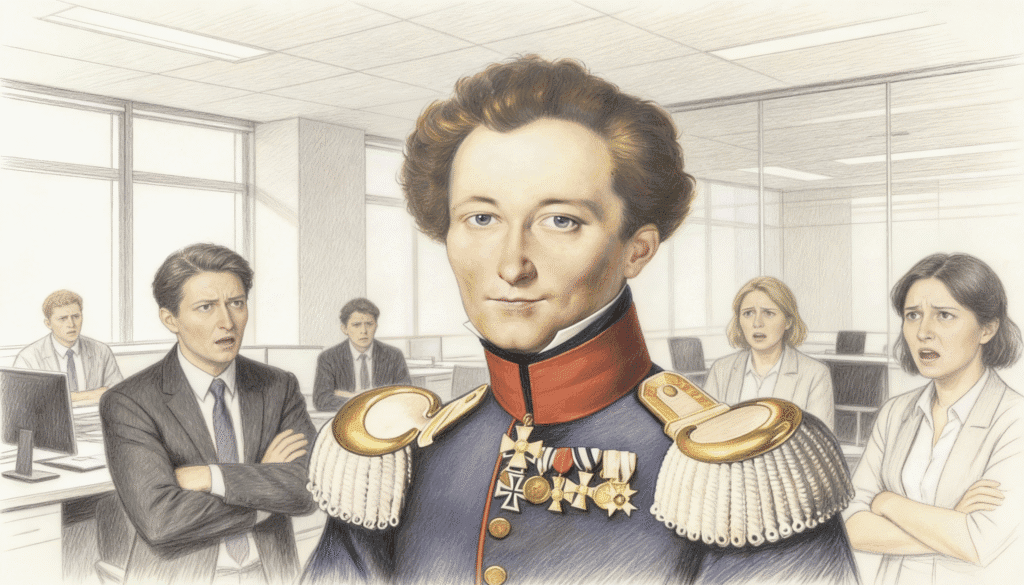
Carl von Clausewitz never met a management consultant. The Prussian general, writing in the early 19th century, would have found their obsession with efficiency puzzling. He spent his career studying war, the messiest human endeavor imaginable, and came to understand something most modern leaders have forgotten: friction is not a bug in the system. It is the system.
Clausewitz called friction “the force that makes the apparently easy so difficult.” He meant the gap between theory and reality. On paper, moving 10,000 troops from point A to point B is simple arithmetic.
In practice, it rains. Horses go lame. Messengers get lost. Soldiers fall ill. Supply wagons break down. Officers misunderstand orders. The enemy does something unexpected. This accumulation of countless small difficulties is friction. It turns elegant plans into chaos.
Modern leaders understand this concept intellectually. They nod when they hear it. Then they spend their entire careers trying to eliminate it.
The Smoothness Obsession
Walk into any corporate strategy meeting and you will see friction treated as the enemy. Leaders speak reverently of “frictionless experiences” and “seamless integration” and “optimized workflows.” The goal is always the same: remove obstacles, smooth the path, make everything glide effortlessly from input to output.
This makes sense on the surface. Why would anyone want friction? Friction slows things down. It wastes energy. It frustrates people. In physics, we literally use lubricants to reduce friction. The metaphor seems perfect.
But Clausewitz was talking about something different. He was not describing a mechanical force that could be engineered away. He was describing the inherent unpredictability of reality itself. And he understood that trying to eliminate it was not just futile. It was dangerous.
The modern workplace has become a shrine to the frictionless. We have project management software that promises perfect coordination. Communication tools that guarantee instant connection. Data analytics that claim to predict every outcome. Automation that removes human variability. The promise is always the same: give us control over your processes and we will eliminate the friction.
Except it never works. Not really. The friction just moves somewhere else.
What We Lose in the Smoothing
Consider how organizations handle uncertainty today. The standard approach is to do more planning. Run more scenarios. Gather more data. Create more detailed contingency plans. Build more sophisticated models. The assumption is that with enough preparation, you can plan your way around friction.
Clausewitz would have laughed. Not because planning is useless, but because this approach misses the point entirely. Friction is not something you plan around. It is something you build the capacity to handle.
Think about how a child learns to walk. They fall constantly. Each fall is friction. Pure, undiluted difficulty. But we do not respond by trying to eliminate the falling. We do not build increasingly sophisticated support structures or create detailed walking plans. We let them fall. Because falling is how they learn to balance.
Modern organizations have forgotten this. They treat every stumble as a failure of planning rather than an opportunity for adaptation. The result is a workforce that has never learned to walk on rough ground.
This shows up everywhere. Teams that cannot function when communication is unclear. Employees who shut down when faced with ambiguous instructions. Managers who panic when plans need to change. Organizations that grind to a halt when circumstances shift unexpectedly.
They have been optimized for the smooth path. When the path gets rough, they have no idea what to do.
The Paradox of Preparation
Here is where things get interesting. The organizations that handle friction best are not the ones that plan the most carefully. They are the ones that have experienced the most friction.
Military special forces do not prepare for missions by creating perfect plans. They prepare by experiencing chaos. Training exercises are deliberately designed to go wrong. Communications fail. Equipment breaks. Plans fall apart. The goal is not to prevent these things from happening in real operations. The goal is to build units that can handle them when they do.
This is counterintuitive. We assume that the way to handle difficulty is to prevent it. But prevention and handling are different skills. Prevention requires foresight and planning. Handling requires resilience and adaptation. You cannot develop the second by only practicing the first.
Look at how this plays out in the startup world. The companies that survive are rarely the ones with the best initial plans. They are the ones that can pivot when reality does not match their projections. They have learned to operate in friction. Their advantage is not that they avoid problems. It is that problems do not paralyze them.
Traditional corporations struggle with this. They have spent decades building systems to minimize friction. Those systems make them incredibly efficient at doing predetermined things. But when the ground shifts, all that efficiency becomes rigidity.
The Metrics Trap
Part of the problem is how we measure success. Modern management loves metrics. And metrics love smoothness.
You can measure efficiency. You can measure speed. You can measure the reduction of errors and delays and complications. All of these measurements push in the same direction: toward the elimination of friction.
But you cannot easily measure adaptability. You cannot measure resilience. You cannot measure the capacity to handle the unexpected. These qualities only show up when things go wrong. And modern organizations try very hard to prevent things from going wrong.
This creates a dangerous blindness. Leaders look at their metrics and see improvement. Processes are faster. Error rates are lower. Costs are down. Everything appears to be working better.
Then reality introduces some friction. A key supplier fails. A market shifts. A technology changes. A pandemic happens. And suddenly all those optimized systems cannot cope. The efficiency gains evaporate. The organization that looked so well run turns out to be fragile.
Nassim Taleb calls this antifragility. Systems can be fragile (they break under stress), robust (they resist stress), or antifragile (they improve under stress). Modern organizations, in their quest to eliminate friction, have made themselves incredibly fragile while believing they are robust.
The Education Mirror
This same pattern shows up in how we educate. Modern schooling is increasingly frictionless. Assignments have rubrics that specify exactly what is expected. Lessons are broken into digestible modules. Everything is structured, scheduled, and optimized.
Students learn to excel in this environment. They get good grades. They meet every requirement. They optimize their performance beautifully.
Then they enter the real world and encounter actual friction. Bosses who do not clearly specify expectations. Projects with no obvious right answer. Situations where the rules are unclear or contradictory. And many of them flounder.
The educational system prepared them for a frictionless world. But the world has friction. It always has. It always will.
The students who do best are often not the ones who excelled most at the optimized game. They are the ones who had to struggle. Who worked jobs where things went wrong. Who pursued projects without clear guidelines. Who experienced friction and learned to work through it.
This is not an argument for making education needlessly difficult. It is an observation that difficulty itself has value. The struggle is not a barrier to learning. Sometimes it is the learning.
The Innovation Problem
Innovation requires friction. This sounds wrong. We think of innovation as making things smoother, easier, better. And in the final product, it often does. But the process of innovation is inherently frictional.
Real innovation means trying things that might not work. It means operating without a clear roadmap. It means discovering problems you did not know existed. It means friction.
Modern organizations say they want innovation. Then they build systems that eliminate the conditions innovation requires. They want clear timelines. Measurable milestones. Predictable outcomes. Guaranteed returns on investment.
This is not how actual innovation works. Innovation is messy. It involves dead ends and false starts and unexpected complications. It requires operating in a state of controlled friction.
The companies that innovate best are not the ones that eliminate friction from their innovation processes. They are the ones that have learned to be productive within friction. They expect things to go wrong. They build teams that can handle ambiguity. They create cultures where it is okay to not have all the answers.
This is hard for modern leaders to accept. The entire thrust of contemporary management theory has been toward control and predictability. The idea that you might deliberately preserve spaces of friction feels like failure.
The Human Element
There is something else at work here. Something more fundamental than just management theory.
Modern life is increasingly frictionless in ways that go beyond the workplace. We can get almost anything delivered to our door. We can communicate instantly with anyone, anywhere. We can access infinite information without leaving our couch. Technology has smoothed away countless daily frictions.
This is wonderful in many ways. But it may also be making us weaker. Not morally weaker or characterologically weaker. Just less practiced at handling friction.
Our grandparents lived with more friction as a basic feature of existence. Things broke and they fixed them. Communication was slow and they dealt with it. Plans changed and they adapted. This was not character building in some romantic sense. It was just normal life.
We have removed so much of this friction that we have lost the muscle memory for dealing with it. When we encounter it now, especially in professional contexts, it feels rogue. Something to be solved rather than something to be handled.
Clausewitz understood that friction is normal. War is an extreme case, but the principle applies everywhere. Any complex human endeavor involves friction. The question is not whether you will encounter it. The question is whether you will be able to function when you do.
Finding the Balance
None of this means friction should be embraced for its own sake. Unnecessary friction is still unnecessary. If you can make something genuinely easier without losing important capabilities, you should.
The key is distinguishing between friction that teaches and friction that just wastes energy. Between difficulty that builds capacity and difficulty that just frustrates. Some friction is pure waste. Bureaucratic redundancy. Unclear communication. Bad tools. These things do not make people stronger. They just make work harder for no reason. Eliminate them.
But other friction is essential. The struggle to master a difficult skill. The challenge of coordinating across different perspectives. The uncertainty of trying something new. This kind of friction is where capability comes from.
What would it look like to embrace friction intelligently?
It would mean building organizations that can function in uncertainty. Not by planning for every contingency, but by developing teams that can adapt to whatever comes. This requires different training, different hiring, different management approaches. It would mean valuing resilience as much as efficiency. Creating spaces where things can go wrong without catastrophic consequences. Letting teams struggle with difficult problems rather than always providing clear solutions.
It would mean changing how we measure success. Looking not just at smooth operation but at how well people handle disruption. Rewarding adaptation as much as execution. It would mean rethinking what development looks like. Instead of only providing clear, structured learning experiences, sometimes throwing people into the deep end. Letting them figure things out. Letting them experience friction.
Clausewitz wrote about war, but his insights apply wherever humans try to accomplish something difficult in an unpredictable world. Which is everywhere.
Modern leaders have built impressively efficient organizations. They have eliminated countless sources of waste and delay. They have optimized processes to a degree that would have seemed impossible a generation ago. But in doing so, they have created something fragile. Organizations that work beautifully on the smooth path but struggle when the ground gets rough. Teams that execute flawlessly when everything goes according to plan but freeze when it does not.
The solution is not to abandon optimization. It is to recognize its limits. To understand that some friction is not a problem to be solved. It is a reality to be navigated.
Clausewitz knew this two centuries ago. We would do well to remember it now.